Nissan Pathfinder Years to Avoid — the 2005–2008 and the 2013–2014.
The 2005 Pathfinder drew 1,050 NHTSA complaints, more than any other year, 547 about a radiator that cracks and leaks coolant into the transmission. The 2013, the first CVT year, drew 891, 289 about the transmission.
Found a Pathfinder You Like?
Enter its VIN for a free preview of title brands, salvage and total-loss records and odometer readings, then ask what was done to the radiator or the CVT.
Free preview · No sign-up · No owner or personal data
Quick Answer
- What Nissan Pathfinder years should you avoid?
- The 2005–2008 and the 2013–2014. The 2005–2008 drew 2,776 complaints, 1,450 about a radiator that mixes coolant into the transmission. The 2013–2014 drew 1,467, 487 about the CVT and 299 describing a shudder or vibration.
- What is the best year for a used Pathfinder?
- Leaving out years where one fault is a quarter or more of complaints, 2012 (23), 2009 (37), 2011 (45) drew the fewest from 1996 to 2020. Of the CVT generation, the 2020 drew the fewest (53).
- What is the Pathfinder "strawberry milkshake" problem?
- On the 2005–2008, the transmission cooler inside the radiator can crack, so coolant and transmission fluid mix. 1,450 complaints describe it, many with a transmission that then slips and needs replacing, and NHTSA lists no recall for it.
Five checks for a used Pathfinder, by year
The Pathfinder's two worst stretches are both about the transmission, by different routes: coolant in the fluid, then the CVT.
- 1Read the year from the VINCharacter 10 is the model year; a 5N1 VIN was built in the US and a JN8 one in Japan.
- 22005–2010: radiator recordsAsk whether the radiator was replaced; pink, milky coolant or transmission fluid means they have mixed.
- 32013–2014: CVT behaviourPull away gently from a stop and accelerate at light throttle; a shudder or a judder is the known fault.
- 42015–2017: listen at idleWith the engine warm, a clacking or tapping from the front can mean worn cooling-fan bushings.
- 5Check title and mileage recordsA salvage brand or a mileage gap shows up by VIN; a cracked radiator does not.
Avoid: the 2005–2008 Pathfinder
The 2005–2008 drew 2,776 complaints, more than the nine 1996–2004 years together (1,401), and the powertrain is the component owners name most on all four. 1,450 describe the radiator: the transmission cooler inside it cracks, coolant and transmission fluid mix, and the transmission starts slipping.
The fuel gauge comes next on the 2005 and 2006: 416 complaints describe a gauge that reads wrong, and many owners trace it to the fuel-level sending unit.
NHTSA lists no recall for the radiator or the transmission. Recall 08V690000 covers a front crash-zone sensor that road salt can rust on 2005–2009 Pathfinders in salt-belt states.
The 2005–2008 by the numbers
- 1,050 · 837 · 561 · 328 complaints on the 2005, 2006, 2007 and 2008.
- 1,450 about the radiator and the transmission.
- 416 2005–2006 complaints about the fuel gauge.
- No recall on NHTSA's list covers the radiator.
Avoid: the 2013–2014, the first CVT years
The redesigned 2013 drew 891 complaints and the 2014 576, and the powertrain leads on both. 487 mention the CVT or transmission, 299 describe a shudder or vibration, and many describe a replacement.
Recall 14V142000 covers a CVT oil-cooler hose that can come loose and leak fluid on early 2013 models; it is the only transmission recall NHTSA lists for the 2013–2020.
The 2013 also drew 156 complaints about the passenger airbag sensor, which recall 13V069000 says can permanently suppress the passenger airbag.
The 2013–2014 by the numbers
- 891 · 576 complaints on the 2013 and 2014.
- 487 about the CVT or transmission.
- 299 describe a shudder or vibration.
- 156 2013 complaints about the passenger airbag sensor.
Every Nissan Pathfinder Model Year Compared
NHTSA complaints and recall campaigns for every Pathfinder from 1996 to 2026, read on 14 November 2026. NHTSA lists no 2021 Pathfinder.
| Year | Generation | Complaints | Crash · fire reports | Recalls | Most-cited component |
|---|---|---|---|---|---|
| 1996 | 1996–2004 | 176 | 20 · 0 | 5 | Suspension |
| 1997 | 1996–2004 | 235 | 18 · 3 | 4 | Suspension |
| 1998 | 1996–2004 | 159 | 23 · 1 | 4 | Suspension |
| 1999 | 1996–2004 | 115 | 20 · 2 | 5 | Suspension |
| 2000 | 1996–2004 | 129 | 11 · 2 | 6 | Suspension |
| 2001 | 1996–2004 | 239 | 19 · 2 | 7 | Suspension |
| 2002 | 1996–2004 | 171 | 16 · 1 | 9 | Suspension |
| 2003 | 1996–2004 | 110 | 11 · 1 | 7 | Engine And Engine Cooling |
| 2004 | 1996–2004 | 67 | 3 · 0 | 7 | Service Brakes |
| 2005 | 2005–2012 | 1,050 | 14 · 6 | 4 | Power Train |
| 2006 | 2005–2012 | 837 | 10 · 0 | 5 | Power Train |
| 2007 | 2005–2012 | 561 | 11 · 2 | 2 | Power Train |
| 2008 | 2005–2012 | 328 | 9 · 0 | 5 | Power Train |
| 2009 | 2005–2012 | 37 | 1 · 0 | 4 | Air Bags |
| 2010 | 2005–2012 | 40 | 2 · 0 | 5 | Air Bags |
| 2011 | 2005–2012 | 45 | 0 · 1 | 2 | Air Bags |
| 2012 | 2005–2012 | 23 | 2 · 1 | 2 | Suspension |
| 2013 | 2013–2020 | 891 | 16 · 1 | 11 | Power Train |
| 2014 | 2013–2020 | 576 | 19 · 3 | 11 | Power Train |
| 2015 | 2013–2020 | 321 | 11 · 1 | 5 | Power Train |
| 2016 | 2013–2020 | 107 | 10 · 0 | 2 | Engine |
| 2017 | 2013–2020 | 188 | 8 · 2 | 2 | Engine |
| 2018 | 2013–2020 | 79 | 3 · 0 | 3 | Service Brakes |
| 2019 | 2013–2020 | 76 | 4 · 1 | 2 | Engine |
| 2020 | 2013–2020 | 53 | 1 · 0 | 0 | Engine |
| 2022 | 2022– | 137 | 3 · 1 | 5 | Service Brakes |
| 2023 | 2022– | 107 | 4 · 0 | 1 | Electrical System |
| 2024 | 2022– | 87 | 1 · 0 | 2 | Service Brakes |
| 2025 | 2022– | 64 | 4 · 0 | 1 | Service Brakes |
| 2026 | 2022– | 15 | 3 · 0 | 0 | Power Train |
Complaints are unverified owner reports and are not divided by sales.
Other Pathfinder Years With a Known Weak Spot
Smaller clusters in NHTSA's records, and the recalls behind them.
1996–2004: strut towers
189 complaints describe rust at the strut towers, frame or suspension. Recall 11V244000: in salt-belt states the strut housing may crack, raising steering effort or worse.
2016–2017: cooling fans
33 2016 and 66 2017 complaints describe the cooling fans, mostly a clacking or tapping noise that some owners trace to worn bushings.
2013–2016: hood latch
Recall 22V420000: the secondary hood latch may stay unlatched with the hood closed.
2022: seats
Recall 21V743000: the second-row seat back frames may have weak welds; 5 recalls list the 2022.
2022–2024: rear brakes
61 complaints describe rear brakes and rotors wearing out early, often at low mileage.
2025: front calipers
Recall 25V173000: one or both front brake calipers may have reduced strength and could break.
What Pathfinder Owners Say
Owners of the 2013–2020 CVT Pathfinder describe two outcomes: SUVs past 150,000 miles with regular fluid changes, and CVTs replaced around 120,000 to 150,000 miles for $4,500 to $7,000.
In owners' words (paraphrased)
- 2015, 80 to 150,000 miles: the best car the owner has had, with oil and CVT fluid changed religiously.
- 2013: the transmission failed at 120,000 miles and cost $4,500 to fix in 2020.
- 2014 in Florida: A/C parts and the radiator fan replaced twice each, then the transmission at 148,000 miles.
- 2017: a transmission shudder traced to the valve body, fixed under warranty at 42,000 miles.
- 2016 past 150,000 miles: only rattling radiator fans, at about 60,000.
- Another 2017 owner: a replacement engine at about 90,000 miles, and new problems since.
Checking a Pathfinder for Sale?
Enter the VIN for a free preview: title brands, junk and salvage records, total-loss records and odometer readings.
Fewest vs. Most Pathfinder Complaints
Fewest is limited to 1996–2020 and leaves out years where one fault is a quarter or more of complaints (1999–2000, 2005–2008, 2010, 2013–2014 and 2016–2017).
Fewest complaints
- 2012: 23 complaints, 2 recalls
- 2009: 37 complaints, 4 recalls
- 2011: 45 complaints, 2 recalls
- 2020: 53 complaints, 0 recalls
- 2004: 67 complaints, 7 recalls
Most complaints
- 2005: 1,050 complaints, 4 recalls
- 2013: 891 complaints, 11 recalls
- 2006: 837 complaints, 5 recalls
- 2014: 576 complaints, 11 recalls
- 2007: 561 complaints, 2 recalls
Recall counts include multi-model campaigns.
The Pathfinders Our Visitors Check
Between 16 June 2026 and 13 November 2026, visitors ran 376 different Nissan Pathfinder VINs through our free preview: 362 US-built and 14 built in Japan. 14 were 1996–2004 models, 54 (14%) 2005–2012, 168 (45%) 2013–2020 and 140 (37%) 2022 or newer.
26 (7%) were 2005–2008s, the radiator years, and 34 (9%) were 2013–2014s. The single most-checked year was the 2026, at 48 VINs; none was a 2021.
Pathfinder Complaints by Generation
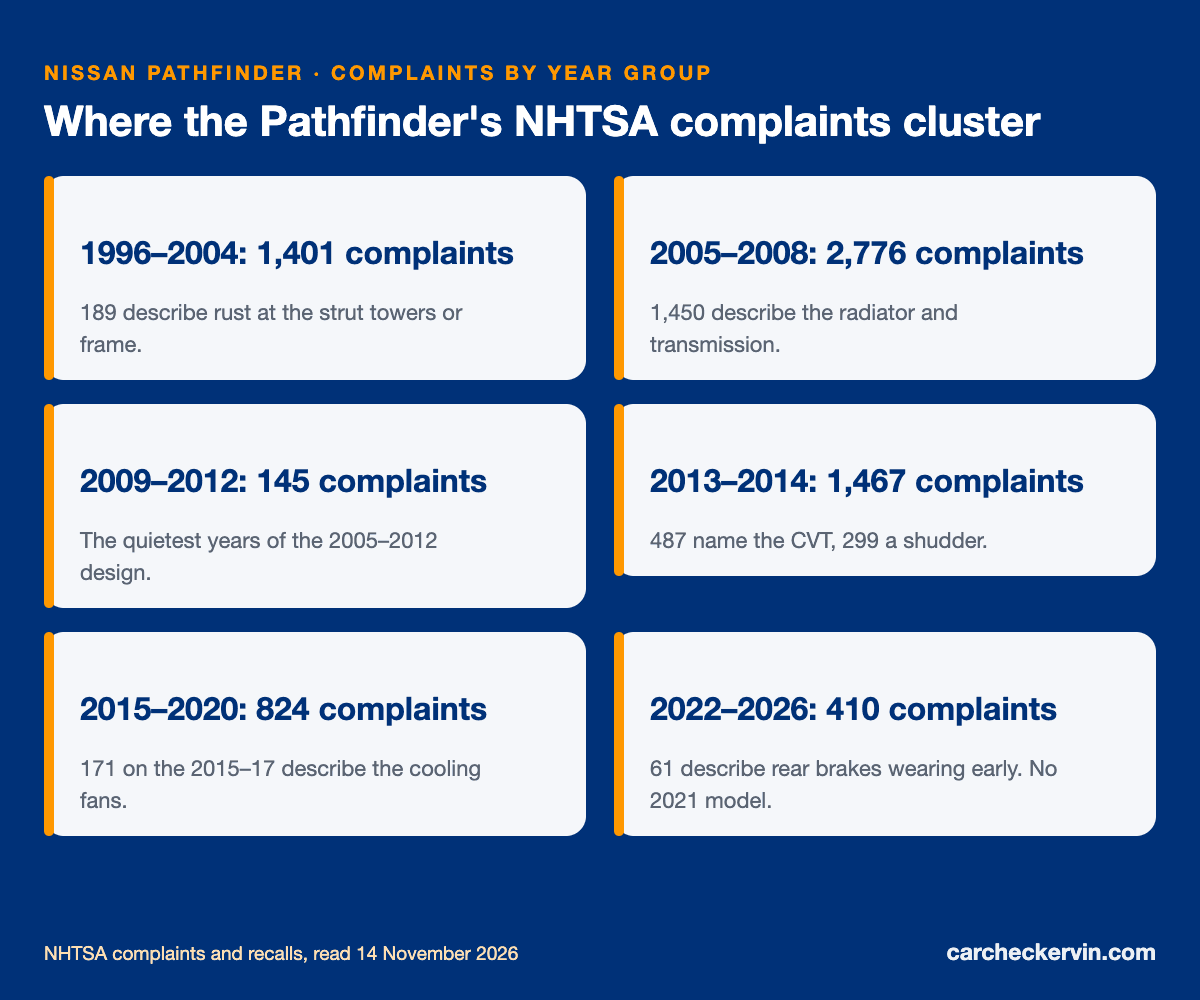
The 2005–2012 generation drew 2,921 complaints, the 2013–2020 2,291, the 1996–2004 1,401 and the 2022-on 410 so far.
What to Check on a Used Pathfinder
By year, the faults to look for.
1996–2004: rust
Look at the strut towers under the hood; confirm 11V244000 on a salt-belt SUV.
2005–2010: radiator
Ask for radiator replacement records; check the coolant and transmission fluid for contamination.
2013–2014: CVT
Feel for a shudder from a stop; ask for CVT fluid changes and any replacement.
2013–2016: airbag sensor
The passenger airbag status light should match who is in the seat.
2015–2017: cooling fans
Listen for clacking at idle with the engine warm.
2022–2025: brakes
Check rear pad and rotor wear; confirm 25V173000 on a 2025.
Reading Pathfinder Complaint Numbers
NHTSA complaints are owner reports, not verified and not divided by sales. The 2009–2012 drew few complaints, but a low count can also mean fewer on the road, so it is not proof the radiator fault was gone.
The fault counts come from searching the words owners used, so they are a minimum. Newer years have had less time: the 2024 has 87 complaints and the 2026 15.
Related Checks and Guides
Recalls, history checks and the Pathfinder's rivals.
Where These Facts Come From
Complaint and recall figures are NHTSA's own records; owner experiences are linked so you can read them in full.
NHTSA records read 14 November 2026. Written by the CarCheckerVIN editorial team with AI assistance, from NHTSA's complaint and recall records, our own preview logs and the owner posts linked above; figures checked November 2026. CarCheckerVIN is not affiliated with Nissan.
Nissan Pathfinder Years to Avoid — Frequently Asked Questions
Radiators, CVTs, fans and the newest Pathfinders.
What is the worst year for the Nissan Pathfinder?+
By NHTSA complaint count, the 2005 (1,050), then the 2013 (891) and the 2006 (837).
Which Pathfinder years have CVT problems?+
The 2013–2014 above all: 487 complaints mention the CVT or transmission. Owners on YouTube report CVT replacements between about 120,000 and 150,000 miles at $4,500 to $7,000.
Was there a 2021 Nissan Pathfinder?+
NHTSA lists no complaints or recalls for one, and none of the Pathfinder VINs our visitors checked was a 2021. NHTSA's list goes straight from the 2020 to the 2022.
Is the 2022 and newer Pathfinder reliable?+
It has drawn far fewer complaints than the 2005–2008 or 2013–2014: 137 on the 2022 and 87 on the 2024, many about the brakes. Check the VIN for the 2022 seat recalls.
How do I know if a 2005–2008 radiator was replaced?+
Ask for the receipt or the shop record. Pink, milky coolant or transmission fluid means the two have already mixed.
Will your report show these problems?+
No history report can tell you a CVT shudders. Ours lists title brands, NMVTIS junk and salvage records, insurance total-loss records, odometer readings, and auction records with the damage the auction recorded and its photos for the VIN. Recalls are free to check on NHTSA's site.
Check the Radiator or the CVT, Then the Title
On a 2005–2008 Pathfinder, ask for the radiator receipt; on a 2013–2014, feel for a shudder from a stop. Free preview first; the full report is $14.99 and lists title brands, NMVTIS junk and salvage records, insurance total-loss records, odometer readings, and auction records with the damage the auction recorded and its photos.
Complaint and recall figures are NHTSA's public records as read on 14 November 2026; complaints are unverified owner reports. Owner comments are paraphrased from the linked pages. CarCheckerVIN is not affiliated with Nissan. Records in our reports reflect what was reported to our data providers. Our reports do not include police or repair-shop accident entries.
Related VIN Checks
More tools to verify any vehicle's history