Rebuilt Title in Florida — what the inspector reads, what it costs and what the brand means.
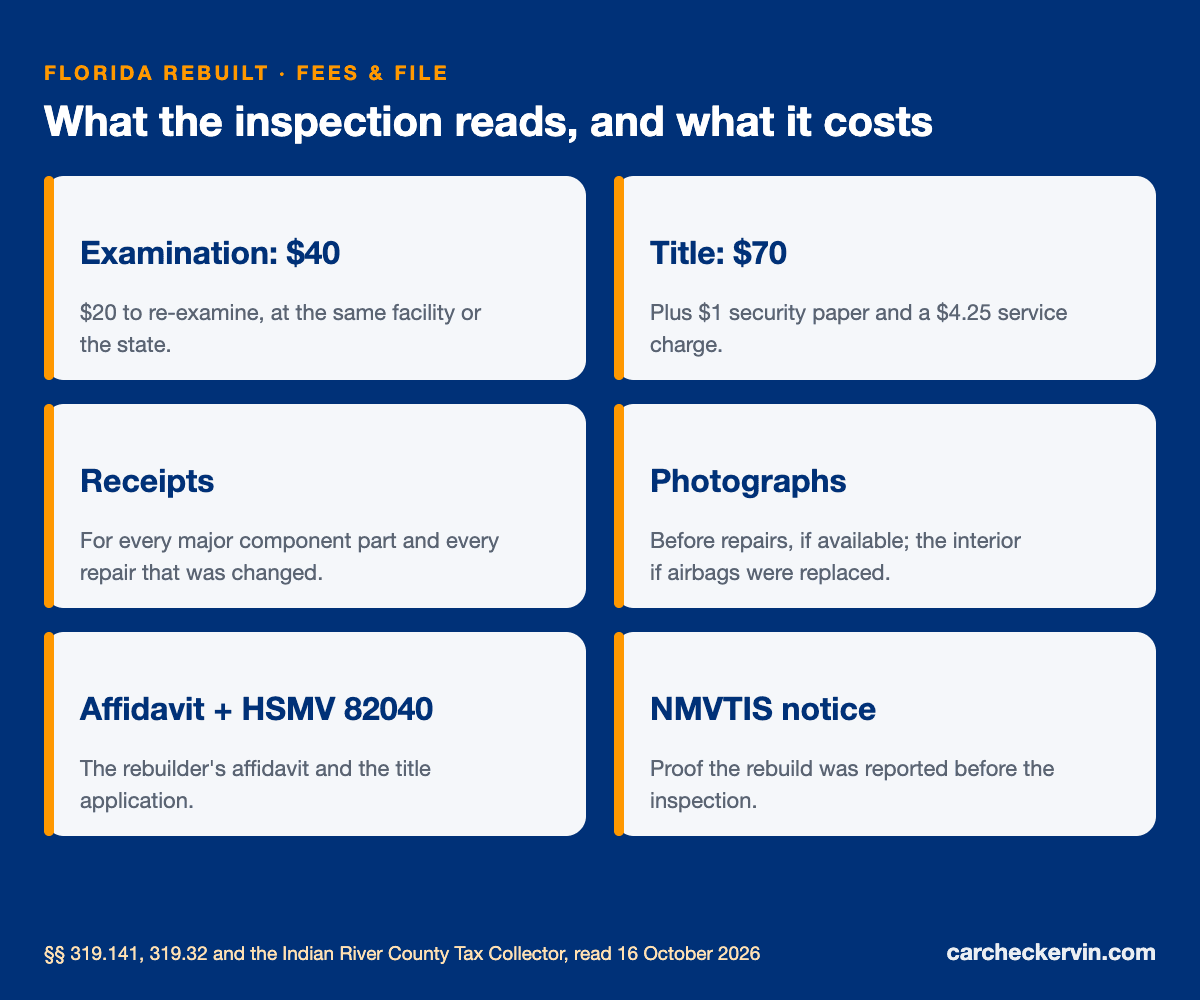
A Florida car with a salvage title cannot be registered or driven until it has been repaired, inspected and retitled with the word "Rebuilt" stamped on the certificate. Section 319.141 lists exactly what the inspection reviews: the endorsed salvage title, your application, a rebuilder's affidavit, photographs from before the repairs, receipts for every major component part and proof the rebuild was reported to NMVTIS. The examination fee is $40. Here is the process, from the statutes and the county offices that issue the title.
Buying a Florida Rebuilt Car?
A Rebuilt brand follows the VIN through NMVTIS whichever state it moves to. Enter the VIN for a free preview of the title brands on record.
Free preview · No sign-up · No owner or personal data
Quick Answer
- How do you get a rebuilt title in Florida?
- Repair the salvage vehicle, keep the receipts for every major component part, photograph it before the work if you can, and complete the title application (HSMV 82040) and a rebuilder's affidavit. Have it inspected at an FLHSMV regional office or a private rebuilt inspection facility, then take the sealed inspection packet to your county tax collector, who issues the title stamped "Rebuilt".
- How much does a rebuilt title cost in Florida?
- The statute charges $40 for the initial examination and $20 for each re-examination, on top of the $70 title fee, a $1 security-paper charge and a $4.25 service charge: $115.25 on the title side for a Florida car that passes first time, before registration and plates. Private facilities set their own inspection charges.
- Where do you get a rebuilt inspection in Florida?
- At an FLHSMV regional office, or at a private rebuilt inspection facility authorized under § 319.141 in 12 counties: Bay, Broward, Duval, Escambia, Hillsborough, Leon, Manatee, Marion, Miami-Dade, Orange, Palm Beach, Volusia. County tax collectors do not inspect rebuilt vehicles; they process the title after the inspection.
Five steps to a Florida rebuilt title
The order comes from § 319.141 and the Indian River County Tax Collector's procedure.
- 1Photograph, then repairPhotos of the damage before work starts, if available; interior photos if airbags were replaced.
- 2Keep every receiptInvoices for all major component parts and the repairs changed, with the donor vehicle's VIN where a part came from another car.
- 3Fill in the paperworkTitle application HSMV 82040, the rebuilder's affidavit and proof the rebuild was reported to NMVTIS.
- 4Pass the inspectionFLHSMV regional office or a private facility; $40 initial, $20 to re-examine.
- 5Title at the tax collectorHand over the sealed packet unopened; the title comes back stamped Rebuilt and the car gets a decal.
Why a Florida Salvage Car Needs a Rebuilt Title
Section 319.14(1)(b) says no one may knowingly offer for sale, sell or exchange a rebuilt vehicle until the department has stamped the certificate of title, in a conspicuous place, with words stating that the vehicle has been rebuilt. A "rebuilt vehicle" is one built from salvage or junk as § 319.30 defines them, and the stamp only follows a physical examination of the vehicle "to assure the identity of the vehicle and all major component parts" that were repaired or replaced. After the title is stamped the department affixes a decal to the vehicle.
The Indian River County Tax Collector puts the practical consequence plainly: a vehicle previously declared salvage or junk "must be issued a rebuilt title before it can be titled, registered, and legally operated on Florida roadways". If you need to drive the car to its inspection, the tax collector can issue a 10-day temporary tag against proof of Florida insurance.
What the Rebuilt Inspection Reviews
Section 319.141(1)(b) defines "rebuilt inspection services" as an examination of the vehicle together with these documents:
The ownership document
A properly endorsed certificate of title, salvage certificate of title or manufacturer's statement of origin, plus the application for a rebuilt certificate of title.
The rebuilder's affidavit
Your sworn statement of who did the work. Tax collectors list the title application, HSMV 82040, alongside it.
Photographs
Of the junk or salvage vehicle before repairs began, if available, and of the interior driver and passenger sides if airbags were deployed and replaced.
Receipts and invoices
For all major component parts and the repairs that were changed. The inspection confirms ownership of the parts, so a donor car's VIN matters.
The NMVTIS notice
Proof that notice of the rebuilding was reported to the National Motor Vehicle Title Information System.
The vehicle itself
The county describes the inspection as verifying the VIN, confirming ownership of major component parts and checking the rebuild meets Florida's requirements.
Major Component Parts: What Needs a Receipt
Section 319.30(1)(j) lists the major component parts for a car: fender, hood, bumper, cowl assembly, rear quarter panel, trunk lid, door, decklid, floor pan, engine, frame, transmission, catalytic converter and airbag. Trucks add any truck bed, including dump, wrecker, crane, mixer and cargo boxes. Motorcycles have their own list, starting with the body assembly, frame, fenders, gas tank and engine.
Electric, hybrid and plug-in hybrid vehicles add their own parts to the list: the electric traction motor, charge port, onboard charger, traction battery pack, among others. Every one of these that you replaced needs an invoice the inspector can tie to a lawful source. That is the part of the file people skimp on, and the reason inspections fail.
If the inspection fails
- Re-examination: $20 under § 319.32.
- Where: only the department or the facility that did the first inspection (§ 319.141(7)).
- Records: facilities keep each inspection file for 5 years.
Florida Rebuilt Title: Fees and Documents
The fee lines from § 319.32 and the document list from § 319.141, side by side.
Every figure is read from the statute on the date shown; private facilities add their own inspection charge.
Rebuilt Title Fees in Florida
From § 319.32, read on 16 October 2026. Registration and plate fees are charged separately by the tax collector.
| Item | Amount |
|---|---|
| Original certificate of title | $70 |
| Initial rebuilt examination (§ 319.14(1)(b) vehicles) | $40 |
| Each subsequent examination | $20 |
| Security paper | $1 |
| Service charge per application | $4.25 |
| Vehicle last registered outside Florida | +$10 |
| Paper title mailed | +$2.50 |
| Lien noted on the title | $2 |
Title-side minimum for a Florida-titled car that passes first time: $115.25. Texas charges a $65 rebuilt salvage fee and California a $50 CHP inspection fee for the same step.
State Office or Private Facility
Until 2022 only the department inspected rebuilt vehicles. Section 319.141 told it to have a private program running by October 1, 2022 in 12 counties: Bay, Broward, Duval, Escambia, Hillsborough, Leon, Manatee, Marion, Miami-Dade, Orange, Palm Beach, Volusia. A facility must hold a $100,000 bond or letter of credit in the department's favor, carry $100,000 of garage liability insurance, operate from a permanent fixed structure that offers nothing but rebuilt inspections, keep the inspection bay out of the customer's sight, and pass criminal background checks on its owners and inspectors. The owner must swear annually to having no interest in any vehicle inspected there.
The department inspects each facility at least once a quarter and cuts off any that falls below the standard. A facility may not inspect a vehicle presented in complete rebuilt condition without the department's prior approval, and only a department-approved participant may charge for the service. If your vehicle fails, § 319.141(7) sends you back to the same facility or to the department, not to a competitor.
Check a Rebuilt Car Before You Pay
Enter the VIN for a free preview of the salvage and rebuilt brands other states and insurers reported.
After the Title: Disclosure When You Sell
Section 319.14(2) requires anyone selling, exchanging or transferring a rebuilt vehicle to disclose in writing, before the deal closes, that the vehicle is rebuilt or assembled from parts, a kit car, glider kit, replica or flood vehicle. Subsection (3) extends that to advertising: any offer to sell the vehicle, in any medium, must clearly and precisely say so.
A "flood vehicle" is a total loss caused by water, and it carries its own stamp. Buyers see the stamp on a Florida title; they see the history of a car that was retitled elsewhere only through NMVTIS, which is why a rebuilt Florida car sold in Georgia still shows its Florida salvage record in a vehicle history report.
What the buyer must be told
- In writing: before the sale, exchange or transfer.
- In every ad: clearly and precisely, in any medium.
- On the title: the Rebuilt (or flood) stamp, then a decal on the car.
Related Checks and Guides
Other states' rebuilt processes, the Florida title pages and the salvage checks.
Where These Facts Come From
From the Florida Statutes and a county tax collector's published procedure, read on 16 October 2026. Procedures and fees change; confirm with your tax collector before you book an inspection.
CarCheckerVIN is not affiliated with FLHSMV, any county tax collector or any inspection facility. This page is general information, not legal advice. FLHSMV's own site could not be read when this page was written; form numbers are quoted from the county tax collector.
Always check the VIN before you buy
The free preview shows title brands, theft status and open recalls in seconds, and flags whether accident and odometer records exist. The full history is $14.99 — one-time, no subscription.
Rebuilt Title in Florida — Frequently Asked Questions
What Florida rebuilders and buyers ask most.
Can you drive a salvage title car in Florida?+
Not until it has a rebuilt title. The county tax collector states that a salvage or junk vehicle must be issued a rebuilt title before it can be titled, registered and legally operated on Florida roads. A 10-day temporary tag lets you drive it to the inspection.
What documents do I need for a Florida rebuilt inspection?+
The endorsed salvage title, the title application (HSMV 82040), a rebuilder's affidavit, photographs of the vehicle before repairs where available, receipts or invoices for every major component part and repair, and proof the rebuild was reported to NMVTIS. Bring photo ID and payment for the fees.
Do county tax collectors inspect rebuilt vehicles?+
No. Inspections happen at an FLHSMV regional office or at a private rebuilt inspection facility authorized under § 319.141. The tax collector processes the title afterwards and opens the sealed inspection packet itself.
What if my rebuilt inspection fails?+
You pay $20 for each subsequent examination, and § 319.141(7) says the re-inspection may be done only by the department or by the facility that did the original inspection.
Does a Florida rebuilt title show up in other states?+
Yes. The rebuild must be reported to NMVTIS before the inspection, and title brands are shared between states through that system, so a vehicle history report shows the salvage and rebuilt history after the car moves.
Is a rebuilt title the same as a salvage title in Florida?+
No. A salvage title means the vehicle was a total loss and cannot be registered. A rebuilt title means it was repaired, inspected and retitled; it can be registered and driven, and must be disclosed as rebuilt when sold.
Run the VIN on a Rebuilt Car
Enter any 17-character VIN for a free preview. The full report lists title brands, NMVTIS junk and salvage records, insurance total-loss records, odometer readings, and auction records with the damage the auction recorded and its photos.
CarCheckerVIN is an independent vehicle-history service and is not affiliated with the Florida Department of Highway Safety and Motor Vehicles or any county tax collector. Requirements are summarized from public sources and are not legal advice. Records in our reports reflect what was reported to our data providers. Our reports do not include police or repair-shop accident entries.
Related VIN Checks
More tools to verify any vehicle's history