REG 101 — what to do when a California title has a mistake on it.
A signature on the wrong line, a crossed-out name, an erasure: the DMV's procedures manual says any erasure or lined-out entry on a California Certificate of Title needs a REG 101 to go with it. One half, the Statement of Error or Erasure, has the person who made the mistake declare, under penalty of perjury, that the entry "was in error and has no bearing on the ownership of the vehicle." The other half, the Statement to Record Ownership, records who the owner actually is. Here is when the DMV requires it, who has to sign, and what goes on each side.
Buying a Car With a Messy Title?
Erasures and crossed-out names are worth a second look. Enter the VIN for a free preview of the title brands, salvage records and odometer readings on file.
Free preview · No sign-up · No owner or personal data
Quick Answer
- What is REG 101 used for?
- To correct a California title. The DMV's procedures manual says a Statement of Error or Erasure (REG 101) is required for any erasure or lined-out information on the California Certificate of Title, and the DMV's title page lists it under "Correct mistakes". The same sheet has a Statement to Record Ownership for recording the vehicle's true owner.
- Who signs REG 101?
- The person whose entry was wrong. If someone's signature appears on the title in error and is lined out, that individual completes the REG 101 explaining the error. A dealer or financial institution can certify to errors its own representatives made. If a printed name or address was lined out, the person who made the mistaken entry can complete it.
- Do I need REG 101 if I signed on the wrong line of my California title?
- Usually yes: lined-out or erased information needs one, signed by you. The manual's one stated exception: no REG 101 is needed if the current registered owner's or new buyer's name is printed or signed on the dealer endorsement line.
Four steps when there's a mistake on the title
Don't try to correct it with more ink. Each fix on the title needs explaining.
- 1Find the lineNote which line of the title carries the wrong signature, name or erasure.
- 2Find who made itThe person whose signature or entry it is signs the REG 101, not the buyer.
- 3Complete the statementVehicle details, the line in error, the reason, and a signature under penalty of perjury.
- 4File it with the titleThe REG 101 goes in with the title and the rest of the transfer paperwork.
What REG 101 Is
REG 101, revised in 3/2007, is two forms on one sheet. The top half, the Statement to Record Ownership, records the vehicle (plate or CF number, VIN or hull ID, make) and the registered owner's true full name exactly as on their California driver license or ID card, with that card's number, AND or OR between co-owners, the address, the purchase date and price, and the lienholder, or "NONE". It also has lines for a leased vehicle's lessee address and where a vessel is principally kept.
The bottom half, the Statement of Error or Erasure, is the part most people need. It says that "the name appearing on or erased from line __ of the CERTIFICATE OF TITLE/OWNERSHIP issued for the above described vehicle/vessel was in error and has no bearing on the ownership of the vehicle/vessel," and that "the name signed or erased should not be a part of the ownership record." You give the reasons for the error and sign under penalty of perjury, with your address and a daytime phone number.
When the DMV Requires a REG 101
From the DMV's Vehicle Industry Registration Procedures Manual, § 11.060, read on 21 October 2026.
| Situation | REG 101 needed? | Who signs |
|---|---|---|
| Any erasure on the California title | Yes | The person whose entry it was |
| A signature on the title in error, lined out | Yes | The individual whose signature appears in error |
| A printed name or address lined out | Yes | The person who made the entry in error may complete it |
| An error by a dealer's or lender's representative | Yes | The dealer or financial institution may certify to it |
| The owner's or buyer's name on the dealer endorsement line | No | — |
The manual's wording covers "any erasure and/or lined out information" on the California Certificate of Title.
REG 101 at a Glance
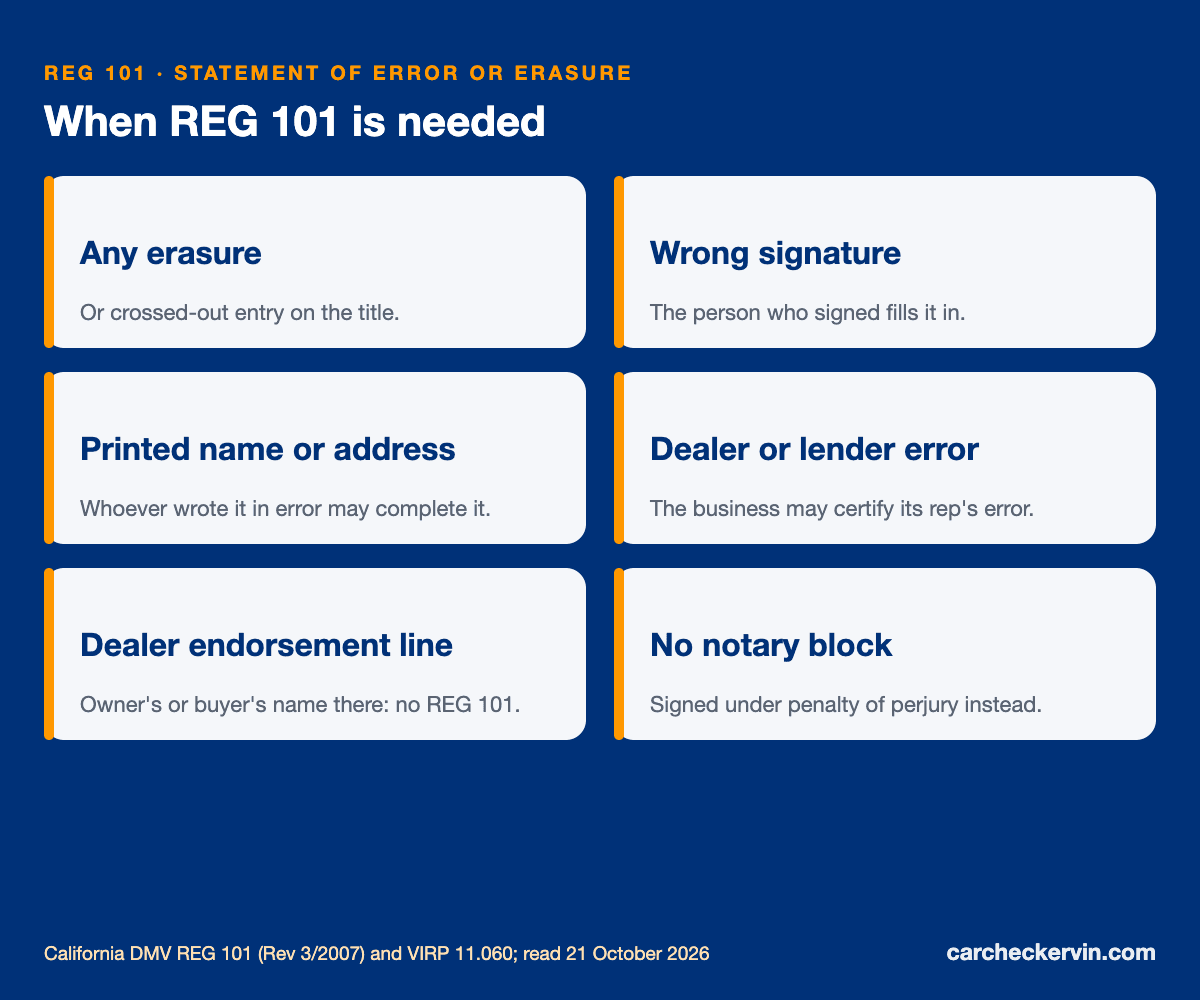
When it's required and who signs, on one card.
From the California DMV's REG 101 (Rev 3/2007) and procedures manual § 11.060, read on the date shown.
Why the Person Who Made the Mistake Has to Sign
A California title is an ownership document, and every name on it is a claim. When a signature is crossed out, the DMV can't tell from the paper whether that person gave up an interest in the car or simply signed on the wrong line. The REG 101 settles it: the person whose name it was states, under penalty of perjury, that the entry was a mistake and has no bearing on who owns the vehicle. That's why the manual puts the duty on "the individual whose signature appears on the title in error" rather than on the new owner.
There are two shortcuts. A dealer or financial institution may certify to errors in signatures, including its own, that a representative made on the title. And when the thing crossed out is a printed name or address rather than a signature, the person who made the mistaken entry can complete the REG 101 themselves.
Who signs, in short
- Wrong signature: the person who signed.
- Printed name or address: whoever wrote it.
- Dealer or lender error: the business can certify.
- Not the buyer: unless it was their mistake.
A Title With Corrections on It?
Most are innocent slips. Before you buy, enter the VIN for a free preview of the title brands and junk and salvage records on file.
Avoiding a REG 101
The easiest REG 101 is the one you never need.
Read the line labels first
Find the seller's and buyer's lines before anyone signs. Signing on the wrong line is the classic REG 101.
No correction fluid
An erasure or a crossed-out entry is exactly what the manual says requires a REG 101.
Names as on the license
REG 101's ownership half asks for true full names as on the California license or ID card. Use them on the title too.
AND or OR
Decide how co-owners are joined before you write them in. It controls who must sign later.
Lienholder: "NONE"
If there's no lender, the form wants the word NONE rather than a blank.
10-day clock
The DMV says a change of ownership must be reported within 10 days, so fix errors quickly.
REG 101 or REG 256
Both are California statements signed under penalty of perjury. They do different jobs.
REG 101
- Explains an error or erasure on the title itself.
- Signed by whoever made the mistake.
- Also records ownership on its top half.
- Names the line of the title in error.
REG 256
- States a fact the DMV can't see on another document.
- Use tax and smog exemptions, title-only status, name statements.
- Signed by the applicant.
- Eight sections; complete the ones that apply.
A misspelled name on your own record goes on REG 256's name statement; a mistaken entry on the title goes on REG 101.
Related Checks and Guides
The other California and Texas DMV form guides, and the title pages they connect to.
Where These Facts Come From
From the California DMV's REG 101, its procedures manual and its title transfers page, read on 21 October 2026. Download the current form from dmv.ca.gov before you file.
CarCheckerVIN is not affiliated with the California Department of Motor Vehicles and does not file DMV forms. This page is general information, not legal advice.
REG 101 — Frequently Asked Questions
What California owners and buyers ask most.
Can I just cross out a mistake on my California title?+
You can, but the crossed-out entry then needs a REG 101 explaining it. The DMV's procedures manual says a REG 101 is required for any erasure or lined-out information on the title.
The seller signed in the wrong place. Who fills out REG 101?+
The seller. When a signature appears on the title in error and is lined out, the manual says the individual whose signature it is must complete the REG 101 explaining the error.
Does REG 101 need to be notarized?+
The form has no notary section. The Statement of Error or Erasure is signed under penalty of perjury, with the signer's address and daytime phone number.
Can a dealer fix a mistake on my title?+
A dealer or financial institution may certify to errors in signatures, including its own, made on the title by one of its representatives. Mistakes made by anyone else need the REG 101 from the person who made them.
What is the Statement to Record Ownership on REG 101?+
The top half of the form. It records the vehicle, the registered owner's true full name as on their California license or ID, co-owners joined by AND or OR, the address, the purchase date and price, the lienholder (or NONE), and lessee or vessel details where they apply.
How long does a corrected California title take?+
The DMV's title page says titles usually arrive by mail within 15 to 30 days.
Check the VIN Before You Sign Anything Else
Enter any 17-character VIN for a free preview. The full report lists title brands, NMVTIS junk and salvage records, insurance total-loss records, odometer readings, and auction records with the damage the auction recorded and its photos.
CarCheckerVIN is an independent vehicle-history service and is not affiliated with the California Department of Motor Vehicles. This guide summarizes the DMV's published REG 101, procedures manual and title pages and is not legal advice. Records in our reports reflect what was reported to our data providers. Our reports do not include police or repair-shop accident entries.
Related VIN Checks
More tools to verify any vehicle's history