REG 4008 — declaring what your truck will weigh in California.
California charges commercial vehicles a weight fee based not on what the truck weighs empty, but on the heaviest it will run loaded. REG 4008 is where you declare that: every registered owner or lessee of a commercial motor vehicle operating at 10,001 lb or more, alone or pulling something, picks a weight code from A to N. The code sets the Commercial Vehicle Registration Act (CVRA) fee, from $332 to $2,064 a year, and goes on your registration card and weight decal. Run heavier than you declared and you face late fees, a citation and fines. Here's the form and the full fee table.
Buying a Used Work Truck?
Check its past before you declare its future. Enter the VIN for a free preview of the title brands, salvage and odometer records on file.
Free preview · No sign-up · No owner or personal data
Quick Answer
- What is the REG 4008 form?
- California DMV's Declaration of Gross Vehicle Weight (GVW) / Combined Gross Vehicle Weight (CGW), Rev. 5/2015. Owners and lessees of commercial motor vehicles operating at 10,001 lb or more use it to declare the highest weight range the vehicle will operate in. That range, coded A through N, sets the CVRA weight fee.
- Do pickup trucks need a REG 4008?
- Not if they're stock. The form excludes pickups with no body type modifications (such as an added utility bed or stake body), an unladen weight under 8,001 lb and a GVWR of 11,499 lb or less. Vehicle Code § 9400.1 also says pickup truck and electric vehicle weight fees aren't calculated under the CVRA schedule.
- What's the difference between GVW and CGW?
- Declared GVW is for a vehicle that hauls a load but doesn't pull another vehicle: its unladen weight plus the heaviest load it will carry. Declared CGW is for a vehicle that pulls another: the unladen weight of the whole combination plus the heaviest load the combination will carry. The form's example is a truck loaded with produce pulling a trailer loaded with bricks.
Four steps through a REG 4008
Sections A, C and D are required. Section B is the definitions.
- 1Owner or lesseeSection A: name, optional fleet number, physical and mailing address, and the California county where it's garaged.
- 2Work out GVW or CGWUnladen weight plus the heaviest load, for the truck alone or the whole combination.
- 3Enter the code and dateSection C: plate, VIN, make, the A–N code and weight, and the date it first runs at that weight.
- 4Certify under penalty of perjurySection D: a company signs with its printed name and an authorized representative.
California CVRA Weight Codes and Fees
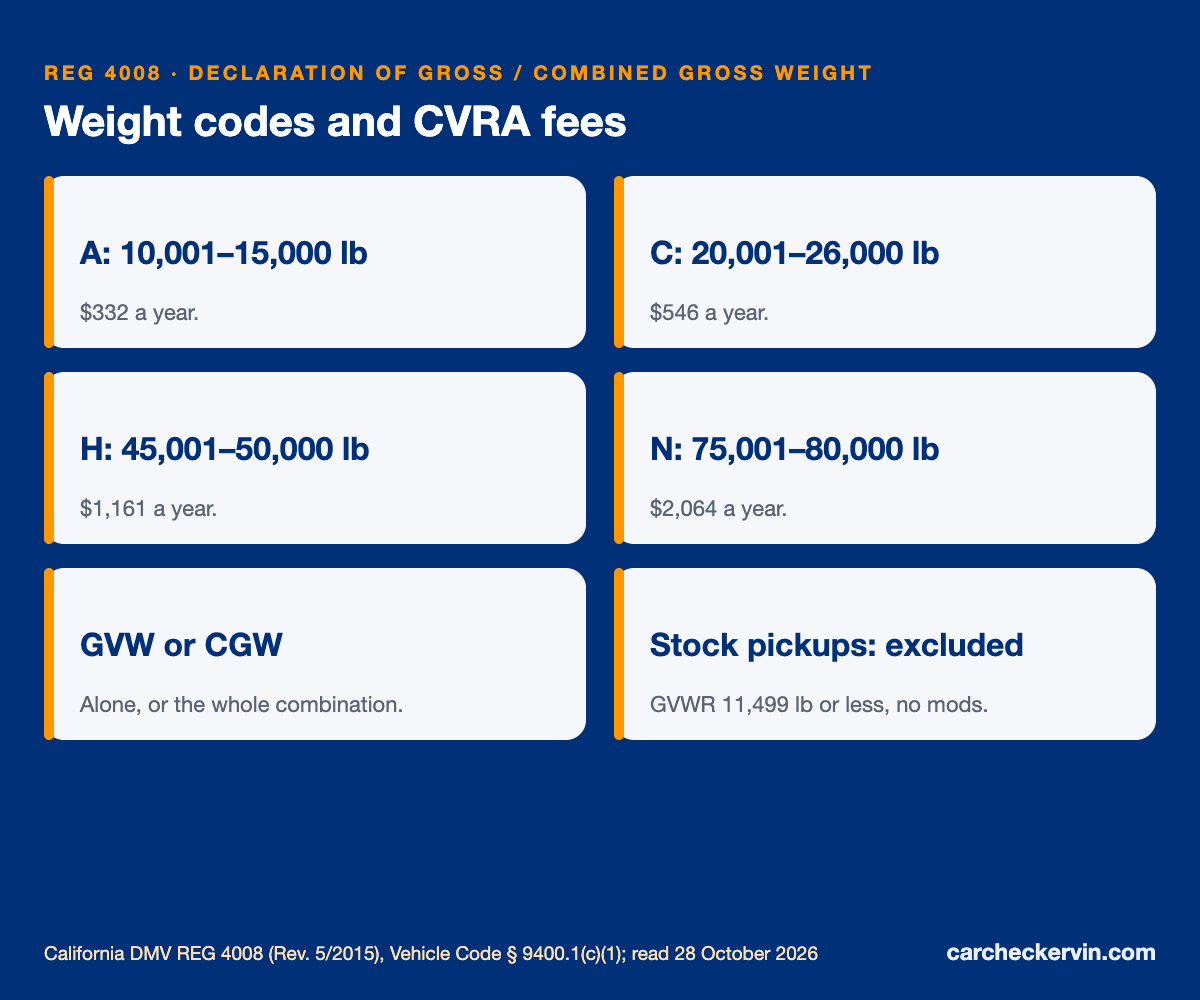
Vehicle Code § 9400.1(c)(1), the schedule printed on REG 4008, read on 28 October 2026. Each fee is per year.
| Declared GVW / CGW (lb) | Weight code | CVRA fee |
|---|---|---|
| 10,001–15,000 | A | $332 |
| 15,001–20,000 | B | $447 |
| 20,001–26,000 | C | $546 |
| 26,001–30,000 | D | $586 |
| 30,001–35,000 | E | $801 |
| 35,001–40,000 | F | $937 |
| 40,001–45,000 | G | $1,028 |
| 45,001–50,000 | H | $1,161 |
| 50,001–54,999 | I | $1,270 |
| 55,000–60,000 | J | $1,431 |
| 60,001–65,000 | K | $1,562 |
| 65,001–70,000 | L | $1,701 |
| 70,001–75,000 | M | $2,004 |
| 75,001–80,000 | N | $2,064 |
Under 10,001 lb: no code and no CVRA fee. Vehicles subject to these weight fees also pay a $3 Cargo Theft Interdiction Program fee (§ 9400.1(d)), and the DMV's fee page lists $3 for CVRA weight and year stickers.
What's on the REG 4008
Rev. 5/2015 is a single page. The top sets the rule: all registered owners or lessees of commercial motor vehicles operating at 10,001 lb or more GVW or CGW and registered with the California DMV must declare the weight at which the vehicle will operate. It also warns that a Motor Carrier Permit may be required as well. Your registration card shows the highest weight in the range you report, and the vehicle must display the matching weight decal and CVRA year sticker. Commercial vehicles can be registered on a Partial Year Registration (PYR) basis.
Section A is the registered owner or lessee: name, an optional fleet number, physical address, the California county of residence or where the vehicle is principally garaged (with a box if there's no California county and it's used out of state), and a mailing address. Section B defines GVW and CGW.
Section C is the declaration itself, one row per vehicle: license number, VIN, make, a box for vehicles that will run under 10,001 lb, the GVW or CGW code with the weight written beside it, and the date the vehicle will first be, or was first, operated at that weight. The form gives clearing a citation as an example of a past date. Section D is the certification under penalty of perjury. A company signs with its printed name and an authorized representative's countersignature, such as "ABC CO., by John Smith".
REG 4008 at a Glance
Who declares, how to pick a code and what running heavy costs, on one card.
From REG 4008 (Rev. 5/2015) and Vehicle Code § 9400.1, read on 28 October 2026.
Declare the Heaviest You'll Run, Not the Usual
The declaration is a ceiling, and the form's warning is about going over it. CVRA fees must be paid before the vehicle operates at a higher weight (CVC 9406.1). Operating heavier than declared brings late fee penalties (CVC 9554.2), a citation (CVC 9406.1) and, on conviction, fines the form says can reach or exceed $2,000 per violation (CVC 42030.1).
So the code you pick should match the heaviest load the vehicle, or the combination, will actually carry. If that changes, say a bigger trailer or a heavier regular load, a new declaration and the higher fee come first. The date field in Section C covers the case where you're catching up after a citation.
Who's out of scope
- Under 10,001 lb: tick the box; no weight code or CVRA fee.
- Stock pickups: unladen under 8,001 lb and GVWR 11,499 lb or less, no body changes.
- Electric vehicles: § 9400.1 says their weight fees aren't calculated under this schedule.
- Over 80,000 lb: the schedule on the form stops at code N.
Check a Used Truck's Record First
A commercial truck may have had several owners and a salvage history. Enter the VIN for a free preview of the title brands, salvage records and odometer readings on file.
Picking the Right Weight Code
Worked from the form's definitions and the § 9400.1 schedule.
Box truck, no trailer
GVW: its unladen weight plus the heaviest load it carries.
Truck pulling a trailer
CGW: the whole combination's unladen weight plus its heaviest load.
20,001 lb–26,000 lb
Code C: $546 a year.
75,001 lb–80,000 lb
Code N: $2,064 a year.
Changing weight
Pay the higher CVRA fee before running heavier.
One row per vehicle
Plate, VIN, make, code and first-operated date for each.
GVW vs. CGW on the REG 4008
Section B's two definitions, side by side.
Declared GVW
- Vehicles that haul a load but don't pull another vehicle.
- Total unladen weight of the vehicle.
- Plus the heaviest load it will transport.
- Entered in the GVW code column.
Declared CGW
- Vehicles that pull another vehicle.
- Total unladen weight of the whole combination.
- Plus the heaviest load the combination will transport.
- Entered in the CGW code column.
The form stresses declaring the total combined operating weight when you tow.
Related Checks and Guides
The other DMV form guides, and the California pages they connect to.
Where These Facts Come From
From the California DMV's form and fee page and the Vehicle Code on leginfo.legislature.ca.gov, read on 28 October 2026. The fee schedule on the 2015 form matches § 9400.1(c)(1) as published today.
CarCheckerVIN is not affiliated with the California Department of Motor Vehicles. This page is general information, not legal or tax advice.
REG 4008 — Frequently Asked Questions
What California truck owners ask most.
Who has to file a REG 4008?+
Registered owners or lessees of commercial motor vehicles registered in California that operate at 10,001 lb or more gross or combined gross weight. Stock pickups under the form's weight limits are excluded.
How much is the CVRA weight fee in California?+
It depends on the declared weight: $332 for 10,001 lb–15,000 lb (code A), rising to $2,064 for 75,001 lb–80,000 lb (code N), per Vehicle Code § 9400.1(c)(1).
What happens if my truck runs heavier than I declared?+
The form warns of late fee penalties (CVC 9554.2), a citation (CVC 9406.1) and, on conviction, fines up to or in excess of $2,000 per violation (CVC 42030.1). Pay the higher fee before operating at the higher weight.
Do I need a REG 4008 for a pickup with a utility bed?+
The pickup exclusion only covers pickups with no body type modifications, so a pickup with an added utility bed or stake body isn't excluded on that basis. It still falls under the form only if it operates at 10,001 lb or more.
What does the weight code do?+
It goes on your registration, which shows the highest weight in your range, and on the weight decal the vehicle must display alongside the CVRA year sticker. The decal must match the weight on the registration card.
Can a company sign the REG 4008?+
Yes, with the company's printed name and an authorized representative's countersignature on the signature line, for example "ABC CO., by John Smith".
Run the VIN on the Truck Before You Register It
Enter any 17-character VIN for a free preview. The full report lists title brands, NMVTIS junk and salvage records, insurance total-loss records, odometer readings, and auction records with the damage the auction recorded and its photos.
CarCheckerVIN is an independent vehicle-history service and is not affiliated with the California Department of Motor Vehicles. This guide summarizes REG 4008, Vehicle Code § 9400.1 and the DMV's fee page and is not legal or tax advice. Records in our reports reflect what was reported to our data providers. Our reports do not include police or repair-shop accident entries.
Related VIN Checks
More tools to verify any vehicle's history