Is VinAudit Legit? Yes — the low price is the confusing part, not the company.
VinAudit sells vehicle history reports for around $9.99, which is cheap enough that people reasonably wonder what the catch is. There isn't one on legitimacy: VinAudit is an approved NMVTIS provider, and you can verify that on a federal list in about a minute. The catch, such as it is, sits elsewhere — in what a federal-records report includes and what it never will, at any price. Below: how to check any seller yourself, what $9.99 actually buys, and where a free summary plus a $14.99 report lands by comparison.
Run a Free VIN Summary — No Sign-Up
Enter the 17-character VIN and we'll return title-brand status, open recalls, and decoded specs instantly — then unlock the full report for $14.99, close to VinAudit's ~$9.99 but with a free tier first.
Free · No sign-up · NMVTIS-backed
Quick Answer
- Is VinAudit legit?
- Yes. VinAudit is a legitimate company and an approved NMVTIS data provider — the US Department of Justice authorizes it to sell National Motor Vehicle Title Information System records. The list of approved providers is public at vehiclehistory.bja.ojp.gov, so you can confirm this in under a minute without trusting anyone's review. The ~$9.99 price throws people off, but a low price is a business-model choice, not evidence of bad data: the title and odometer records come from the same federal database the expensive services use.
- Is a $9.99 report too cheap to be real?
- No — but it's worth understanding whyit's cheap. NMVTIS is a federal system, and every approved provider pulls from the same well, so the raw title, brand, salvage and odometer records cost roughly the same to source no matter who sells them. What varies is everything layered on top. VinAudit keeps the layer thin and the price low; the premium services charge for proprietary accident and service narratives that NMVTIS does not contain at any price. Cheap gets you the federal facts. It does not get you a dealer's maintenance log.
- What is a VinAudit vehicle history report?
- A VinAudit vehicle history report is an official NMVTIS report from VinAudit.com, one of the government-approved providers that can sell NMVTIS data to consumers. It covers title brands, salvage and total-loss records, odometer readings, theft, liens, and sales history keyed to the VIN. VinAudit is known for a low flat price — about $9.99 — and for also selling a vehicle-history API to dealers and developers.
- How much does a VinAudit report cost?
- A single VinAudit report typically runs about $9.99, which the company markets as roughly 70% cheaper than a Carfax report. That flat, low, one-time price is VinAudit's main selling point — there's no subscription. It's the closest direct price competitor to CarCheckerVIN's $14.99 full report.
- Is CarCheckerVIN better than VinAudit?
- They're close — both pull official NMVTIS data, so the core title and odometer records overlap. The differences are the free summary CarCheckerVIN gives every VIN before you pay, and a more readable, buyer-focused layout versus VinAudit's data-table style. VinAudit wins on rock-bottom price; CarCheckerVIN wins on the free tier and presentation for a few dollars more.
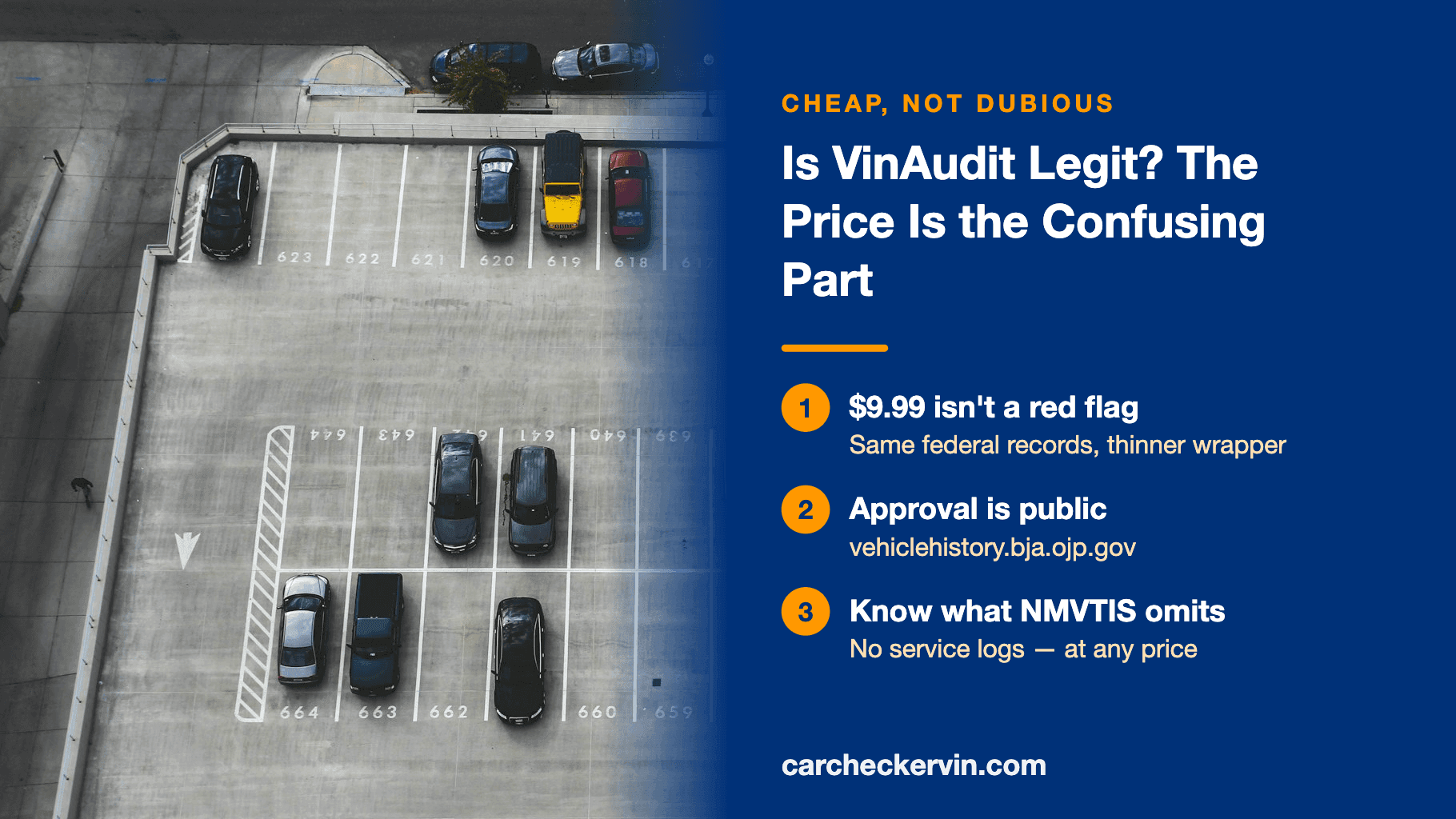
What a VinAudit Report Covers
Six things to understand about a VinAudit vehicle history report — and where CarCheckerVIN lands on each.
Official NMVTIS title records
VinAudit is an approved NMVTIS access provider, so its title brands — Salvage, Junk, Rebuilt, Flood, Lemon — come straight from the federal title system that every state DMV, insurer, and salvage yard reports into. This is authoritative government data, the same backbone CarCheckerVIN's report is built on. On title brands specifically, the two reports draw from the same well.
Salvage, theft & total-loss checks
A VinAudit report flags total-loss records, theft filings, and salvage-auction history tied to the VIN, plus lien and impound records where reported. These are the make-or-break facts about a used car. CarCheckerVIN covers the same salvage, theft, and total-loss records from overlapping NMVTIS and insurance sources, so on the core problem checks the two are comparable.
Odometer readings
VinAudit compiles odometer readings captured at title transfers and inspections and flags likely rollbacks. Mileage fraud is a federal crime, and this timeline is one of the most valuable parts of any history report. CarCheckerVIN tracks the same readings from the same title and inspection feeds, so the odometer picture you get is equivalent.
Where the data comes from
Because VinAudit accesses NMVTIS directly and adds NHTSA, theft, lien, and sales data, its records come from the same authoritative government and industry feeds that reputable providers use. That's why a low price doesn't mean low-quality data — the title and odometer records are the real thing. It also means VinAudit and CarCheckerVIN overlap heavily on the facts that matter.
Presentation: data table vs report
This is where VinAudit and CarCheckerVIN diverge most. VinAudit's consumer report leans toward a compact data-table format — accurate but sparse, aimed partly at API and dealer users. CarCheckerVIN presents the same records in a readable, buyer-focused layout with a plain-language summary, so a first-time private buyer can actually interpret what the records mean without decoding a spreadsheet.
Price and the free tier
VinAudit's headline is its ~$9.99 flat price, and credit where due — it's cheap and honest, with no subscription. CarCheckerVIN's full report is $14.99, a few dollars more, but every VIN gets a genuinely free summary first: title-brand status, open recalls, and decoded specs at no cost. So you can screen a car for free with CarCheckerVIN and only pay when you've found one worth the full report.
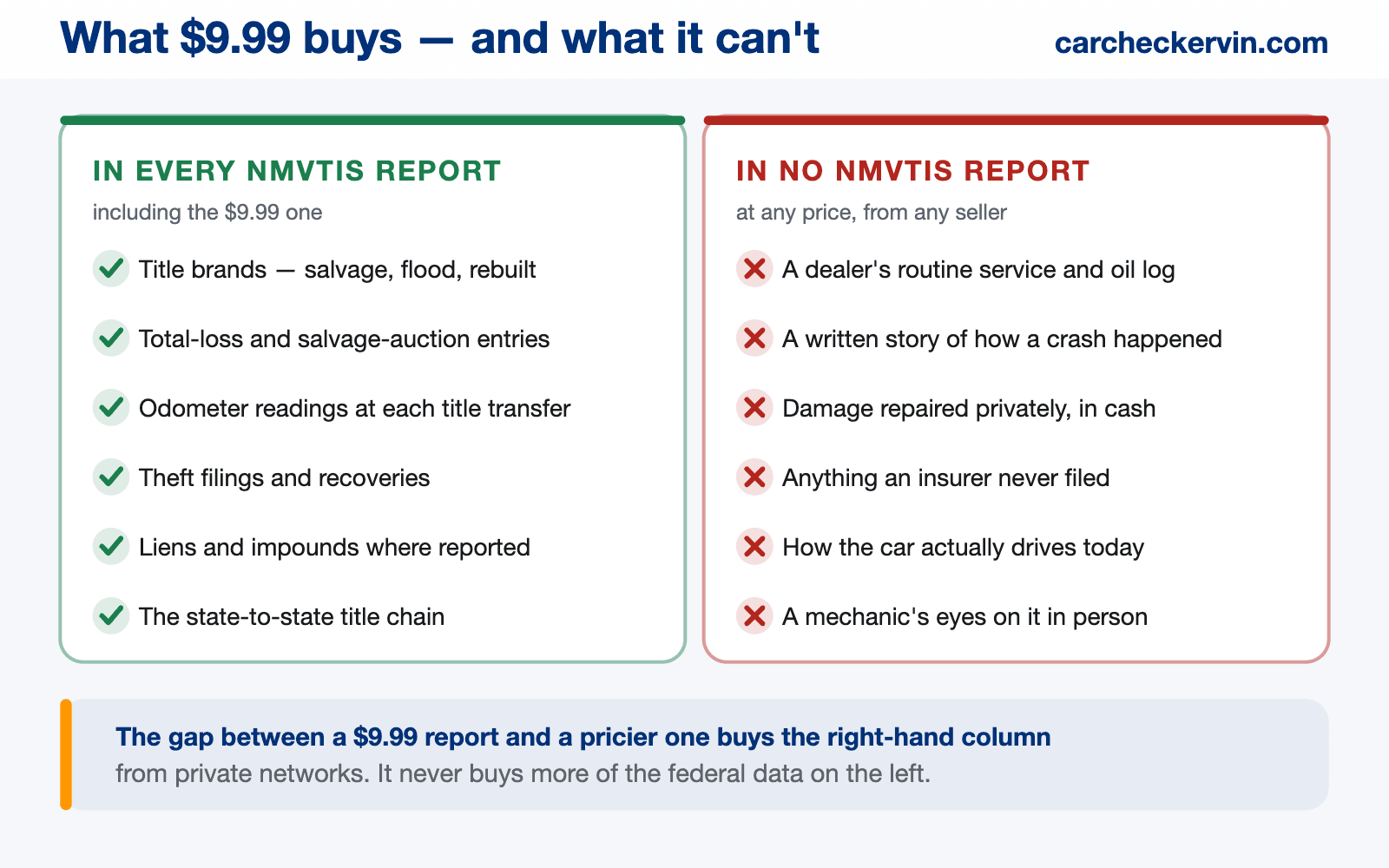
How to Tell Whether a Cheap VIN Report Is Real
Price alone tells you almost nothing. These four checks work on any vehicle-history seller and take about five minutes.
Settle approval first, price second
Before you argue about whether $9.99 is suspiciously low, find out whether the seller is allowed to sell the data at all. The Department of Justice lists every approved NMVTIS provider at vehiclehistory.bja.ojp.gov. VinAudit appears there. Once approval is established, a low price stops being a red flag and becomes a business-model question — which is a much easier question to answer.
Work out what the price doesn't include
This is where cheap reports actually disappoint people, and it has nothing to do with fraud. NMVTIS carries titles, brands, odometer readings, total-loss and salvage entries. It does not carry a dealer's oil-change log or a written narrative of a fender-bender. Those come from proprietary networks the premium brands built themselves. A $9.99 report isn't hiding that data — nobody selling federal records has it.
Confirm the charge doesn't repeat
Sort the one-time payments from the subscription entry points before you type a card number, and find the cancellation route while you're there. VinAudit's flat one-off price is genuinely one-off, which is a point in its favour, but check it yourself rather than taking our word for it — recurring billing dressed as a single fee is the most common complaint in this whole category.
Get a free baseline before you compare anything
Run the 17-character VIN through a free lookup first. Title-brand status, open recalls, decoded specs — enough that you walk into any paid report already knowing roughly what it should say. If the paid version contradicts that baseline on something basic, you've learned something useful, and it cost nothing to learn.
Check it at the source
The approved-provider list is published by the Department of Justice at vehiclehistory.bja.ojp.gov, and open recalls come from nhtsa.gov. Neither charges anything or asks for a card. Our NMVTIS VIN check page sets out exactly which records that federal database holds — the same records a $9.99 report and a $40 one are both built on.
Same NMVTIS Data — Start Free
Title-brand status, open recalls, and decoded specs — instantly and free. Full report a one-time $14.99, in a layout built for buyers.
CarCheckerVIN vs VinAudit
Both pull official NMVTIS data, so the core records overlap. The difference is the free tier, the presentation, and a few dollars of price. Here is where the line falls.
CarCheckerVIN — free + $14.99
- Free VIN summary — no account, no card
- Official NMVTIS title, salvage, odometer
- Full report a one-time $14.99
- Readable, buyer-focused layout
- Downloadable PDF, no subscription
A few dollars more than VinAudit — but with a free screening tier and a clearer report.
VinAudit — ~$9.99
- Lowest flat price, around $9.99
- Official NMVTIS access provider
- Title brands, salvage, odometer, liens
- Strong vehicle-history API for business
- Compact data-table presentation
Want the full head-to-head? See VIN check vs VinAudit , or read how NMVTIS data both services rely on actually works.
Compare & Verify — More Tools
Price is one factor. These pages cover the head-to-head, the NMVTIS data source, and the free tier behind any report.
Always check the VIN before you buy
The free preview shows title brands, theft status and open recalls in seconds, and flags whether accident and odometer records exist. The full history is $14.99 — one-time, no subscription.
Is VinAudit Legit? — Frequently Asked Questions
The questions buyers ask most when comparing a VinAudit report to the alternatives.
Is VinAudit legit and accurate?+
Yes — VinAudit is a legitimate company and an official NMVTIS access provider, which means the title-brand, salvage, and odometer data in its reports comes straight from the federal NMVTIS database that state DMVs, insurers, and salvage yards are legally required to report into. You can verify the approval yourself instead of relying on reviews: the Department of Justice publishes the approved-provider list at vehiclehistory.bja.ojp.gov, and VinAudit is on it. On the core records — title brands, total-loss, odometer — VinAudit's data is as authoritative as any premium provider's, because it's the same government source. Where VinAudit is thinner is the storytelling layer: it doesn't build detailed accident narratives the way Carfax does, and its consumer report reads more like a data table than a written history. So it's accurate and legit for the facts that matter most; it just presents them plainly.
Why is VinAudit so cheap — is $9.99 a red flag?+
It isn't, and the reason is structural rather than reassuring marketing. NMVTIS is a federal system, and every approved provider draws from the same database, so the raw title, brand, salvage, and odometer records cost broadly the same to source regardless of who resells them. What differs between a $9.99 report and a $40 one is the layer built on top. VinAudit keeps that layer minimal — a compact data presentation, a lean operation, no subscription — and prices accordingly. The expensive services are charging for proprietary accident narratives and dealer service records collected through their own networks, which NMVTIS simply does not contain. So the honest framing is not 'cheap data versus good data' but 'federal records versus federal records plus a proprietary layer.' If you need the proprietary layer, no NMVTIS reseller at any price will give it to you. If you need the title and odometer facts, $9.99 buys the same government records the premium report does.
How do I check whether a VIN report site is legitimate?+
Start with federal approval, because it's the one credential that can't be manufactured. The NMVTIS consumer portal at vehiclehistory.bja.ojp.gov lists every approved data provider; a seller that isn't on it is reselling records without authorization, which matters far more than how polished its site looks. Next, work out what the report can and cannot contain — knowing that NMVTIS covers titles, brands, odometer, and total-loss entries but not service logs stops you from feeling cheated by a report that did exactly what it promised. Third, confirm whether the price is a single charge or a subscription entry point, and find the cancellation route before you pay. Finally, run the VIN through a free lookup first so you have a baseline to check the paid report against. Independent review platforms like Trustpilot and the BBB are worth reading too — read the complaints first and look for patterns rather than counting stars.
What is a VinAudit vehicle history report?+
A VinAudit vehicle history report is an official NMVTIS report sold by VinAudit.com, one of the government-approved data providers licensed to sell National Motor Vehicle Title Information System data to the public. Keyed to a vehicle's 17-character VIN, it compiles title-brand records, salvage and total-loss history, odometer readings, theft filings, liens, impound and export records, and prior sales data. VinAudit is well known for two things: a low flat price of around $9.99 per report — which it markets as roughly 70% cheaper than Carfax — and a vehicle-history API that dealers and developers use to pull the same data programmatically. Because it accesses NMVTIS directly, the underlying title and odometer records are authoritative government data, the same backbone CarCheckerVIN's report is built on.
How much does a VinAudit report cost?+
A single VinAudit vehicle history report typically costs about $9.99, and some channels advertise per-report rates even lower for bulk or API use. That low, flat, one-time price is VinAudit's central selling point — there's no subscription and no trial-to-monthly trap. It's the closest direct price competitor to CarCheckerVIN, which charges a one-time $14.99 for its full report. The few-dollar gap buys you two things with CarCheckerVIN: a genuinely free summary for every VIN before you pay anything, and a more readable, buyer-oriented report layout rather than VinAudit's compact data-table presentation. Both avoid subscriptions, so with either provider you pay once for the report you need.
Where does VinAudit's data come from?+
VinAudit accesses NMVTIS — the National Motor Vehicle Title Information System operated by the US Department of Justice — directly, as an approved provider. NMVTIS aggregates title, brand, odometer, and total-loss data from every participating state DMV, insurer, and salvage auction, all of which are legally required to report into it. On top of NMVTIS, VinAudit layers NHTSA recall data and additional theft, lien, impound, export, and sales records. These are the same authoritative government and industry feeds that other reputable providers rely on, which is why VinAudit's low price doesn't imply low-quality data. It's also why the core title, salvage, and odometer records in a VinAudit report overlap substantially with what CarCheckerVIN reports — both are drawing from NMVTIS at the foundation.
How does CarCheckerVIN compare to VinAudit?+
VinAudit is CarCheckerVIN's closest direct competitor on price, and we're upfront about that. Both pull official NMVTIS data, so the core title-brand, salvage, total-loss, and odometer records overlap heavily. VinAudit's advantage is the absolute lowest price, around $9.99, and a strong API for business users. CarCheckerVIN's advantages are two: a genuinely free summary for every VIN — title-brand status, open recalls, decoded specs — that lets you screen cars before paying anything, and a more readable, buyer-focused report layout versus VinAudit's compact data-table style. CarCheckerVIN's full report is $14.99, a few dollars more than VinAudit, but for a first-time private buyer the free screening tier and the clearer presentation usually justify the small difference. If rock-bottom price is your only criterion, VinAudit is hard to beat; if you want to screen for free and read a clear report, CarCheckerVIN fits better.
Is VinAudit a good Carfax alternative?+
Yes — VinAudit is one of the better-known budget alternatives to Carfax, and it markets itself explicitly that way, at roughly 70% less than a Carfax report. Because it pulls official NMVTIS data, it captures the title brands, salvage, total-loss, and odometer records that catch the most serious problems, which is the majority of what most buyers need. What it doesn't replicate is Carfax's detailed service-history and accident narratives, since that data comes from Carfax's own proprietary network rather than NMVTIS. So VinAudit is a strong Carfax alternative for the core title and history facts at a fraction of the price, but not a like-for-like clone of Carfax's storytelling. CarCheckerVIN sits in the same value tier — NMVTIS-backed, far cheaper than Carfax — while adding a free summary and a more readable report.
Do I need both a VinAudit and a CarCheckerVIN report?+
No — running both is redundant, since VinAudit and CarCheckerVIN draw on the same NMVTIS foundation, so the core title, salvage, and odometer records would largely repeat. Pick one based on what you value. If you want the lowest possible flat price and are comfortable reading a data-table report, VinAudit's ~$9.99 is a solid choice. If you'd rather screen cars for free first and read a clearer, buyer-focused report, start with CarCheckerVIN's free summary on every car you consider, then unlock the $14.99 full report on the one you're serious about. Either way, one NMVTIS-backed report per car is enough — you don't need to pay two providers for overlapping data.
Same NMVTIS Records, a Clearer Report
Enter any 17-character VIN for a free summary — title-brand status, open recalls, and decoded specs. Unlock the full report for a one-time $14.99.
“VinAudit” is a trademark of its respective owner. CarCheckerVIN is an independent vehicle-history service and is not affiliated with, endorsed by, or sponsored by VinAudit. Pricing figures for VinAudit are approximate and set by VinAudit — verify current pricing directly with VinAudit. CarCheckerVIN report data is sourced from NMVTIS, NHTSA, the NICB, and licensed insurance-history providers.
Related VIN Checks
More tools to verify any vehicle's history