VSA 17A — Virginia's form for titling and registering a car.
The VSA 17A is the Application for Certificate of Title and Registration. Virginia DMV uses it to title, register or both a passenger vehicle, motorcycle, truck, motor home or trailer, and you hand it in at any DMV customer service center. With it you pay a $15 titling fee and the motor vehicle sales and use tax: 4.15% of the sale price, never less than $75.
Check the Car Before You Title It
The form records the odometer reading you swear to. The free preview shows the readings and title brands already on file.
Free preview · No sign-up · No owner or personal data
Quick Answer
- What is the VSA 17A form?
- It's Virginia DMV's Application for Certificate of Title and Registration. You use it to apply for a title, a title and license plates, or registration alone, for a passenger vehicle, motorcycle, truck, motor home or trailer. You complete it and return it to any DMV customer service center, and DMV may ask for proof of anything on it.
- How much does it cost to title a car in Virginia?
- Virginia DMV lists a $15 titling fee plus the motor vehicle sales and use tax. Under Va. Code 58.1-2402 that tax is 4.15% of the sale price for sales on or after July 1, 2016, with a minimum of $75. Registration fees are separate if you take plates at the same time.
- What do I bring with the VSA 17A?
- Virginia DMV's titling page lists proof of address and proof of the purchase price: a buyer's order, a bill of sale, or the sale price the seller declared on the title. Bring the signed-over title for a used car. The form itself asks for owner details, the vehicle's VIN, any lien, the sale, the odometer reading and an insurance certification.
Five steps with the VSA 17A
The form follows the order DMV processes it in. Have the papers ready before you start.
- 1Choose the application typeTitle only, or title and registration with plates.
- 2Fill in the ownersFull legal names and a street address, not a P.O. Box.
- 3Describe the vehicleVIN, make, model, year, body type, weights and fuel.
- 4Swear the odometerOne of four statements about the mileage, under penalty of law.
- 5Pay at a DMV center$15 to title, plus 4.15% sales and use tax.
What the VSA 17A Asks, Section by Section
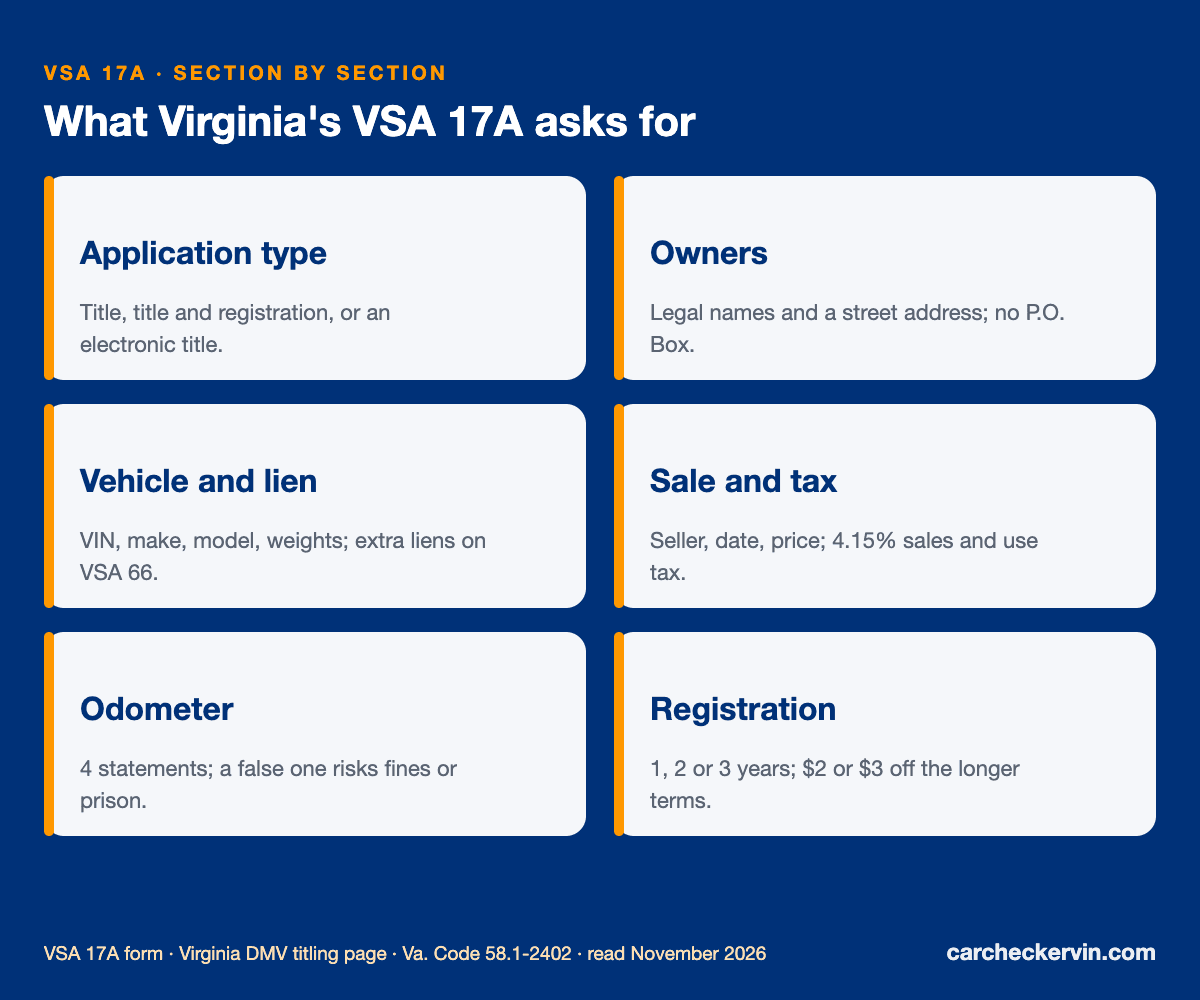
The form opens with the application type: a title, a title and registration with license plates, or an electronic title, where DMV keeps the title on file and no paper copy is issued. Joint owners are asked whether ownership should pass to the survivor if one of them dies.
Owner details come next, with a hard rule: the residence or business address can't be a P.O. Box, and changing an address on file takes form ISD-01. Then the vehicle, any lien (a second lien goes on form VSA 66), how and from whom you bought the car, the price, and the sales and use tax.
The VSA 17A at a glance
- Covers: passenger vehicles, motorcycles, trucks, motor homes and trailers.
- Filed at: any Virginia DMV customer service center.
- Title fee: $15, per the DMV's titling page.
- Sales and use tax: 4.15% of the sale price, $75 minimum.
- Extra liens: on form VSA 66, attached.
The VSA 17A's Sections and What Each One Needs
Read from the form itself. Each section has its own documents behind it.
| Section | What it asks | Have ready |
|---|---|---|
| Application type | Title, title and registration, or electronic title | Decide whether you want plates now |
| Owner information | Legal names, ID or SSN, street address, garaging location | Address proof; no P.O. Box |
| Vehicle information | Make, model, year, body, VIN, axles, weights, color, fuel | The title or Manufacturer's Certificate of Origin |
| Lien information | Date of first lien and lienholder; more liens on VSA 66 | Your loan paperwork |
| Source of ownership | New, used or demonstrator; seller; date; price; tax | Bill of sale or buyer's order |
| Odometer statement | One of 4 mileage statements | The current reading |
| Car tax relief | Business-use questions for personal property tax relief | How the car is used |
| Insurance and registration | Insurer, registration period and type, plate | Insurance company name |
Read on the VSA 17A PDF in November 2026. Virginia requests the Social Security Number under Va. Code 46.2-623 and 46.2-629; the form says refusing to give required information means the certificate is denied.
The Odometer and Insurance Certifications
The odometer section is the one with legal weight. Federal and state law require the mileage at a transfer, and the form offers 4 statements: the reading is the actual mileage, it's beyond the odometer's mechanical limits, it is not the actual mileage, or the car was exempt from disclosure in the state it was last titled in. The form warns that a false statement can bring fines or prison.
The insurance certification is a promise, not a formality: you certify the vehicle is covered by a liability policy from an insurer licensed in Virginia and will stay insured while registered, whether or not it's driven.
Sales and Use Tax and the Title Fee
Virginia's motor vehicle sales and use tax is set by Va. Code 58.1-2402: 4.15% of the sale price for sales on or after July 1, 2016. The same section sets a $75 minimum on any taxable sale, with exemptions listed in 58.1-2403. The VSA 17A has a box for the tax in its source-of-ownership section.
On top of the tax, the DMV's titling page lists a $15 titling fee, and asks for proof of the purchase price: a buyer's order, a bill of sale or the price the seller declared on the title. It also offers a drop-off option with pickup in 3–5 days.
Buying a Used Car in Virginia? Check It First
The VSA 17A asks you to swear to the mileage. Our free preview shows the title brands, salvage records and odometer readings already on file.
Registration Choices on the Form
If you take plates at the same time, the VSA 17A's registration section has a few decisions in it.
One year
The standard registration period.
Two years
A $2 discount, per the form.
Three years
A $3 discount, but not available in emissions areas.
Plate transfer
Move a plate you already have by entering its number.
Special plates
Virginia offers more than 200 unique plates; some need a certification form.
Car tax relief
Answer the business-use questions so a personal car qualifies.
Virginia on CarCheckerVIN
Virginia buyers check a lot of cars here. Between August 1 and October 31, 2026, 134 VIN lookups on CarCheckerVIN came from Virginia, covering 108 different vehicles: 3.9% of the 3,470 US lookups with a known state, the 7th-highest of the 51 states and districts we saw.
The order matters. The VSA 17A records the sale; a VIN check before you sign tells you whether the title you're about to transfer carries a brand from another state.
Related Checks and Guides
More Virginia guides and the checks that go with a title transfer.
Where These Facts Come From
Everything here comes from the form, Virginia DMV's own page and the Code of Virginia.
How we made this page: written by the CarCheckerVIN editorial team with AI assistance, from the VSA 17A form, Virginia DMV's titling page and the Code of Virginia, read in November 2026. The Virginia lookup figures are our own count from the site's lookup log, August 1–October 31, 2026, aggregated by state.
VSA 17A — Frequently Asked Questions
Filling it in, fees and tax.
Where do I file the VSA 17A?+
At any Virginia DMV customer service center, by the form's own instructions.
Can I use a P.O. Box on the VSA 17A?+
Not for the residence or business address. The form says that address can't be a P.O. Box; a separate mailing address can be added.
What is the electronic title option?+
A choice on the form to have DMV keep the certificate of title electronically. No paper title is issued.
How is Virginia sales tax on a car calculated?+
At 4.15% of the sale price under Va. Code 58.1-2402, with a $75 minimum. Exemptions are listed in 58.1-2403.
What if there's more than one lien?+
The VSA 17A has room for the first lien. Additional liens go on form VSA 66, attached to the application.
Is a three-year registration always cheaper?+
The form gives a $3 discount for three years and $2 for two, but the three-year option isn't available in emissions areas.
Does the VSA 17A need to be notarized?+
The form doesn't call for a notary. You and any co-applicant sign it to certify the information is true and correct.
Check the VIN Before You Sign the Title Over
Enter any 17-character VIN for a free preview of its title brands and odometer readings. The full report is $14.99 once and lists title brands, NMVTIS junk and salvage records, insurance total-loss records, odometer readings, and auction records with the damage the auction recorded and its photos.
This page summarizes a Virginia DMV form for general information and is not legal advice. Fees and rules were read in November 2026; confirm current amounts with Virginia DMV. CarCheckerVIN is not affiliated with the Virginia Department of Motor Vehicles. Records in our reports reflect what was reported to our data providers. Our reports do not include police or repair-shop accident entries.
Related VIN Checks
More tools to verify any vehicle's history