What does “as is — no warranty” mean?
It is a checkbox on the FTC Buyers Guide, and the FTC permits it only where state law allows. It does not automatically mean you have no recourse — and the window form legally outranks anything the contract says against it.
On an as-is car, the history is the protection
Title brands, flood and salvage records — before you sign.
No account · Nothing stored · $14.99 only for the full report
Quick Answer
- What does “As Is — No Warranty” mean?
- It is a box on the FTC Buyers Guide, the window form a covered dealer must display. Ticking it means the dealer is offering no warranty, written or implied. But the FTC only permits that version “if state law allows it”— in states that limit or prohibit eliminating implied warranties, the dealer must use the “Implied Warranties Only” version instead.
- Does it mean I have no recourse at all?
- No — and anyone telling you otherwise is overstating it. Whether an as-is sale actually removes implied warranties depends on your state. It also never licenses a dealer to lie: a misrepresentation is a different problem from a car that simply broke.
- What is the most useful thing to know?
- That the window form beats the paperwork. Every covered sales contract must state that information on the window form “overrides any contrary provisions in the contract of sale.” If the Guide says Warranty and the contract says as is, the Guide wins.
Where the phrase actually comes from
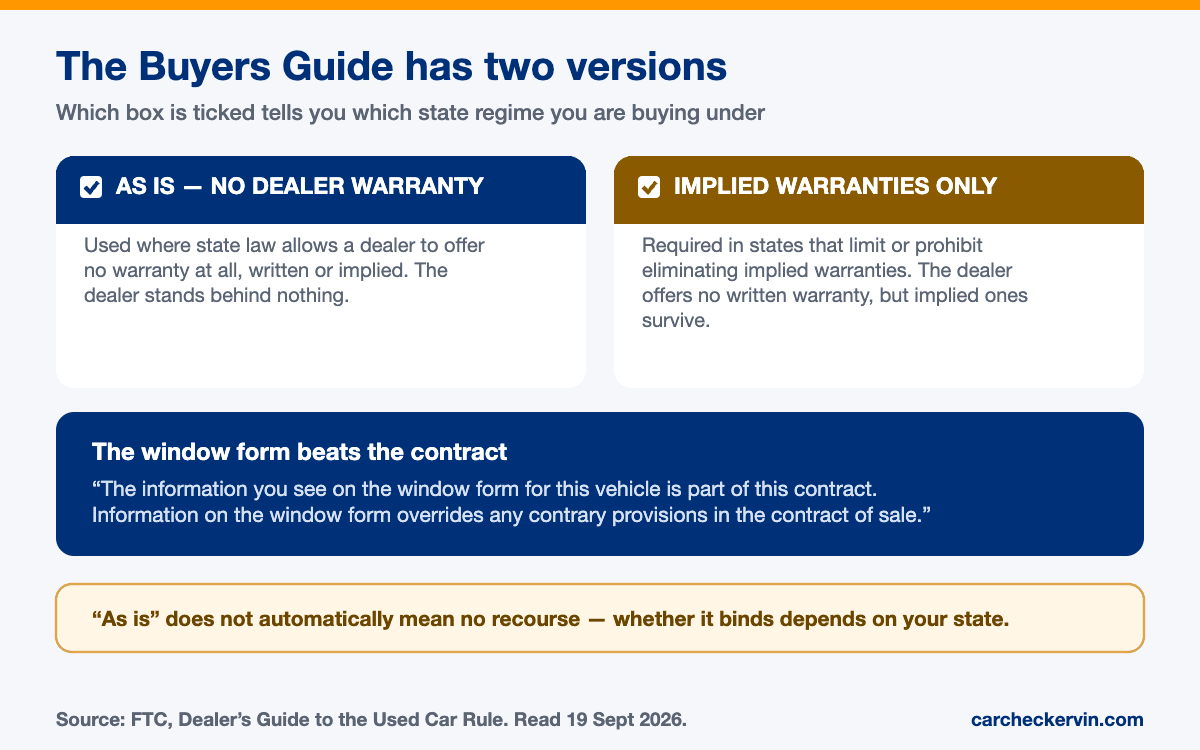
It is not sales patter. “As Is — No Dealer Warranty” is a heading on the Buyers Guide, the window form the FTC's Used Car Rule requires a covered dealer to display before a car is shown at all. The Buyers Guide has two versions: One says "As Is-No Dealer Warranty;" the other says "Implied Warranties Only."
Which version is on the glass is therefore information, not decoration. It tells you what the dealer is offering and, indirectly, what your state permits them to offer.
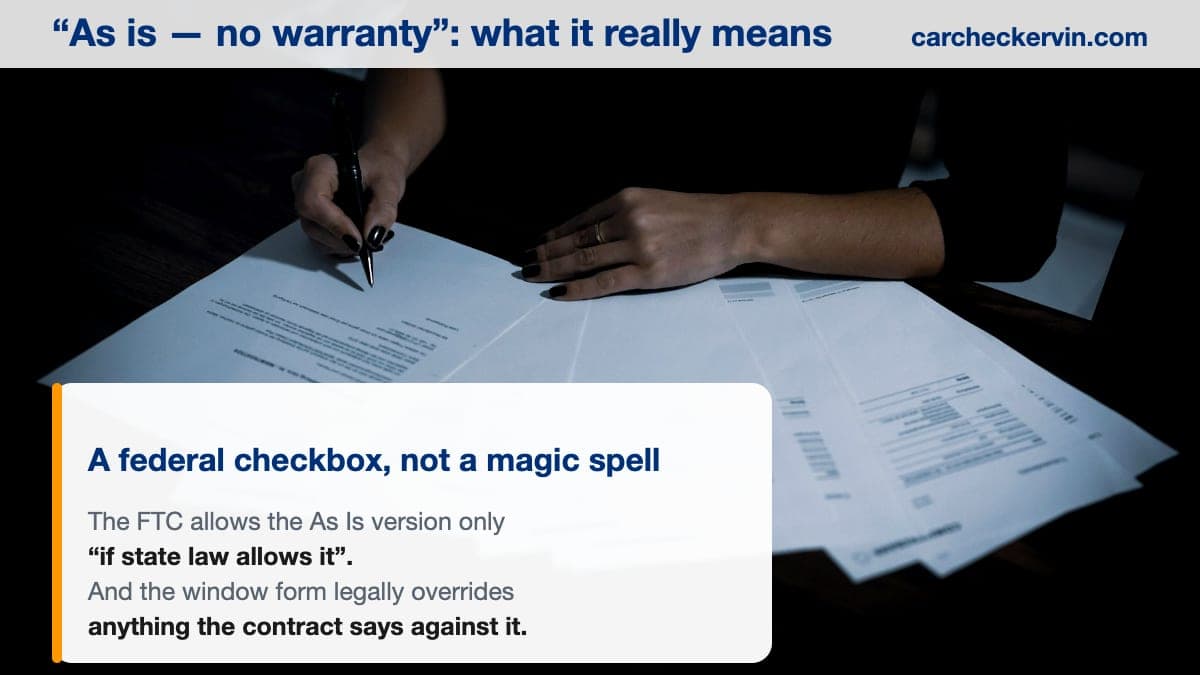
It does not mean what most people think
The common belief is that “as is” is absolute — you signed, so you own the problem. The FTC's own guidance to dealers does not read that way:
“If state law allows it, and you choose not to offer a warranty — written or implied — you must use the “As Is” version and check the box next to the heading “As Is-No Dealer Warranty” on the Guide.”
“If state law allows it” is doing a great deal of work in that sentence. The FTC continues: “In some states, use of the “As Is-No Dealer Warranty” Buyers Guide may be legally sufficient to eliminate implied warranties. In other states “as is” sales are allowed only if specific action is taken or certain language is used.”
We deliberately do not publish a list of which states do what. There is no single authoritative source for that, and getting it wrong could convince someone with a real claim that they have none. The FTC directs dealers to their state Attorney General on exactly this point — that is the right address for a buyer too.
The sentence worth photographing
If you take one thing from this page, take this. Every covered sales contract must carry a specific disclosure, and it settles what happens when the paperwork disagrees with itself:
“The information you see on the window form for this vehicle is part of this contract. Information on the window form overrides any contrary provisions in the contract of sale.”
So if the Buyers Guide on the window shows a warranty and the contract inside says the car is sold as is, the window form wins. Photograph the Guide before you sign. It costs nothing, it takes a second, and it is the evidence that outranks the contract.
As is means the history is your only warranty
Title brands, salvage and flood records before you sign — $14.99, no account.
Where the Guide must be, and where it must not
The display rules are strict, and a dealer ignoring them is worth noticing before you get to the price:
- “The Buyers Guide must be displayed prominently and conspicuously on or in a vehicle when a car is available for sale. This means it must be in plain view and both sides must be visible.”
- “A Guide in a glove compartment, trunk or under the seat is not conspicuous because it is not in plain sight.”
- “You may remove the Guide for a test drive, but you must replace it as soon as the test drive is over.”
- “If you conduct a used car transaction in Spanish, you must post a Spanish language Buyers Guide on the vehicle before you display or offer it for sale.”
Dealers who violate the Used Car Rule may be subject to penalties of up to $53,088 per violation in FTC enforcement actions.
What the FTC tells dealers to tell you
The Guide itself carries advice for buyers. It is worth reading as a checklist, not least because one item is the federal regulator telling you to do exactly what this site exists for:
- that oral promises are difficult to enforce
- to get all promises in writing
- to ask to have the car inspected by an independent mechanic before they buy
- to get a vehicle history report and to visit ftc.gov/usedcars for information on how to get a vehicle history report, how to check for safety recalls, and other topics
- to ask for a Spanish Buyers Guide if the sale is conducted in Spanish
- to keep the Buyers Guide for reference after the sale
What to do before you sign an as-is deal
- 1
Photograph the Buyers Guide
Both sides, on the car, before any paperwork. It becomes part of the contract and overrides contrary terms — but only if you can show what it said.
- 2
Check which version is ticked
As Is — No Dealer Warranty, or Implied Warranties Only. That single box tells you which regime you are buying under.
- 3
Get every promise in writing
The FTC's own advice. An oral assurance that the dealer will 'sort it out' is, in its words, difficult to enforce.
- 4
Have it inspected independently
Also the FTC's advice, and more important on an as-is car than any other, because nobody is standing behind it afterwards.
- 5
Run the VIN
An as-is sale removes the dealer's promises, not the car's past. Title brands, salvage, flood and odometer history are $14.99 and cannot be talked away.
Sources
- FTC — Dealer's Guide to the Used Car Rule
The two Buyers Guide versions, the As Is box, the contract-override wording, display rules and the penalty ceiling. Read 19 September 2026.
- FTC Consumer Advice — Buying a Used Car From a Dealer
The consumer-facing companion to the Used Car Rule. Read 19 September 2026.
- NMVTIS — U.S. Department of Justice
The Justice Department's consumer entry point for the National Motor Vehicle Title Information System. Read 19 September 2026.
- NHTSA Recalls by VIN
The federal safety-recall lookup: free, by VIN, covering unrepaired recalls.
Always check the VIN before you buy
The free preview shows title brands, theft status and open recalls in seconds, and flags whether accident and odometer records exist. The full history is $14.99 — one-time, no subscription.
Keep reading
Frequently asked questions
Is an “as is” sale legally binding?+
Usually, but not automatically and not everywhere. The FTC's guidance to dealers is explicit that the As Is version may be used only "if state law allows it", and that "In states that limit or prohibit the elimination of implied warranties, you must use the “Implied Warranties Only” version and check the box next to the “Implied Warranties Only” if you don't offer a written warranty." So the honest answer is that it depends on your state — and your state Attorney General, which is who the FTC points dealers to, can tell you which regime applies.
Can I return a car sold as is?+
Generally no, and there is no federal cooling-off period for vehicle purchases. But 'as is' governs the car's condition, not the truth of what you were told. If the dealer misrepresented the vehicle — its history, its title, its mileage — that is a different claim from a part failing after the sale, and as-is does not license it.
What is the difference between the two Buyers Guide versions?+
The Buyers Guide has two versions: One says "As Is-No Dealer Warranty;" the other says "Implied Warranties Only." The As Is version is for dealers offering no warranty where state law permits that. The Implied Warranties Only version is required in states that limit or prohibit eliminating implied warranties. Which one is on the glass tells you which regime you are in.
What if the contract contradicts the window sticker?+
The window sticker wins, and this is the single most valuable thing on this page. Every covered sales contract must carry the disclosure: "The information you see on the window form for this vehicle is part of this contract. Information on the window form overrides any contrary provisions in the contract of sale." Photograph the Guide before you sign — it is evidence, and it outranks the contract.
Where does the dealer have to display it?+
"The Buyers Guide must be displayed prominently and conspicuously on or in a vehicle when a car is available for sale. This means it must be in plain view and both sides must be visible." And explicitly: "A Guide in a glove compartment, trunk or under the seat is not conspicuous because it is not in plain sight." A dealer may take it off for a test drive but "You may remove the Guide for a test drive, but you must replace it as soon as the test drive is over." If no Guide is displayed on a covered dealer's car, that is itself a compliance failure worth asking about.
Does any of this apply to a private seller?+
No. The Used Car Rule binds sellers of more than five used vehicles in a 12-month period, and it applies in every state except Maine and Wisconsin. A private individual owes you no Buyers Guide at all, which is why a private sale is a different risk with different protections.
What happens to a dealer who ignores the Rule?+
"Dealers who violate the Used Car Rule may be subject to penalties of up to $53,088 per violation in FTC enforcement actions." The FTC also notes that many states have similar laws, and some incorporate the Used Car Rule by reference, so state and local officials may be able to act too.
Does the Buyers Guide have to be in Spanish?+
If the transaction is conducted in Spanish, yes: "If you conduct a used car transaction in Spanish, you must post a Spanish language Buyers Guide on the vehicle before you display or offer it for sale." Buyers can and should ask for it.
What should I do before signing an as-is deal?+
Treat the car's history as the warranty you are not getting. The FTC's own Guide tells dealers to advise buyers "to get a vehicle history report and to visit ftc.gov/usedcars for information on how to get a vehicle history report, how to check for safety recalls, and other topics" Running the VIN for title brands, flood and salvage records costs $14.99 and is the closest thing to protection an as-is sale allows.
Check it before you sign
An as-is sale removes the dealer's promises, not the car's past — $14.99.
Related VIN Checks
More tools to verify any vehicle's history