What is a catalytic converter?
A chamber in the exhaust that turns regulated pollutants into less harmful gases. Two things follow that most explanations skip: removing one is a federally prohibited act, and on a lot of used cars it is still under warranty.
Buying a car that needs one?
Check the record before you accept the discount.
No account · Nothing stored · $14.99 only for the full report
Quick Answer
- What does a catalytic converter do?
- It drives chemical reactions on the exhaust as it flows through, converting regulated pollutants into less harmful gases. The name is literal — it converts rather than filters, which is why there is no element inside to replace.
- Is it illegal to remove one?
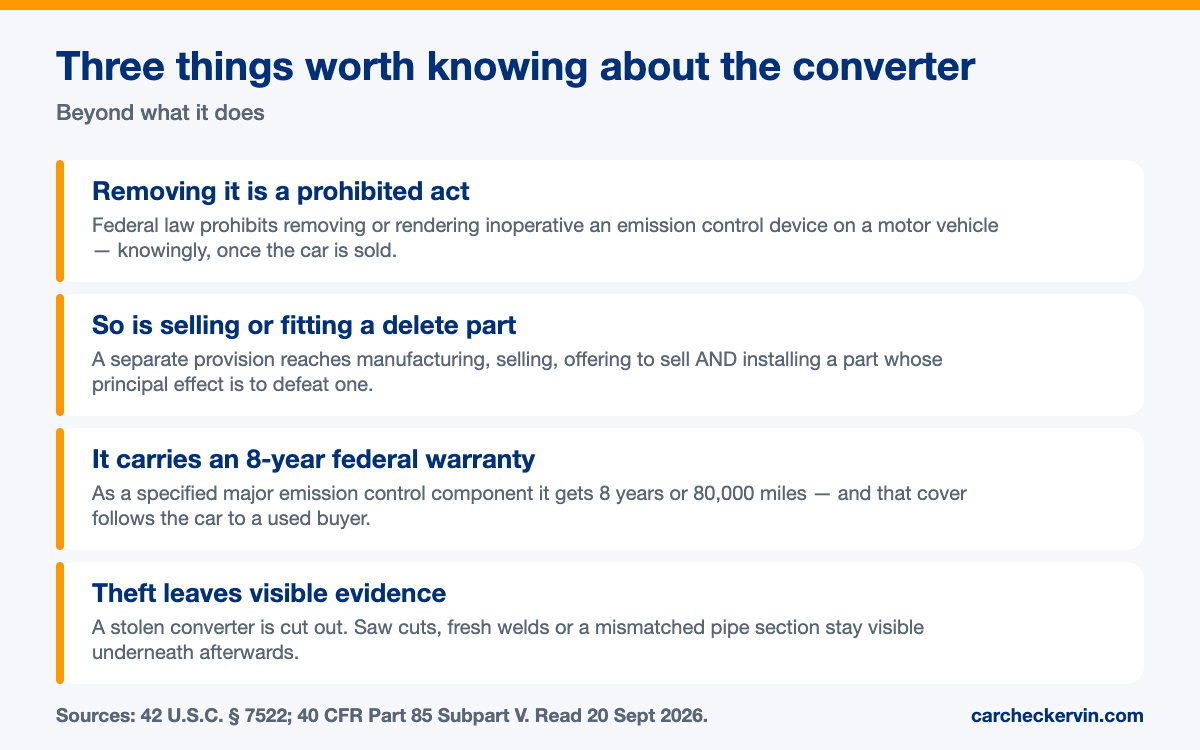
- On a motor vehicle, yes — federal law makes it a prohibited act to remove or render inoperative an emission control device, and separately to sell or install a part whose principal effect is to defeat one. It is not a grey-area modification.
- Could mine still be under warranty?
- Quite possibly. It is one of the specified major emission control components, which carry 8 years or 80,000 miles of federal emissions warranty — and that coverage follows the car to a used buyer.
What it actually does
1It converts, it does not filter
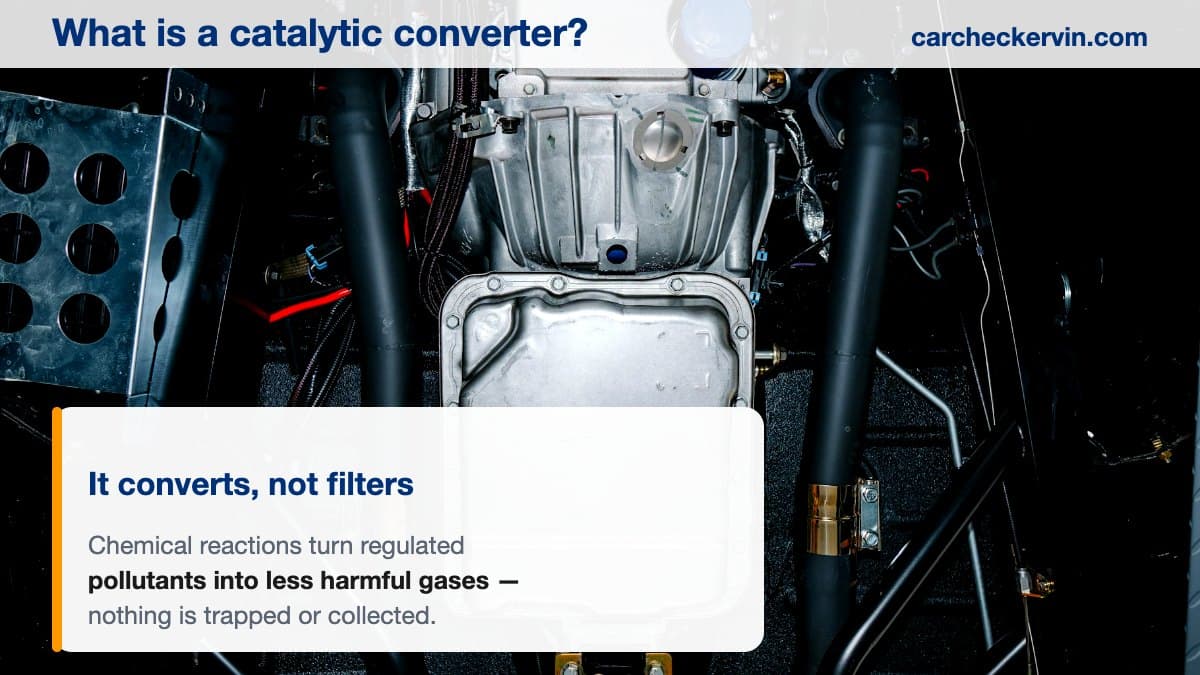
The name is literal. It is a chamber of coated substrate that drives chemical reactions on the exhaust as it passes through, turning regulated pollutants into less harmful gases. Nothing is collected or trapped, which is why there is no element to change.
2It needs heat to work
The reactions only run once the converter is hot, which is why a cold start is the dirtiest part of any journey and why very short trips are hard on the emissions system.
3It is monitored, not just fitted
On a modern car the engine computer watches the converter's performance using oxygen sensors before and after it. A converter that has stopped working efficiently sets a fault and illuminates the malfunction indicator lamp.
4It is a federally required emission control device
That status is what brings it inside both the tampering prohibition and the federal emissions warranty. It is not an accessory, and it is not optional equipment.
Removing one is a prohibited act
This is stated more plainly in federal law than most people expect. It is not framed as a warranty consequence or an emissions test problem — it is a prohibited act in its own right:
“for any person to remove or render inoperative any device or element of design installed on or in a motor vehicle or motor vehicle engine in compliance with regulations under this subchapter prior to its sale and delivery to the ultimate purchaser, or for any person knowingly to remove or render inoperative any such device or element of design after such sale and delivery to the ultimate purchaser”
Before the vehicle reaches its first buyer the prohibition is unqualified. After that point it applies to removing or disabling the device KNOWINGLY.
A second provision targets the part rather than the act, which is what reaches the shop selling a delete pipe:
“for any person to manufacture or sell, or offer to sell, or install, any part or component intended for use with, or as part of, any motor vehicle or motor vehicle engine, where a principal effect of the part or component is to bypass, defeat, or render inoperative any device or element of design installed on or in a motor vehicle or motor vehicle engine in compliance with regulations under this subchapter, and where the person knows or should know that such part or component is being offered for sale or installed for such use or put to such use”
Note the verbs: manufacture, sell, offer to sell, install. The prohibition does not stop at the car's owner.
Check the record before you accept the discount
Title brands, theft and salvage records, reported mileage and open recalls — $14.99, no account.
It may still be under warranty
The converter is one of the specified major emission control components, which carry 8 years or 80,000 miles under the federal emissions warranty — and that warranty is written to follow the vehicle rather than its first buyer.
“Owner means the original purchaser or any subsequent purchaser of a vehicle.”
That is the single most valuable thing on this page for someone being quoted for a converter on a used car. The full picture — both warranties, the periods, and what a manufacturer may ask you to prove — is on the emissions warranty page.
What this means when you are buying
1A failed emissions test often means this part
It is the most common expensive cause of a failure. If a seller is discounting a car because it 'needs a cat', establish first whether the manufacturer still owes that repair under the federal emissions warranty.
2A cat delete is not a modification, it is a prohibited act
Buying a car with the converter removed or defeated means buying a car that cannot legally pass and may not be registrable where you live — and putting it right is your bill.
3An aftermarket replacement may not be compliant
Replacement converters are not interchangeable commodities. One that does not meet the requirements for that vehicle can fail the test just as a missing one does.
4Theft leaves evidence
A converter cut out of a car is removed with a saw, and the cuts stay visible on the pipe. Fresh welds or mismatched sections under a car are worth asking about.
We publish no replacement prices and no theft statistics here, because no primary source in front of us gives them. Figures circulating for both vary enormously by vehicle and by place, and a number invented for the sake of completeness would be worse than none.
Sources
- 42 U.S.C. § 7522 — Prohibited acts (Clean Air Act § 203)
The prohibition on removing or rendering inoperative an emission control device on a motor vehicle, and on manufacturing, selling or installing a part whose principal effect is to defeat one. Read from govinfo, USCODE-2023-title42 on 2026-09-20.
- 40 CFR Part 85, Subpart V — Emission Control System Performance Warranty
The warranty periods that make a catalytic converter a 8-year/80,000-mile component, and the definition of owner that carries it to a subsequent purchaser.
- NHTSA Recalls by VIN
The federal safety-recall lookup: free, by VIN, covering unrepaired recalls.
Always check the VIN before you buy
The free preview shows title brands, theft status and open recalls in seconds, and flags whether accident and odometer records exist. The full history is $14.99 — one-time, no subscription.
Keep reading
Frequently asked questions
What is a catalytic converter, simply?+
A chamber in the exhaust containing a coated substrate. Exhaust gas passes over it and chemical reactions convert regulated pollutants into less harmful gases. It converts rather than filters — nothing is trapped, so there is no element to change.
Why does it need to be hot?+
Because the reactions only run at temperature. That is why a cold start is the dirtiest part of a journey, and why a car used only for very short trips is hard on its emissions system.
How does the car know the converter has failed?+
It watches it. The engine computer compares oxygen sensor readings before and after the converter, and a converter that is no longer working efficiently sets a fault and turns on the malfunction indicator lamp — the check engine light.
Is removing a catalytic converter actually illegal?+
On a motor vehicle it is a prohibited act under federal law: "for any person to remove or render inoperative any device or element of design installed on or in a motor vehicle or motor vehicle engine in compliance with regulations under this subchapter prior to its sale and delivery to the ultimate purchaser, or for any person knowingly to remove or render inoperative any such device or element of design after such sale and delivery to the ultimate purchaser" Before the vehicle reaches its first buyer the prohibition is unqualified. After that point it applies to removing or disabling the device KNOWINGLY.
What about a 'cat delete' pipe?+
Covered by a separate provision aimed at the part itself: "for any person to manufacture or sell, or offer to sell, or install, any part or component intended for use with, or as part of, any motor vehicle or motor vehicle engine, where a principal effect of the part or component is to bypass, defeat, or render inoperative any device or element of design installed on or in a motor vehicle or motor vehicle engine in compliance with regulations under this subchapter, and where the person knows or should know that such part or component is being offered for sale or installed for such use or put to such use" So the prohibition reaches manufacturing, selling, offering to sell AND installing — not only the vehicle owner.
Is the converter covered by a warranty?+
It is one of the specified major emission control components, which carry 8 years or 80,000 miles under the federal emissions warranty — far longer than most manufacturer bumper-to-bumper cover, and the regulation defines an owner as the original purchaser or any subsequent purchaser.
The seller says the car just needs a cat. What should I do?+
Work out the car's in-service date and mileage before you agree a discount. If it is inside the federal emissions warranty window, the manufacturer may owe that repair at no cost to you, which makes the discount you are being offered the wrong number.
How can I tell if a converter has been stolen or removed?+
Look underneath. A stolen converter is cut out, and saw cuts, fresh welds or a mismatched section of pipe stay visible afterwards. A car that is unusually loud from cold is worth putting on a lift before you buy it.
Does a vehicle history report show this?+
Not the part itself — no record tracks whether a specific converter is present. What the $14.99 report shows is the context: title brands, theft records, salvage and flood history and open recalls. Combine that with a look underneath and an emissions test result.
Check the car's history
Title brands, theft records and open recalls — $14.99.
Related VIN Checks
More tools to verify any vehicle's history