What is a lien on a car — and why buyers check first.
A lien is a lender's recorded claim on a car — collateral until the loan is paid and a release filed. Routine when financing; dangerous in a private sale, where the lender can repossess a car you already paid for.
Check any VIN's title record — free to start
17-character VIN → title status, brands and flags, before any payment.
Free preview · no card, no account
Quick Answer
- What is a lien on a car, in plain English?
- A lien is a lender's legal claim on the vehicle— the security interest a bank, credit union or finance company records against the title until the loan it secures is paid off. The driver has the keys; the lienholder has the title. Until a release is filed, the car is collateral, not fully the seller's to hand over.
- Is a lien on a car bad?
- Not by itself — most financed cars carry one; it's how auto loans work. It becomes dangerous at sale time: buy a car with an open lien and an unpaid loan, and the lender can repossess it from you, even though you paid the seller. The problem isn't the lien existing — it's a lien nobody told you about.
- How do I find out if a car has a lien before buying?
- The lien lives in the title record: the lienholder is printed on the certificate of title, and the state DMV holds the electronic status. Start from the 17-character VIN— the check above reads the NMVTIS-backed title status and brand history free, and the issuing state's DMV can confirm the lien itself.
Four lien situations every used-car deal falls into
The same word covers four very different positions. Find the row you're standing in — the risk and the move change completely:
| The situation | What the lien means here | Your move |
|---|---|---|
| You're financing your own car | Routine — the lender records its interest and holds the title until payoff | Nothing to fix; the lien clears automatically when the loan does |
| Seller's car has an open loan | The seller can't transfer clear ownership until the lienholder is paid | Get the payoff letter and pay the lender directly — never the seller on trust |
| Seller says "the loan is paid off" | Only a recorded lien release makes that true — words don't clear titles | Ask for the release document, or verify with the issuing state's DMV |
| Nobody mentioned a lien at all | The dangerous case: an undisclosed claim that survives the sale | Run the VIN's title record before money moves — every time |
The pattern across all four rows: the paper title and the recorded lien status decide everything, and the seller's story decides nothing. Liens are facts on file, which is exactly why they're checkable.
How liens end up on cars
Auto loans write most of them, but not all — four claims can attach to a title:
The auto-loan lien
Finance a car and the lender records a security interest with the state DMV, appearing on the title as lienholder. In most states the lender holds the title itself until payoff — the reason a financed seller often can't produce it at the point of sale.
The title-loan lien
Borrowing cash against a paid-off car puts a new lien on it. These loans carry aggressive terms, and a seller unloading a title-loaned car may be racing their own repossession — a strong reason their "quick sale" needs your slow check.
Mechanic's, storage and judgment liens
Unpaid repair or storage bills and court judgments can also attach claims to a vehicle, depending on state law. They're rarer, but they're precisely the liens a private seller is least likely to mention — and least able to paper over.
What an open lien does to a sale
Three consequences follow a lien into every transaction, and none of them care who has the keys:
The title isn't the seller's to give
With an open lien, the lienholder's claim rides ahead of the buyer's. The seller can take your money, but they can't convey clear ownership — the one thing you were actually buying.
Repossession outlives the handshake
If the loan behind the lien goes unpaid, the lender's remedy is the car — wherever it is, whoever paid for it. That's the risk an undisclosed lien quietly transfers from the seller's driveway to yours.
Your registration hits a wall
Even in the gentler case, an unreleased lien stalls the title transfer — leaving you with a car you can't register in your name while the paperwork untangles. Cheap to prevent, painful to unwind.
The lien question is a title question. Ask the VIN.
Title status, brands and record counts for any 17-character VIN — free, before any seller conversation gets serious.
From loan to clear title — the moment that matters
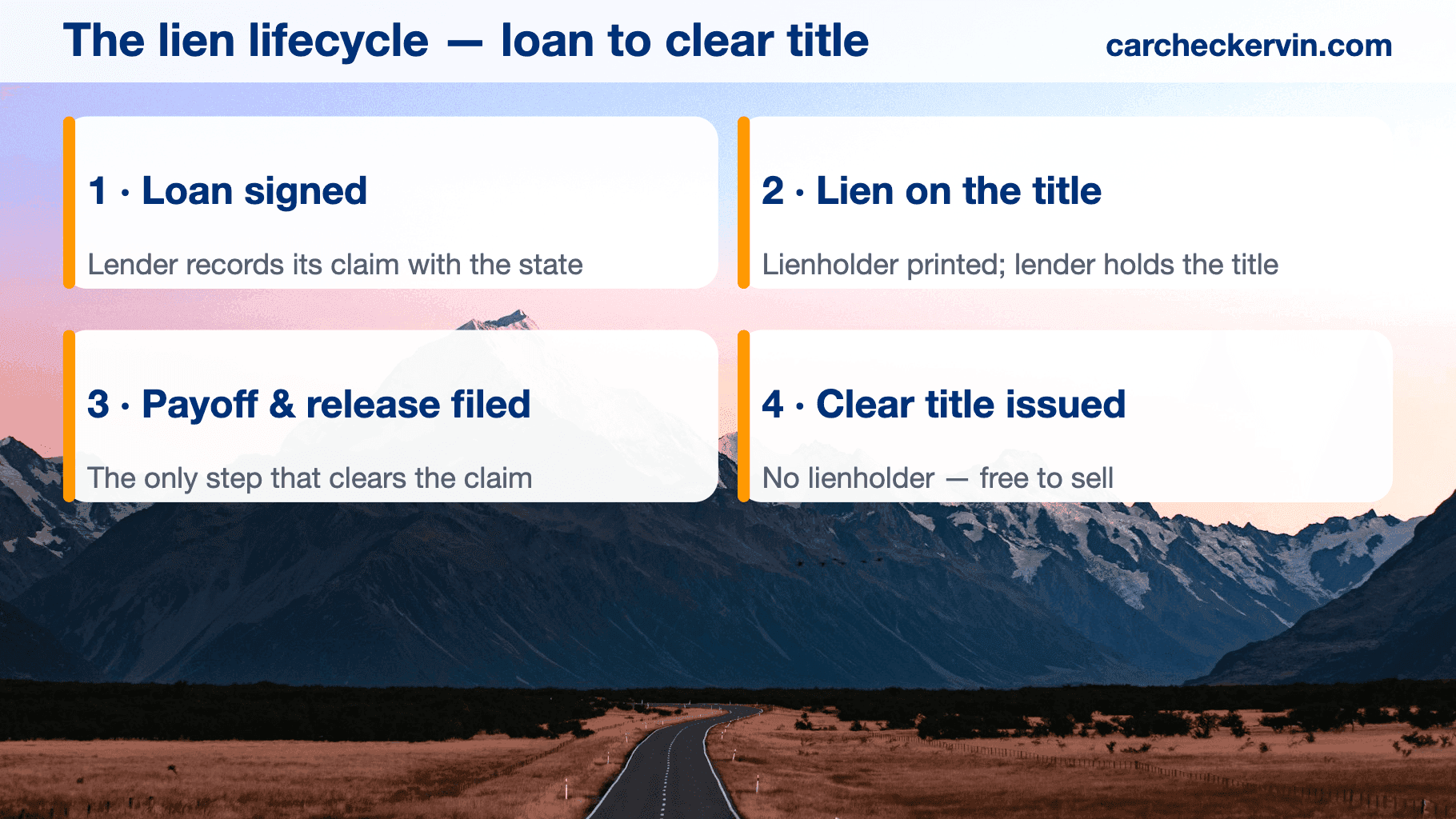
Every lien follows the same arc, and one step in it is the whole game. The loan is signed and the lender records its security interest with the state DMV — from that moment the lienholder appears on the certificate of title, and in most states holds the title outright. Then comes the step buyers should care about: the lender files a lien release, and the DMV issues a fresh title with no lienholder — a clear title. Everything before that filing is an open lien, whatever anyone says out loud. That's why the safest financed-car purchase runs through the lender or the DMV counter: payoff straight to the lienholder, release recorded on the spot, clear title issued while everyone is still in the room. A seller's promise to "pay it off next week" asks you to fund the gap — with your car as the stake.
What the VIN check reads from the title record
The lien itself is recorded at the state DMV — and the title record around it is exactly what a VIN check reads. Six things the $14.99 report surfaces before you're standing in anyone's driveway:
Title status and state chain
Which state issued the current title and how ownership has moved — including the cross-state transfers where recorded liens occasionally fail to follow.
Brands on the title
Salvage, rebuilt, flood and junk brands across all reporting states. Branded titles and lien complications travel together on problem cars.
Odometer at each transfer
The reading recorded every time the title changed hands — rollbacks live in the same title chain liens do, and get caught the same way.
Total-loss and salvage filings
Insurer write-offs that explain why a title was reissued — context that makes sense of a car's lien and title history.
Vehicle identity, decoded
Year, make, model, trim and plant confirmed against the VIN — because cloned VINs are one way a financed or stolen car hides in plain sight.
Auction lanes and photos
Wholesale appearances with photos where available — the venue where lien-troubled and repossessed cars most often resurface.
The honest boundary: lienholder names live with the state DMV and on the title document itself — no consumer report replaces reading them there. What the VIN check does is put the whole title record in front of you first, so you know exactly which questions the seller has to answer.
Vetting several candidates?
Private-party shopping means a shortlist, and every car on it deserves the same title read. Packs keep the arithmetic friendly — with the free preview filtering who earns a paid report:
At $9.00 a report on the 10-pack, title-checking an entire shortlist costs less than one hour of the legal help an undisclosed lien eventually requires.
The rest of the lien question
From definition to verification, page by page.
Always check the VIN before you buy
The free preview shows title brands, theft status and open recalls in seconds, and flags whether accident and odometer records exist. The full history is $14.99 — one-time, no subscription.
Car liens — what people actually ask
The plain-English answers, including the ones that send you to the DMV.
What is a lienholder on a car?+
The party whose claim is recorded against the vehicle — usually the bank, credit union or finance company that funded the loan. The lienholder appears on the certificate of title, and in most states holds the title itself until the loan is paid. When the balance clears, the lienholder files a lien release and the state issues a clear title with no one listed.
Is it bad to buy a car that has a lien on it?+
It's routine when handled correctly and dangerous when handled on trust. The safe sequence: confirm the lien, get the lender's written payoff letter, pay the payoff amount directly to the lienholder — not the seller — and close where the release can be recorded, at the lender or the DMV. What's genuinely bad is paying a seller in full and hoping they settle their loan afterwards.
Can someone sell me a car without telling me about the lien?+
They can try — and this is the scenario the whole checking habit exists for. The lien doesn't vanish because it went unmentioned: the lender's claim survives the sale, and an unpaid loan can end in repossession from the new owner's driveway. The defense is procedural, not personal: read the title, run the VIN's title record, and verify with the issuing state's DMV before paying.
What's the difference between a lien and a loan?+
The loan is the debt; the lien is the lender's recorded claim on the car that secures it. Pay the loan and the lien has no reason to exist — but it only actually disappears when the lender files the release and the state reissues the title. That gap between "paid" and "released" is where sales go wrong, which is why buyers ask for the release document, not the payoff story.
Does a lien show up on the car's title?+
Yes — that's precisely where it's recorded. The lienholder is printed on the certificate of title, and the state DMV maintains the electronic status behind it. That's also why a seller who "can't find the title" on a financed car often isn't being careless: their lender is holding it, which is itself the fact you needed to know.
How is a lien removed from a car?+
By ending the claim that created it: the secured debt gets paid, the lienholder files a lien release with the state, and the DMV issues a new title with no lienholder listed. For disputed claims — a mechanic's or judgment lien the owner contests — the route runs through whoever filed it or the courts, not the DMV counter. Either way, removal is a recorded event, checkable in the title record.
Will a vehicle history report show me the lienholder's name?+
No consumer report substitutes for the title document and the state DMV on that — lienholder names live there, and honest products say so. What the $14.99 VIN report gives a buyer is the title record around the lien question: title status, the state chain, brands, odometer at each transfer and total-loss filings — the file that tells you which questions to make the seller answer, with the DMV as the final word.
Every lien is on file somewhere. Read the file first.
Start with the VIN: title status, brands and record counts free, and the full NMVTIS-backed report for $14.99 when a car gets serious.
Related VIN Checks
More tools to verify any vehicle's history