What is TPMS?
The tire pressure monitoring system — the equipment behind that horseshoe shaped light. The part worth knowing is how flat a tire has to be before it lights, and that federal rules require a second warning for a fault in the system itself.
Test-driving a car with the light on?
Find out what else the car is not telling you — run the VIN.
No account · Nothing stored · $14.99 only for the full report
Quick Answer
- What is TPMS?
- A tire pressure monitoring system — the equipment behind the horseshoe shaped warning light on your dashboard. Federal rules require it on most vehicles rated at 10,000 pounds GVWR or less, so it warns you when a tire goes significantly flat.
- How flat is the tire when the light comes on?
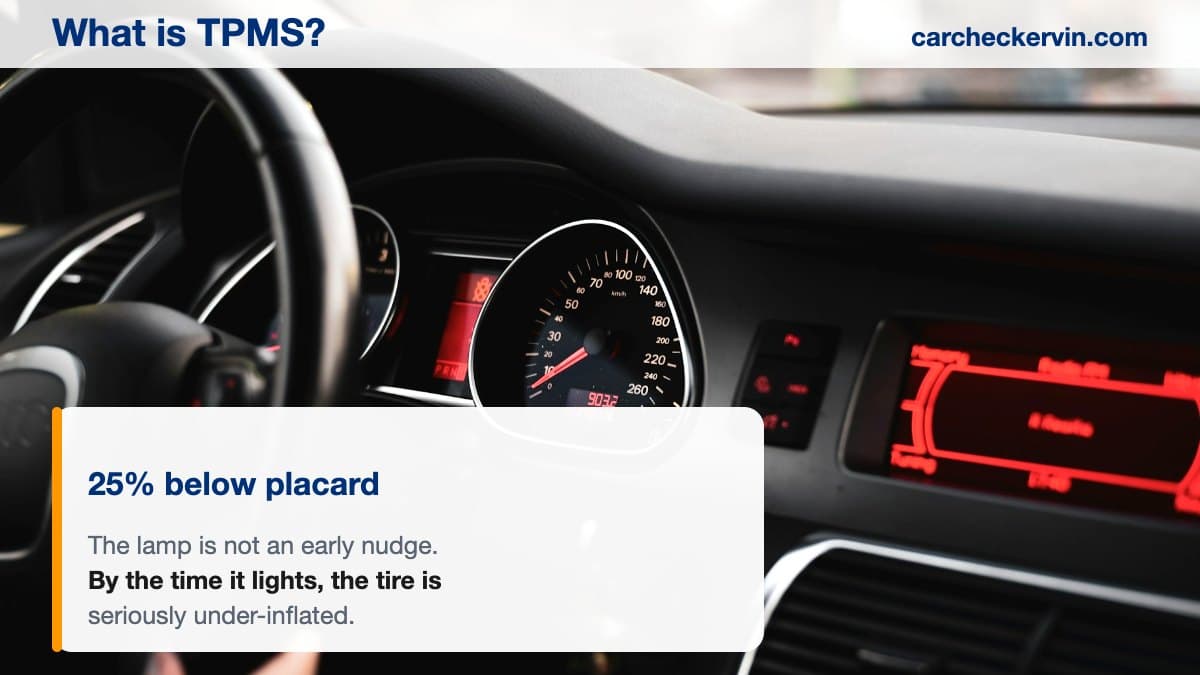
- Much flatter than most people assume. The lamp must illuminate when pressure falls to 25 percent or more below the pressure your car's placard asks for. It is a warning, not an early nudge — by then the tire is badly under-inflated.
- Why won't my TPMS light go off after inflating?
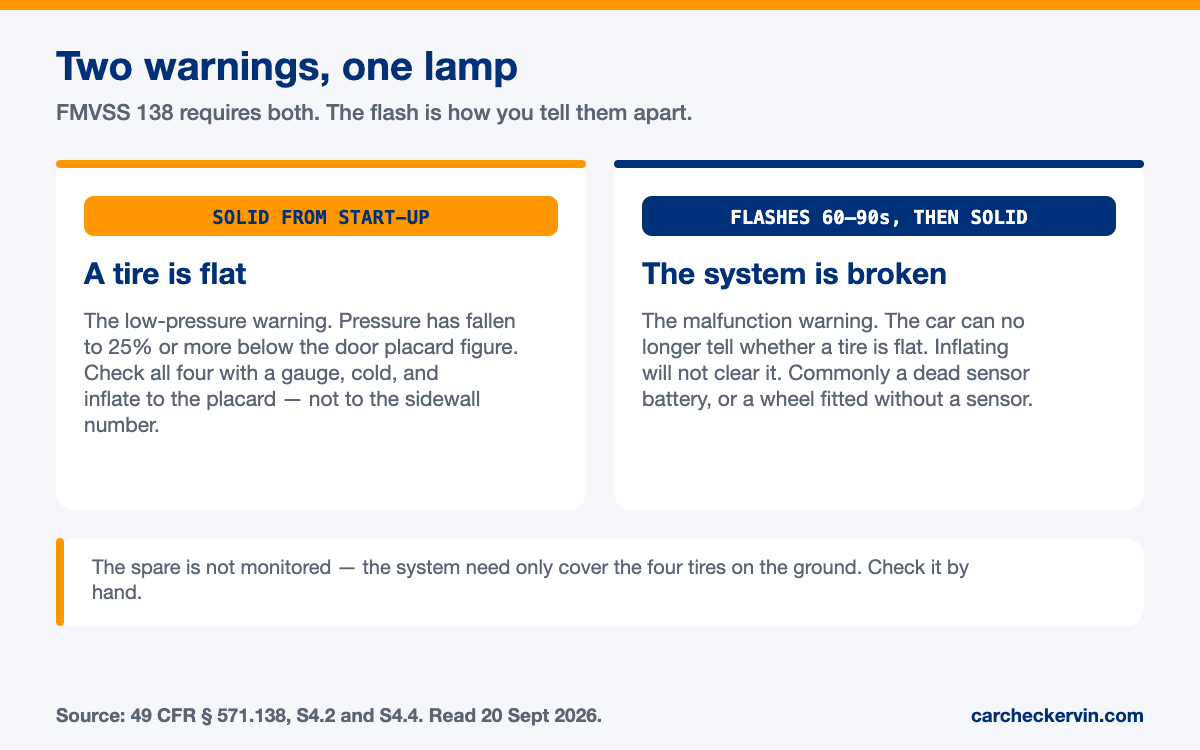
- Because it may not be the low-pressure warning at all. The rules require a separate indication when the system itself malfunctions — on a shared lamp, a flash of 60–90 seconds at start-up before it goes solid. A light that survives correct inflation usually points at the system, commonly a dead sensor.
What the system is for
A TPMS watches the pressure in your tires and warns you when one goes significantly flat. The standard that requires it states the job in a single sentence:
“This standard specifies performance requirements for tire pressure monitoring systems (TPMSs) to warn drivers of significant under-inflation of tires and the resulting safety problems.”
Note the word significant. The system was never designed to tell you a tire is a few pounds soft, and reading it as a precision gauge is the most common mistake people make with it.
How flat is flat enough to trigger it
This is the number that reframes the light. The rule sets both a threshold and a deadline:
“Illuminate a low tire pressure warning telltale not more than 20 minutes after the inflation pressure in one or more of the vehicle's tires, up to a total of four tires, is equal to or less than either the pressure 25 percent below the vehicle manufacturer's recommended cold inflation pressure, or the pressure specified in the 3rd column of Table 1 of this standard for the corresponding type of tire, whichever is higher.”
25 percent below the pressure on your door placard is a long way down. A tire that should be at its placard figure is meaningfully flat by the time the lamp appears — running hotter, wearing at the shoulders and steering worse. The trigger is whichever of those two pressures is HIGHER, so on some tires the lamp lights before the 25 percent point is reached.
The system must monitor up to 4 tires — the ones on the ground. Your spare is not among them, which is why a space-saver can sit flat in the boot for years with no warning at all. Check it by hand.
A warning light is a question, not a verdict
Title brands, flood and salvage records, reported mileage and open recalls — $14.99, no account.
The second warning almost nobody explains
Here is the part that resolves most confused searching about this light. The standard requires a separate indication when the monitoring system itself goes wrong:
“The vehicle shall be equipped with a tire pressure monitoring system that includes a telltale that provides a warning to the driver not more than 20 minutes after the occurrence of a malfunction that affects the generation or transmission of control or response signals in the vehicle's tire pressure monitoring system.”
So there are two distinct messages your car can send you with the same piece of dashboard: a tire is flat, and I can no longer tell whether a tire is flat. They call for completely different responses, and confusing them is why people inflate all four tires and watch the lamp stay on.
Which vehicles must have one
Not all of them, and the exceptions are worth knowing before you conclude a car is faulty:
“This standard applies to passenger cars, multipurpose passenger vehicles, trucks, and buses that have a gross vehicle weight rating of 4,536 kilograms (10,000 pounds) or less, except those vehicles with dual wheels on an axle, according to the phase-in schedule specified in S7 of this standard.”
Two carve-outs matter in practice. Anything rated above 10,000 pounds GVWR is outside the standard, and so is any vehicle running dual wheels on an axle — so a dually pickup with no tire pressure light is not necessarily broken. The requirement also arrived on a phase-in schedule, so age matters on older cars.
Why some cars name the tire and others do not
Both behaviours are compliant. The standard permits a telltale that identifies the offending wheel, and specifies how it must work if fitted:
“In the case of a telltale that identifies which tire(s) is (are) under-inflated, each tire in the symbol for that telltale must illuminate when the tire it represents is under-inflated.”
A car with a plain generic lamp is not cheaping out on safety — it is meeting the same requirement with less information. Either way the lamp has to sit where you will see it: “Is mounted inside the occupant compartment in front of and in clear view of the driver.”
What to do when the light is on
- 1
Check all four with a gauge, cold
Placard pressure is a cold figure. Checking after a drive reads high and can convince you nothing is wrong when something is.
- 2
Inflate to the door placard, not the sidewall
The sidewall number is the tire's maximum, not your car's target. The placard in the driver's door opening is the figure the system is measuring against.
- 3
Drive, then see whether it clears
A genuine low-pressure warning should go out once pressure is correct. Give it a few minutes of driving — the system is allowed time to respond.
- 4
If it stays on, suspect the system
A lamp that survives correct inflation is pointing at itself. Sensors contain batteries and do die with age, and a wheel changed at some point in the car's life may never have had one fitted.
- 5
Treat it as a negotiating item on a used car
A fault you find before buying is a price conversation. The same fault found afterwards is just your bill — as is everything else the seller did not mention, which is what the $14.99 history check is for.
Sources
- 49 CFR § 571.138 — FMVSS No. 138 — Tire pressure monitoring systems
The standard behind the light: which vehicles must have a system, the 25 percent trigger, the 20-minute limit on illuminating, and the separate malfunction warning required by S4.4. Read 2026-09-20.
- NHTSA Recalls by VIN
The federal safety-recall lookup: free, by VIN, covering unrepaired recalls.
Always check the VIN before you buy
The free preview shows title brands, theft status and open recalls in seconds, and flags whether accident and odometer records exist. The full history is $14.99 — one-time, no subscription.
Keep reading
Frequently asked questions
What does TPMS stand for?+
Tire pressure monitoring system. The standard describes its job plainly: "This standard specifies performance requirements for tire pressure monitoring systems (TPMSs) to warn drivers of significant under-inflation of tires and the resulting safety problems."
Which vehicles are required to have it?+
"This standard applies to passenger cars, multipurpose passenger vehicles, trucks, and buses that have a gross vehicle weight rating of 4,536 kilograms (10,000 pounds) or less, except those vehicles with dual wheels on an axle, according to the phase-in schedule specified in S7 of this standard." Two things follow: a heavy-duty vehicle above 10,000 pounds GVWR is outside the rule, and so is anything running dual wheels on an axle — so a dually pickup may legitimately have no system at all.
Exactly when must the light come on?+
"Illuminate a low tire pressure warning telltale not more than 20 minutes after the inflation pressure in one or more of the vehicle's tires, up to a total of four tires, is equal to or less than either the pressure 25 percent below the vehicle manufacturer's recommended cold inflation pressure, or the pressure specified in the 3rd column of Table 1 of this standard for the corresponding type of tire, whichever is higher." The trigger is whichever of those two pressures is HIGHER, so on some tires the lamp lights before the 25 percent point is reached.
So is a lit light an emergency?+
Treat it as urgent rather than catastrophic. At 25 percent below placard the tire is running hot, wearing badly and handling worse, and the rule exists because that state causes crashes. Check all four with a gauge — the system need only monitor up to 4 tires, and a spare is not among them.
Why do some cars show which tire is low?+
Because the standard allows a per-tire telltale and specifies how it must behave: "In the case of a telltale that identifies which tire(s) is (are) under-inflated, each tire in the symbol for that telltale must illuminate when the tire it represents is under-inflated." A car with a plain generic lamp is equally compliant — it simply tells you less.
What is a TPMS malfunction warning?+
A second, distinct requirement. "The vehicle shall be equipped with a tire pressure monitoring system that includes a telltale that provides a warning to the driver not more than 20 minutes after the occurrence of a malfunction that affects the generation or transmission of control or response signals in the vehicle's tire pressure monitoring system." It is a warning about the monitoring system, not about the air in your tires.
How do I tell the two warnings apart?+
By the flash. Where one lamp does both jobs, the standard prescribes the pattern exactly: "Flashes for a period of at least 60 seconds but no longer than 90 seconds upon detection of any condition specified in S4.4(a) after the ignition locking system is activated to the “On” (“Run”) position. After each period of prescribed flashing, the telltale must remain continuously illuminated as long as a malfunction exists and the ignition locking system is in the “On” (“Run”) position." So a malfunction announces itself by flashing for 60 to 90 seconds from start-up before going solid, while a genuine low-pressure warning is solid immediately. "This flashing and illumination sequence must be repeated each time the ignition locking system is placed in the “On” (“Run”) position until the situation causing the malfunction has been corrected." Some vehicles instead fit a dedicated telltale: "The vehicle meets the requirement when equipped with a dedicated TPMS malfunction telltale mounted inside the occupant compartment in front of and in clear view of the driver."
Where is the light, and what does the symbol look like?+
"Is mounted inside the occupant compartment in front of and in clear view of the driver." "Is identified by one of the symbols shown for the “Low Tire Pressure” Telltale in Table 1 of Standard No. 101 (49 CFR 571.101)." In practice it is the cross-section of a tire with an exclamation mark — the shape people describe as a horseshoe or a cupped hand.
What does this mean when I'm buying a used car?+
A TPMS light that is on during a test drive is a question you should ask, not ignore. If correct inflation does not clear it, you are likely looking at a system fault. Sensors have batteries and do fail with age, and replacement is a genuine cost — one worth settling before money changes hands rather than after. The car's wider record, including open recalls, comes from the $14.99 history check.
Check the car's history
Title brands, flood records and open recalls — $14.99.
Related VIN Checks
More tools to verify any vehicle's history