What Are the Best SUVs to Buy: A Buyer's Guide to Finding the Right One
From $28,000 compact crossovers to $80,000 full-size haulers, finding the best SUV means weighing reliability data, total ownership cost, and title history — not just trim badges.
Check the car you're reading about
Free VIN decode and recall check
Factory specs and open NHTSA recalls in seconds. No sign-up.
On this page· 9
- How Reliability Data Actually Gets Measured — and Why It Matters
- The Compact Class: What Are the Best SUVs to Buy Under $40,000
- Midsize SUVs: Three-Row Utility vs. Real-World Trade-Offs
- Full-Size SUVs: What Are the Best Large SUVs for 2026
- Electric and Plug-In Hybrid SUVs: The Emerging Value Equation
- Used SUVs and the Hidden Costs Buyers Routinely Underestimate
- Financing Strategies: Lease to Own vs. Traditional Auto Loan
- Cost vs. Risk: Weighing a New SUV Against a CPO or Private-Party Used Unit
- Extended Warranties and Service Contracts: What the Fine Print Actually Says

Anyone asking what are the best SUVs to buy in the current market faces a deceptively complex decision: SUVs now account for roughly 58 percent of all new-vehicle sales in the United States, according to the Alliance for Automotive Innovation's 2025 data, which means the segment is flooded with options ranging from genuinely engineered workhorses to badge-engineered cost-cuts dressed in plastic cladding. A buyer who chooses on styling alone and skips a vehicle history report can inherit a rebuilt-title machine, an odometer rollback, or a frame that was straightened after a flood event catalogued in NMVTIS — the National Motor Vehicle Title Information System maintained by the U.S. Department of Justice. The goal of this guide is to cut through the marketing and give a careful buyer a framework: which platforms have earned their reliability reputations through longitudinal owner data, which cost categories get overlooked at the dealership, and what contract language to watch before any money changes hands.
The short answer
For most buyers, the Toyota RAV4 Hybrid, Honda CR-V, and Kia Telluride represent the strongest combination of reliability, resale value, and total-cost efficiency across compact and midsize classes — but the 'best' SUV is the one whose title is clean, whose ownership costs fit your budget, and whose powertrain warranty still has meaningful coverage remaining.
How Reliability Data Actually Gets Measured — and Why It Matters
Consumer Reports publishes an annual reliability survey drawing on responses from roughly 300,000 vehicles owned by subscribers, scoring models on a 0-to-100 scale across 17 trouble areas including engine, transmission, and infotainment. J.D. Power's Vehicle Dependability Study, meanwhile, measures problems per 100 vehicles (PP100) among three-year-old models — a lower score is better — and its 2025 results placed the Toyota RAV4 at 142 PP100, well below the industry average of 190 PP100 for compact SUVs. These aren't vanity metrics; a platform with chronic transmission complaints at 60,000 miles will cost the buyer real money in repair bills, rental cars, and resale haircuts that never appear on the window sticker.
What Reliability Scores Don't Capture
Reliability surveys measure reported problems, not repair costs. A vehicle with modest PP100 scores but expensive proprietary parts — certain European crossovers carry dealer-only module costs exceeding $1,800 per unit — can be more expensive to own than a statistically 'less reliable' Japanese platform with readily available aftermarket components. Buyers should cross-reference reliability rankings with average annual repair cost data from sources such as RepairPal, which pegs the national average annual repair cost for SUVs at approximately $573, and compare that figure against the specific model they're considering before committing.
The Compact Class: What Are the Best SUVs to Buy Under $40,000
The compact SUV segment — vehicles priced roughly between $28,000 and $40,000 new — is the most competitive battleground in the U.S. market, and for good reason: these vehicles deliver the cargo utility most families actually need without the fuel and insurance penalties attached to three-row models. The Toyota RAV4 Hybrid starts at approximately $33,500 MSRP and returns an EPA-estimated 38 mpg combined, which at national average fuel prices translates to meaningful five-year savings over its non-hybrid stablemate. The Honda CR-V, redesigned on a thoroughly validated platform, earns a Consumer Reports reliability prediction score of 5 out of 5 — the highest available — making it the benchmark against which most rivals are measured.
Subaru's Forester and Outback deserve mention for buyers in northern states where standard all-wheel drive matters: Subaru's Symmetrical AWD comes standard across virtually every trim, unlike competitors that charge $1,500 to $2,000 to add AWD. However, Subaru's EyeSight driver-assistance camera system is sensitive to calibration after windshield replacements, and that calibration service runs $200 to $400 at a dealer — a recurring cost worth factoring in for high-hail-risk ZIP codes.
- Toyota RAV4 Hybrid: ~$33,500 MSRP, 38 mpg combined (EPA), 142 PP100 (J.D. Power 2025 VDS).
- Honda CR-V: Consumer Reports 5/5 predicted reliability; hybrid variant adds ~$3,000 over base.
- Subaru Forester: Standard AWD saves $1,500–$2,000 vs. competitors; windshield recalibration adds $200–$400 per service.
- Mazda CX-5: Consistently ranked in the top three for long-term dependability by Consumer Reports; premium interior without European pricing.
- Hyundai Tucson Hybrid: 10-year/100,000-mile powertrain warranty (Hyundai Motor America) is the class benchmark for coverage length.
Midsize SUVs: Three-Row Utility vs. Real-World Trade-Offs
Three-row midsize SUVs — the Kia Telluride, Hyundai Palisade, Toyota Highlander, and Honda Pilot — target buyers who need to seat seven or eight but cannot stomach full-size truck-based running costs. The Kia Telluride has won the MotorTrend SUV of the Year award multiple times and consistently fetches at or above MSRP on the used market, reflecting genuine consumer confidence rather than artificial scarcity. Telluride's powertrain — a 3.8-liter V6 rated at 291 horsepower — pairs with an eight-speed automatic transmission that has shown strong durability in owner surveys, and Kia backs it with that same 10-year/100,000-mile powertrain warranty that Hyundai carries across its lineup.
The Honda Pilot, completely redesigned, added a TrailSport variant aimed at buyers who want light off-road credibility without paying Jeep Grand Cherokee L pricing. Toyota's Highlander Hybrid remains the fuel-efficiency leader in the class at an EPA-estimated 36 mpg combined in front-wheel-drive configuration, a figure that separates it meaningfully from V6 competitors averaging 22–24 mpg combined. Buyers considering a used midsize SUV should pull a VIN check early in the process — vehicles in this price bracket are frequent auction-lane regulars after off-lease returns, and NMVTIS brands do not always migrate cleanly between state DMV databases.
Full-Size SUVs: What Are the Best Large SUVs for 2026
Full-size body-on-frame SUVs — the Chevrolet Tahoe, GMC Yukon, Ford Expedition, and their luxury derivatives — carry a base price floor around $57,000 and can crest $90,000 in loaded Denali or Platinum trim. The Chevrolet Suburban remains the default choice for buyers who genuinely need maximum passenger and cargo capacity simultaneously; its wheelbase of 130 inches provides a third-row experience that compressed unibody rivals simply cannot match. However, fuel economy averages 15 mpg combined for the standard V8 (EPA), which at 15,000 miles per year and current national average gas prices represents a fuel cost roughly $800–$1,000 higher annually than a midsize hybrid alternative.
The Ford Expedition's 3.5-liter EcoBoost twin-turbocharged V6 matches or exceeds the Tahoe's 355-horsepower V8 output while returning slightly better observed fuel economy in real-world driving per owner surveys on FuelEconomy.gov, which is operated by the U.S. Department of Energy. Buyers financing at this price point should be aware that auto loan interest is not tax deductible for most consumers under current IRS guidelines — the Tax Cuts and Jobs Act of 2017 eliminated the personal interest deduction — though business buyers using the SUV for qualified business purposes may be able to deduct interest and depreciation under IRS Section 179.
Electric and Plug-In Hybrid SUVs: The Emerging Value Equation
The federal EV tax credit under the Inflation Reduction Act — up to $7,500 for qualifying new electric SUVs purchased through a licensed dealer, subject to income and MSRP caps — has meaningfully altered the math for buyers considering vehicles like the Chevrolet Equinox EV (base price approximately $34,995 before incentives) or the Ford Mustang Mach-E. The IRS income caps are $150,000 adjusted gross income for single filers and $300,000 for joint filers, which effectively targets the credit at middle-income buyers rather than affluent early adopters.
Plug-in hybrid variants such as the Toyota RAV4 Prime and Jeep Wrangler 4xe allow buyers to offset daily fuel costs while retaining range confidence on long trips — the RAV4 Prime carries a 42-mile all-electric range (EPA), enough for most American round-trip commutes under the U.S. Department of Transportation's average commute figure of approximately 27 miles each way. The trade-off is charging infrastructure dependency: buyers in multi-unit housing without dedicated parking frequently report difficulty accessing Level 2 charging, which reduces the plug-in hybrid's value proposition considerably.
Used SUVs and the Hidden Costs Buyers Routinely Underestimate
The used SUV market carries risks that do not appear on a Monroney sticker. NMVTIS — established under 49 U.S.C. § 30502 and administered by the DOJ's Bureau of Justice Assistance — requires insurers, salvage yards, and junkyards to report total-loss and salvage events within specified timeframes, but reporting gaps remain, particularly for vehicles processed through smaller independent salvage operators in states with inconsistent enforcement. A vehicle history report surfaces NMVTIS-sourced title brands and reported odometer readings, but it does not capture every accident or mechanical failure — two realities a buyer must internalize before treating any report as a clean bill of health.
Rebuilt engines cost significantly more than buyers often anticipate when shopping used SUVs with high mileage: a professionally rebuilt motor for a popular V6 platform runs $3,500 to $6,500 in parts and labor at independent shops, according to RepairPal national averages, while dealer-installed short blocks on newer models can push $8,000 or higher. Rebuilt motors and rebuilt engines sourced from low-cost remanufacturers may carry only 90-day warranties — a stark contrast to the 36,000-mile or 3-year coverage that typically accompanies a new powertrain. Buyers examining used SUVs with high miles should request a pre-purchase inspection from an independent mechanic and ask explicitly about compression readings and evidence of coolant intrusion.
Watch for Auction-Lane Units at Retail Prices
A significant share of used SUVs on independent dealer lots and BHPH (buy here, pay here) operations were purchased at Copart or IAA Insurance Auto Auctions — platforms that sell salvage, flood, and run-and-drive units. BHPH dealers are not always required by state law to disclose auction history verbally; the FTC Used Car Rule (16 C.F.R. Part 455) mandates a Buyers Guide disclosure of warranty status but does not require disclosure of auction source. Run a VIN check before you negotiate, not after.
Financing Strategies: Lease to Own vs. Traditional Auto Loan
A lease to own car arrangement — more precisely, a lease with a purchase option exercised at contract end — is increasingly common in the SUV segment as manufacturers use residual value guarantees to lower monthly payments. A buyer who leases a $45,000 midsize SUV at a 55 percent residual over 36 months, then exercises the purchase option, may pay less total interest than a 72-month traditional loan at prevailing rates, provided the residual is set at or below actual market value at lease end. The catch: lease contracts typically restrict mileage to 10,000–15,000 miles per year, and excess-mileage charges run $0.15 to $0.30 per mile — a buyer who drives 20,000 miles annually could owe $1,500 to $3,000 in penalties at turn-in.
As noted above regarding full-size SUV financing, auto loan interest is not tax deductible for personal use under current IRS rules — a point that surprises buyers who remember the pre-1986 Tax Reform Act environment when consumer interest was broadly deductible. Business-use buyers should consult a CPA regarding Section 179 expensing and bonus depreciation rules, which allow immediate deduction of a qualifying SUV's purchase price up to applicable limits set by the IRS each tax year.
Cost vs. Risk: Weighing a New SUV Against a CPO or Private-Party Used Unit
The spread between a new compact SUV and a two-year-old certified pre-owned (CPO) equivalent has narrowed considerably as new-car inventory normalized post-2023. A new Toyota RAV4 Hybrid at $33,500 versus a two-year-old CPO unit at $28,500 represents a $5,000 price gap — but the new vehicle carries full factory warranty coverage while the CPO unit's remaining factory coverage is typically supplemented by a Toyota-backed extension to 7 years/100,000 miles from original sale date. If the CPO unit is already 24 months old, the buyer is purchasing 5 years of remaining powertrain coverage, which is materially less than buying new.
Private-party purchases widen the risk corridor substantially. A private seller is not required by federal law to provide a Buyers Guide, and many states allow 'as-is' sales without any implied warranty of merchantability. The buyer assumes full mechanical and title risk. That risk calculates differently depending on a few variables: the age and mileage of the vehicle, the availability of a pre-purchase inspection, and whether a vehicle history report reveals any NMVTIS flags. At roughly $5,000–$8,000 below comparable dealer pricing on popular midsize SUVs, the private-party discount can be compelling — but a single undisclosed transmission failure costing $4,500–$6,000 can erase that entire advantage before the first oil change under new ownership.
- Identify your use case first: daily commuting, weekend hauling, off-road, or maximum passenger capacity — each favors a different platform.
- Pull a vehicle history report and cross-reference any NMVTIS title brand with your state DMV to confirm current title status.
- Get an independent pre-purchase inspection (typically $100–$200) at a mechanic who has no financial relationship with the seller.
- Calculate total ownership cost over 60 months: payment, insurance, fuel at your actual annual mileage, expected maintenance, and residual value.
- Confirm warranty coverage dates and mileage in writing — CPO coverage is tied to the original in-service date, not the purchase date from you.
- If financing, compare the APR on a traditional auto loan against a lease-to-own structure using the same total price and your actual annual mileage.
- Check for open recalls using NHTSA's safercar.gov database, which is free and updated in near-real-time by the National Highway Traffic Safety Administration.
Extended Warranties and Service Contracts: What the Fine Print Actually Says
Extended warranties — more accurately called vehicle service contracts under FTC terminology — are governed at the state level, with many states requiring providers to maintain reserves or post surety bonds. The FTC's Magnuson-Moss Warranty Act (15 U.S.C. § 2301 et seq.) does not mandate that any seller offer an extended warranty, but it does require that any warranty offered be made available for inspection before purchase — a right buyers frequently waive by not asking to read the contract before signing. Dealer-offered service contracts add an average of $1,500 to $3,500 to the purchase transaction, and finance managers are typically paid significant back-end commissions on their sale.
Third-party service contracts from providers such as Endurance or CARCHEX vary widely in coverage scope; the most common consumer complaint, documented by the Consumer Financial Protection Bureau in its complaint database, involves claim denials citing 'pre-existing conditions' and 'lack of maintenance records.' Buyers who want extended coverage on a new or CPO SUV are almost always better served by the manufacturer's own extended warranty — Toyota's ToyotaCare Plus and Honda's Care plans, for instance, are administered by the manufacturer and service at any brand dealership nationwide, eliminating the third-party authorization bottleneck that generates most complaints.
What to do next
Before you visit a single dealer, run a vehicle history report on any used SUV you are seriously considering — it takes under two minutes, surfaces NMVTIS title brands and reported accidents, and gives you concrete negotiating leverage or a reason to walk away before you've invested time in a test drive.
About the author
CarCheckerVIN Editorial Team
In-house automotive research team
The CarCheckerVIN editorial team combines decades of automotive industry, dealer, and journalism experience to produce trustworthy buying, selling, and ownership guidance backed by NMVTIS, NICB, and manufacturer data.
See more of our guides on Google
Add CarCheckerVIN as a preferred source and Google will show our guides more often in your results.

Frequently asked questions
- What's the most reliable SUV to purchase?
- Based on J.D. Power's 2025 Vehicle Dependability Study and Consumer Reports' annual survey, the Toyota RAV4 and Honda CR-V consistently rank at the top of the compact class, while the Kia Telluride leads the midsize segment. Hyundai and Kia's 10-year/100,000-mile powertrain warranty — the longest standard coverage in the mainstream market — provides additional financial protection if reliability concerns arise.
- Which SUV is number 1?
- No single model holds every top ranking simultaneously, but the Toyota RAV4 is the best-selling SUV in the United States by volume, according to industry sales data tracked by the Alliance for Automotive Innovation, and it ranks near the top for reliability, resale value, and total ownership cost. The Kia Telluride frequently wins awards for the midsize class from MotorTrend and Consumer Reports.
- What was the best crossover SUV in 2018?
- The 2018 Honda CR-V and Toyota RAV4 were the dominant compact crossovers that year, both earning top marks from Consumer Reports. The Mazda CX-5 also earned consistent praise for driving dynamics and interior quality. Buyers considering a 2018-vintage SUV today should check for any NHTSA recalls via safercar.gov and run a vehicle history report to verify title status and reported mileage before purchase.
- What are the best large SUVs for 2026?
- For 2026, the Chevrolet Tahoe and Suburban remain the volume leaders in the full-size body-on-frame class, with the Ford Expedition offering a competitive turbocharged V6 alternative. For buyers prioritizing luxury, the Cadillac Escalade and Lincoln Navigator command premium prices above $80,000 but offer materially upgraded interiors. Fuel cost remains the primary ownership penalty in this class at roughly 15 mpg combined per EPA ratings.
Keep reading
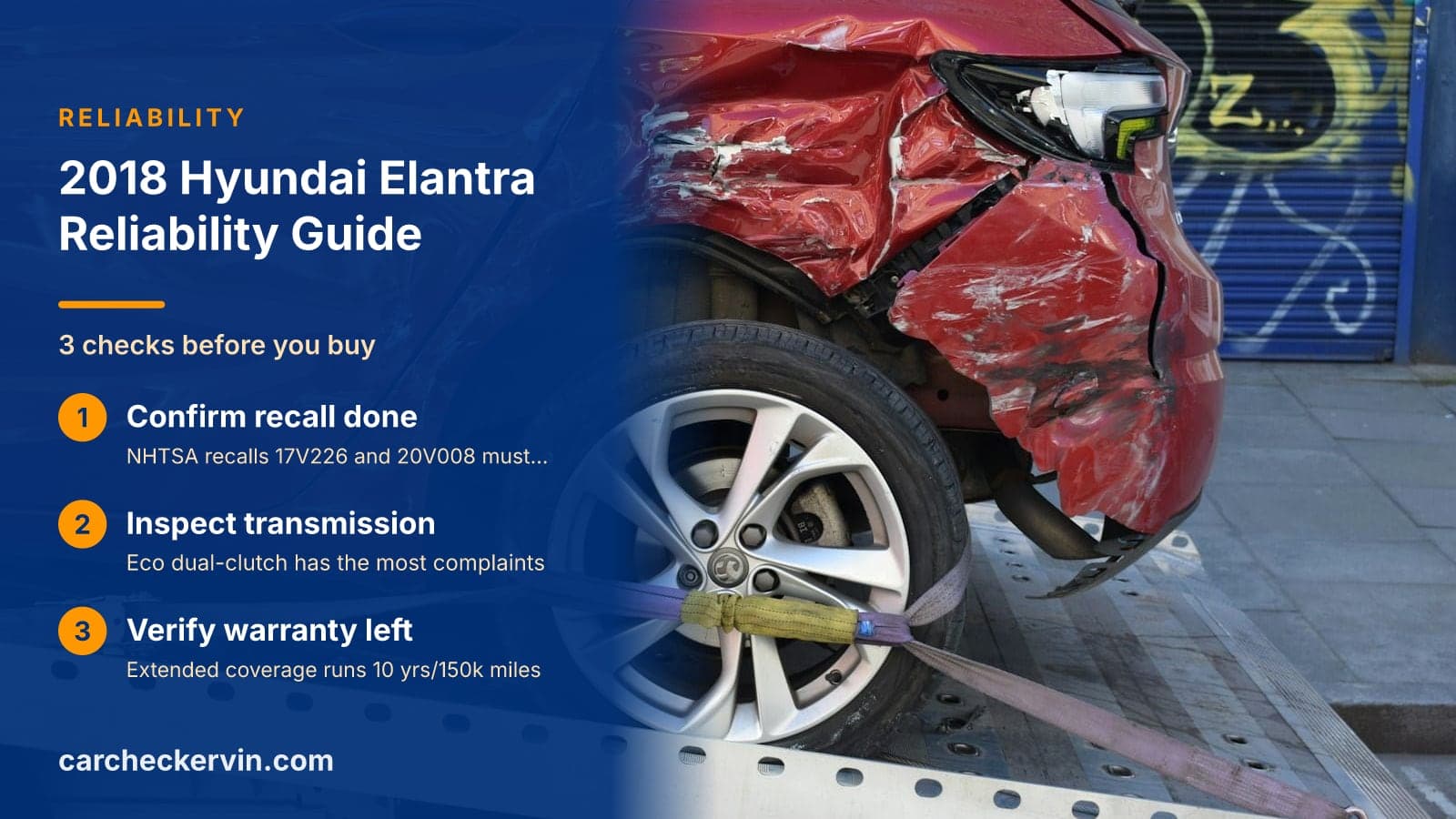
2018 Hyundai Elantra Reliability: What Used-Car Buyers Must Know Before Signing
The 2018 Elantra is affordable and fuel-efficient, but engine seizure recalls and transmission complaints deserve a hard look before you hand over cash.
Oct 27, 2026 · 10 min read

Second Hand Car Buying Advice: The No-Nonsense Guide for US Buyers
From title brands and auction lots to financing traps and the best used EVs, this guide gives US buyers the specific, skeptical second hand car buying advice they need before spending a dollar.
Oct 27, 2026 · 11 min read

Bumper to Bumper Warranty: What It Covers, What It Doesn't, and Whether to Buy Extra
A bumper to bumper warranty sounds complete, but the exclusions can cost you thousands. Here's exactly what's covered, what isn't, and how to decide if extended coverage is worth the price.
Oct 26, 2026 · 8 min read