What Each Character in Your VIN Actually Means
Your 17-character VIN is a structured code, not a random string. Here's what every single position means, from the country of origin to the check digit.
Check the car you're reading about
Free VIN decode and recall check
Factory specs and open NHTSA recalls in seconds. No sign-up.
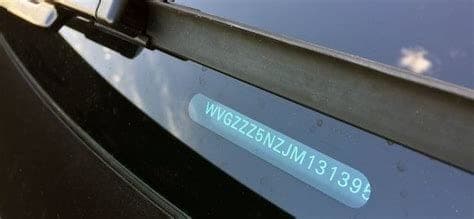
Every 17-character VIN since 1981 is a structured code defined by ISO 3779. Each position tells you something specific about the vehicle, and once you know the structure you can decode any VIN at a glance — verify a year-model match against a seller's claim, check for a counterfeit VIN, or just understand what you're looking at. Here's the position-by-position breakdown.
Quick reference
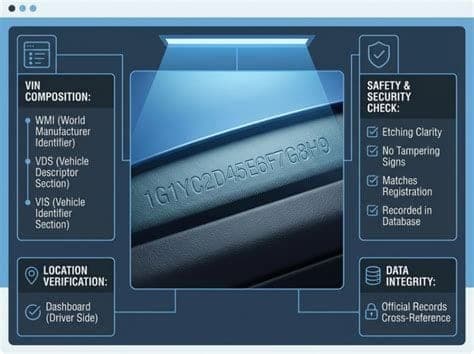
Positions 1-3 = World Manufacturer Identifier (country + maker). Positions 4-8 = vehicle attributes (model, body, engine, restraints). Position 9 = check digit. Position 10 = model year. Position 11 = plant. Positions 12-17 = serial number.
The big picture
A VIN is 17 characters long. The allowed characters are digits 0-9 and uppercase letters except I, O, and Q (to avoid confusion with 1 and 0). Every position has a defined role under ISO 3779, but the specific meaning of positions 4-8 varies by manufacturer — each manufacturer files a 'VIN decoder map' with NHTSA that explains their internal encoding.
Positions 1–3: World Manufacturer Identifier (WMI)
The first three characters identify where the car was made and who made it. The first character is the country/region, the second is the manufacturer, and the third is a vehicle type or further manufacturer subdivision.
Common first-character codes
- 1, 4, 5 — United States
- 2 — Canada
- 3 — Mexico
- J — Japan
- K — South Korea
- L — China
- S — United Kingdom
- V — France or Spain
- W — Germany
- Y — Sweden or Finland
- Z — Italy
Common WMI prefixes (full first 3 characters)
- 1HG / 2HG / 3HG / 5HG — Honda (US, Canada, Mexico, US light truck respectively)
- 1FA / 1FT / 1FM — Ford passenger / Ford truck / Ford SUV (US)
- 1G1 / 1GC / 2G1 — Chevrolet passenger (US) / Chevrolet truck (US) / Chevrolet passenger (Canada)
- 5YJ — Tesla
- JT2 / JT3 / JTD / JTE — Toyota passenger / Toyota truck (older) / various Toyota body styles
- WBA / WBS — BMW (Germany)
- WDB / WDC / WDD — Mercedes-Benz passenger / SUV / various
- WVW — Volkswagen passenger (Germany)
- KMH / KNA — Hyundai / Kia (South Korea)
Positions 4–8: Vehicle Descriptor Section (VDS)
These five characters encode model line, body style, restraint system, engine, and other attributes specific to that manufacturer. The exact meaning varies by manufacturer, so a VIN decoder is needed to translate them accurately. For example, on a Honda Civic the VDS might encode 'EM2' for the body style and door count, while on a Ford F-150 the same positions encode payload class and cab configuration.
The NHTSA's free VIN decoder at vpic.nhtsa.dot.gov resolves these positions accurately for every US-market manufacturer and is the canonical source for VIN-to-spec translation.
Position 9: Check digit
A mathematical checksum of the other 16 characters. The federal government uses a weighted modulo-11 algorithm — each character is assigned a numeric value, multiplied by a position weight, summed, and divided by 11. The remainder (or 'X' if the remainder is 10) is the check digit.
Why it matters: if any other character in the VIN is altered, the check digit no longer matches. A VIN with an invalid check digit is either typo'd or counterfeit. Most VIN-decoder tools verify the check digit automatically; if a tool tells you 'invalid VIN' even though you typed it carefully, that's a strong signal something is off with the physical VIN on the car.
Position 10: Model year
Encoded as a single character following a published table. Common values for 2010s and 2020s:
- A = 1980 or 2010
- B = 1981 or 2011
- C = 1982 or 2012
- D = 1983 or 2013
- E = 1984 or 2014
- F = 1985 or 2015
- G = 1986 or 2016
- H = 1987 or 2017
- J = 1988 or 2018
- K = 1989 or 2019
- L = 1990 or 2020
- M = 1991 or 2021
- N = 1992 or 2022
- P = 1993 or 2023
- R = 1994 or 2024
- S = 1995 or 2025
- T = 1996 or 2026
- V = 1997 or 2027
The same letter is used for cars 30 years apart, so position 10 alone is ambiguous. But position 7 can usually disambiguate — pre-2010 VINs use a digit (0-9) in position 7 for the body class, while 2010+ VINs typically use a letter. There's a full position-10 decoder chart on our blog if you want the complete table.
Position 11: Plant code
Identifies the specific assembly plant where the vehicle was built. Each manufacturer assigns its own plant codes (Ford's 'P' is Twin Cities; Toyota's 'C' is Cambridge, Ontario; etc.). Plant codes matter for warranty recalls and parts sourcing, and are sometimes used to identify pre-production or limited-run vehicles.
Positions 12–17: Serial number
A six-digit production sequence number that identifies the specific vehicle within its model year and plant. Early production units in a given year typically have lower serial numbers; later production has higher numbers. Some manufacturers use the serial number to identify special-edition or limited-production vehicles.
Putting it together: example decode
Take the VIN 1HGCM82633A123456. Decoded:
- 1HG — Honda Motor Company, United States plant.
- CM826 — vehicle descriptor (Honda Accord coupe with a specific engine and restraint configuration).
- 3 — check digit.
- 3 — model year 2003 (or 1973, but Hondas weren't made in 1973 so unambiguously 2003).
- A — assembly plant: Marysville, Ohio.
- 123456 — production serial number.
Why VIN structure matters for buyers
- Verify the seller's claimed make/model/year matches the VIN — instant catch on misrepresented listings.
- Catch cloned VINs by verifying the WMI matches the brand visible on the car (a Ford with a Honda WMI is fake).
- Check the model year against the title and the seller's listing — small details like year discrepancies often hide bigger problems.
- Identify the plant for recall and warranty purposes.
- Verify the check digit to catch typo'd VINs before paying for a history report.
Pre-1981 vehicles
VINs on US vehicles before 1981 weren't standardized to 17 characters and don't follow ISO 3779. They can be anywhere from 5 to 13 characters and the meaning of each position varies by manufacturer. Decoding them requires a manufacturer-specific reference; don't expect a standard VIN tool to handle them.
What to do next
Next time you're looking at a used-car listing, glance at the VIN's first three characters and its tenth character. The WMI plus model year alone catch a surprising number of misrepresented listings — and the check is free.
About the author
CarCheckerVIN Editorial Team
In-house automotive research team
The CarCheckerVIN editorial team combines decades of automotive industry, dealer, and journalism experience to produce trustworthy buying, selling, and ownership guidance backed by NMVTIS, NICB, and manufacturer data.
Keep reading
How Many Owners by VIN: The Real Number Behind 'One-Owner Car'
"One-owner car" sounds great on a listing — but is it true? Here's how to check how many owners by VIN and what the number actually tells you about a used vehicle.
Aug 1, 2026 · 5 min read

JDM Import VIN Decoding: Navigating the 25-Year Rule and Japanese Chassis Numbers
Japanese-market vehicles use chassis numbers that don't follow US VIN standards. Here's how to decode them, verify legal import status, and avoid titling nightmares.
Jul 25, 2026 · 7 min read
The Monroney Label: How to Read a New Car Window Sticker by VIN
The Monroney label is federally mandated on every new car sold in America. Here's how to read one, retrieve it by VIN, and spot the details most buyers miss.
Jul 20, 2026 · 6 min read