Buying a car out of state — and the brand that crossed with it.
Out-of-state buying is normal: better price, better selection, a bit more paperwork. It's also where title brands get lost — which makes the federal record worth more here than anywhere else.
Check any out-of-state VIN before you travel — free
17-character VIN → brands across every reporting state, before any payment.
Free preview · no card, no account
Quick Answer
- Can you buy a car in another state?
- Yes, and people do it constantly for price and selection. The paperwork is the part that trips buyers up: you register the car in your own state, not the one you bought it in, so your state's title, tax and inspection rules are the ones that decide what you need.
- What's the biggest risk buying out of state?
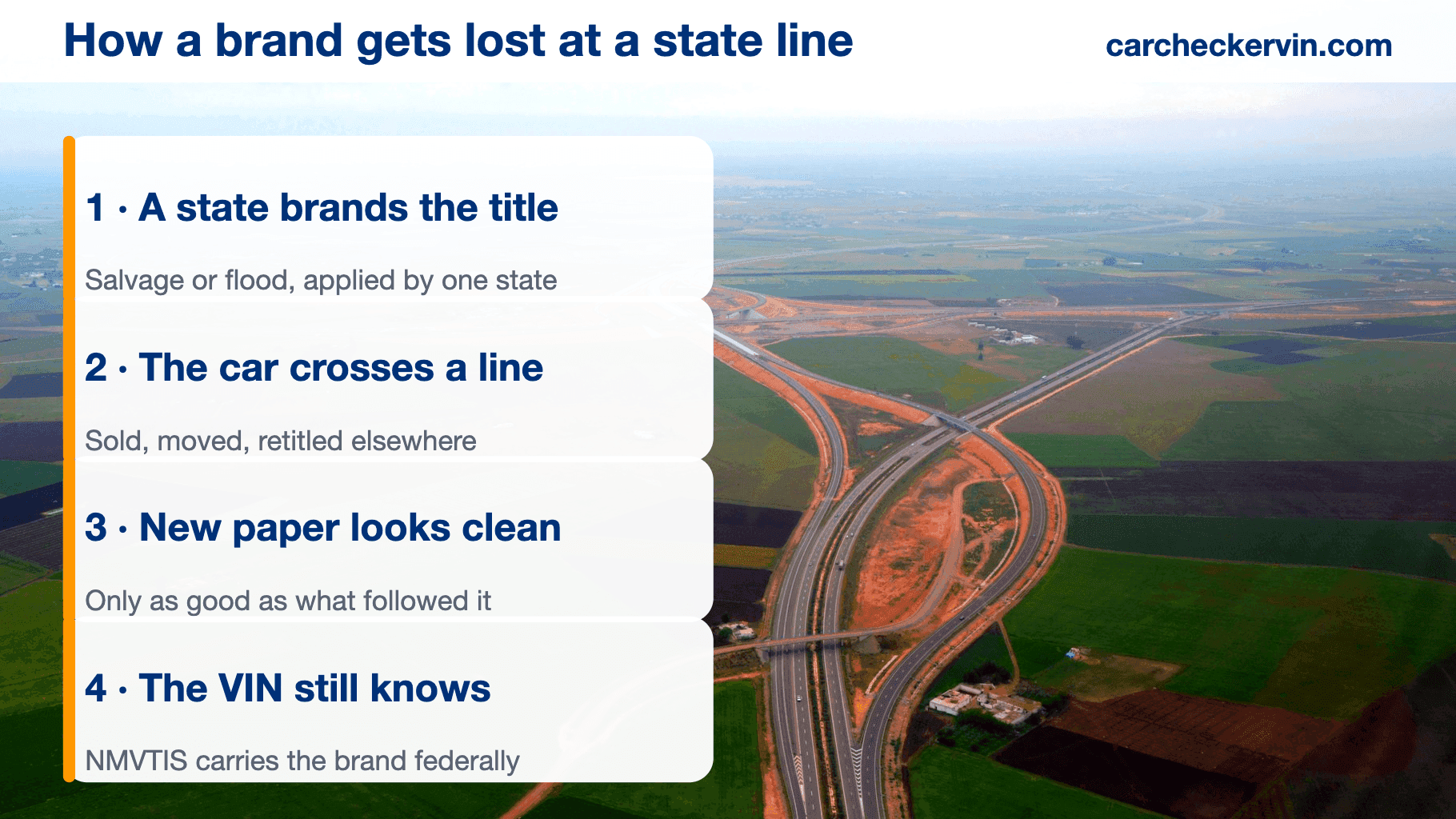
- Not the drive home — title washing. Brands like salvage and flood are issued by individual states, and moving a car across state lines is historically how one gets shed. A title that reads clean in a new state can sit on a VIN that shows a brand federally.
- How do I check a car in another state?
- Read the federal record, not the seller's paper. Brands are carried nationally through NMVTIS regardless of which state printed the document, so a 17-character VIN is enough to see the whole title chain from wherever you are — before you book travel or a transporter.
The out-of-state purchase, in order
Distance changes the sequence: the checks that are optional locally become the ones that decide whether you get in the car at all.
| Stage | What you do | Why distance changes it |
|---|---|---|
| 1 · Before you travel | Read the VIN's federal record — brands, title chain, odometer, accidents | It's the only step that costs nothing to do from home, and the one that saves the trip |
| 2 · Before you commit | Arrange an independent inspection near the seller | You can't drop by twice; the mechanic is your eyes when you aren't there |
| 3 · At the sale | Title signed correctly, bill of sale, odometer disclosure, lien released if any | Fixing paperwork from several states away is the expensive kind of mistake |
| 4 · Getting it home | Temporary tag or transport, and insurance active before it moves | Rules differ by state — the seller's state issues the tag, yours issues the plate |
| 5 · At home | Title and register in your own state, pay what your state charges | Your state's rules govern, whatever the seller's paperwork looked like |
Because rates, fees and inspection requirements differ by state and change, confirm stages four and five with your own DMV rather than any national article — including this one.
Why out-of-state is where brands disappear
This is the risk that makes an out-of-state car different from the one down the road, and it's mechanical rather than moral:
Brands are issued state by state
A salvage or flood brand is applied by one state's system. Retitle the car in another state and the new document is only as good as the information that followed it — which is how a branded car can end up holding clean-looking paper.
You can't eyeball the paperwork
Locally you'd see the title, meet the seller, notice the car came from three states away. At distance you're often working from photographs and a phone call, which is exactly the environment brand-washing survives in.
The federal record travels with the VIN
Brands are carried nationally through NMVTIS regardless of which state printed the document. One VIN query shows the title chain across every reporting state — so the paper in the seller's hand stops being the last word.
Check the VIN before you book the flight.
Brands across every reporting state, the title chain and odometer flags — free, from wherever you are.
Buying at a distance, honestly
The awkward truth about an out-of-state purchase is that you make the decision with less information than a local buyer and more money at stake, because travel and transport are sunk before you ever see the car. That asymmetry is worth naming, because it changes what the records are for. Locally, a history report is one input among many — you can look at the car twice, take a friend, walk away cheaply. At distance, the report is doing the work your eyes would otherwise do: it tells you whether the trip is worth taking, whether the description matches the title chain, and whether the car has quietly changed states in a way that deserves a question. A clean record doesn't replace an inspection, and nothing replaces an independent mechanic near the seller. But an unclean record, read from your kitchen table, saves the entire journey — and that is the cheapest money you will spend on the whole purchase.
What one VIN query answers from anywhere
Six sections of the $14.99 report, each doing more work when the car is a thousand miles away:
Brands across every state
The federal view, so a clean-looking document from one state can be checked against what the national system carries.
The title chain, state by state
Where the car has been titled and in what order — the pattern that reveals a car that has been moved around.
Odometer at each transfer
Recorded readings in sequence across state lines, where mileage discrepancies most often hide.
Accident and damage records
Reported entries with severity where recorded, so the listing photos aren't your only evidence.
Total-loss and salvage filings
Insurer write-offs behind any brand — including one a later state's paperwork doesn't show.
Auction lanes, with photos
Wholesale appearances and lane photos where available: the car as it looked before it travelled.
The honest boundary: this is the records half. The mechanical half still needs a person with a lift near the seller, and your own DMV is still the authority on what you'll owe when you register.
Checking the state it's coming from
The federal record tells you what brands exist. The issuing state's own system is where you confirm a title's current status — start with the state the car is titled in now:
Comparing cars in several states?
Widening the search across state lines is the whole point — and it multiplies the candidates worth checking before you commit to travel:
At $9.00 a report on the 10-pack, screening ten out-of-state candidates costs less than two single reports at Carfax's $44.99 retail — and a fraction of one wasted trip.
The rest of the cross-border purchase
Verification, titles and the paperwork that follows the car home.
Always check the VIN before you buy
The free preview shows title brands, theft status and open recalls in seconds, and flags whether accident and odometer records exist. The full history is $14.99 — one-time, no subscription.
Buying out of state — what buyers ask
Including the ones your own DMV has the final say on.
Can I buy a car in another state?+
Yes — buyers do it routinely for price and selection, and nothing stops a private sale crossing a state line. What changes is the admin: you title and register the car in the state where you live, so your own state's rules decide what documents, taxes and inspections apply, whatever the seller's state required.
What's the biggest risk when buying a car out of state?+
Title washing. Brands such as salvage and flood are applied by individual states, and retitling a car in a new state is historically how one gets shed — leaving clean-looking paper on a car whose VIN still shows a brand federally. It's also the risk distance makes worse, because you're working from photos rather than standing next to the documents.
How do I check a car that's in another state?+
Run the 17-character VIN against the federal record before you travel. Brands are carried nationally through NMVTIS regardless of which state printed the title, so one query shows the chain across every reporting state from wherever you are. The free preview shows what's on file; the full report at $14.99 adds damage records, the odometer trail and auction photos.
Where do I pay sales tax on an out-of-state car?+
Generally in the state where you register it rather than where you bought it — but the mechanics, credits for tax already paid, and the paperwork differ enough by state that this is a question for your own DMV or revenue department, not a national article. Ask them before you agree a price, so the total cost is known while you can still negotiate.
How do I get the car home legally?+
Either a temporary tag or permit — usually issued through the seller's state — or a transporter, and in both cases insurance active before the car moves. Requirements vary and change, so confirm the specific route with the seller's DMV and your insurer rather than assuming what worked for someone else online will work for you.
Is a car from another state worth less?+
Not for having moved, no. What does move value is anything in the record that travelled with it: a salvage or rebuilt brand takes roughly 30–50% off a clean-title equivalent, permanently. That's precisely why the federal check matters more on an out-of-state car — you're pricing the history, not the geography.
Should I still get a mechanic's inspection if the record is clean?+
Yes. The records tell you what happened to the car on paper; a mechanic tells you what the car is today, and no database reports worn suspension or a fresh leak. Arrange an independent inspection near the seller — it's the substitute for the second visit you can't easily make, and it's cheap next to the travel you'd otherwise waste.
The car crossed a state line. Did its history?
Preview any 17-character VIN free — brands across every reporting state — and read the full NMVTIS-backed report for $14.99 before you travel.
Related VIN Checks
More tools to verify any vehicle's history