What does a clean title mean — and what it doesn't.
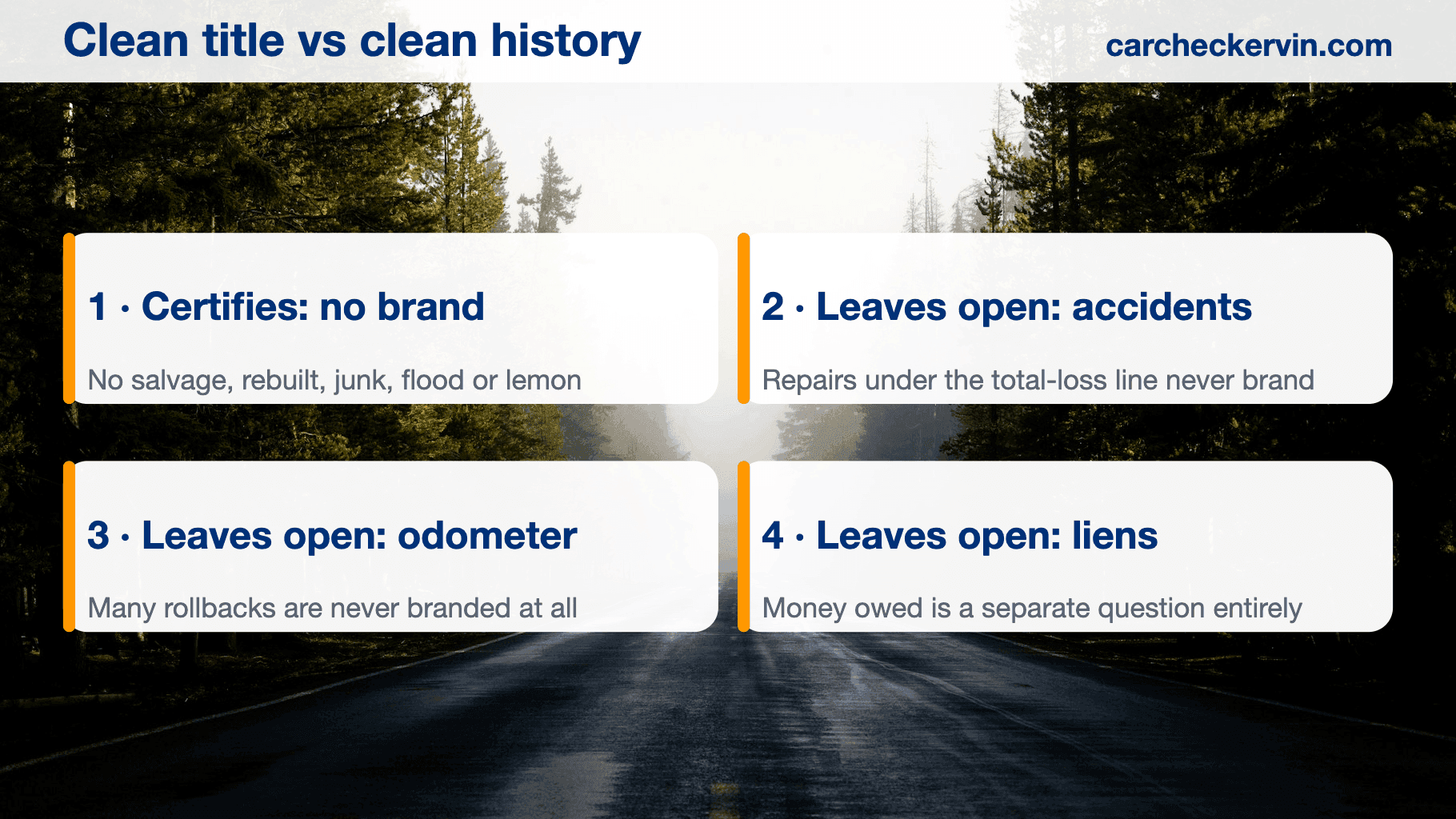
A clean title means no brand on record: no salvage, rebuilt, junk, flood or lemon. It's a statement about paperwork, not about the car — and the gap between the two is where buyers lose money.
Check whether a title is really clean — free to start
17-character VIN → brands on record, title chain and flags, before any payment.
Free preview · no card, no account
Quick Answer
- What does a clean title mean?
- It means the vehicle's title carries no brand on record— no salvage, rebuilt, junk, flood or lemon designation from any state. That's the whole claim. A clean title says the paperwork is unmarked; it does not say the car was never damaged, never repaired, or never in a crash.
- Does a clean title mean the car has no accident history?
- No — and this is the costliest misunderstanding in used-car buying. A title is only branded when an insurer declares a total loss (or a state applies another brand). Damage repaired below that threshold, or paid for out of pocket, leaves the title spotless. Plenty of wrecked-and-repaired cars carry perfectly clean titles.
- How do I confirm a title is genuinely clean?
- Check the federal record, not just the paper. Brands are issued by states but carried nationally through NMVTIS, so a title that reads clean in one state can still show a brand federally — that gap is what title washing exploits. Enter the 17-character VIN above to see the record itself.
What a clean title does and doesn't promise
Read the claim precisely and most used-car confusion disappears. Line by line, what the words on that title actually cover:
| The question | Does a clean title answer it? | Where the answer lives |
|---|---|---|
| Was it ever declared a total loss? | Yes — a total loss brands the title, so clean means no insurer wrote it off | The title record itself, carried federally |
| Was it ever in an accident? | No — repairs below the total-loss threshold never touch the title | Accident and damage records in the history report |
| Has the odometer been rolled back? | Not reliably — a rollback brand exists, but many go unbranded | The odometer reading recorded at each title transfer |
| Was it flooded? | Only if an insurer or state applied a flood brand | Total-loss filings, auction records and damage entries |
| Is there money still owed on it? | No — liens are separate from brands entirely | The lienholder line on the title and the state DMV |
One row is what a clean title actually certifies. The other four are questions buyers assume it answers — and it never did. That's not a flaw in the system; it's a misreading of what the document is for.
The three things clean genuinely tells you
The claim is narrow, but it isn't worthless — here's the real value of a clean title:
No insurer ever wrote it off
No total-loss declaration is on record, which is the single most expensive event a used car can carry. That alone separates a clean-title car from the branded market and its permanent discount.
Normal registration, insurance and lending
Clean-title cars register anywhere, insure on the full menu of coverage, and finance without the friction branded titles bring. The paperwork simply gets out of your way.
It resells as an ordinary car
You inherit no brand to disclose and no permanent discount to pass along. The whole buyer pool stays available to you, which is worth real money at trade-in time.
Where “clean title” quietly stops short
Three specific gaps turn a clean title into false comfort — each one common enough that experienced buyers check for all three:
Damage under the threshold
Insurers brand a title only when repair costs cross their total-loss line. A serious collision repaired just under it — or paid for privately to avoid a claim — leaves the title clean and the damage in the car's past, not on its paperwork.
Title washing across state lines
Brands are issued by individual states, and moving a car between states has historically been the way to shed one. A title reading clean in a new state can sit on a VIN that shows a brand federally — which is exactly what the national record is for.
Everything that isn't a brand
Open recalls, lien status, auction history, service gaps, mileage inconsistencies — none of these brand a title. A clean title is silent about all of them, and each has ended a deal that the paperwork blessed.
Clean paperwork is easy to show. Clean history is checkable.
Brands on record, title chain and flags for any 17-character VIN — free, before you take the seller's word for either one.
Reading the record behind a clean title
Verifying "clean" is really two checks in sequence. First: is the title genuinely unbranded on the federal record, not merely on the paper in the seller's hand — that's the title-washing question, and only a national look answers it. Second, and more often decisive: what does the rest of the file say? A car can be honestly clean-titled and still show reported accidents, a wholesale auction appearance with photographs of the damage, an odometer reading that shrank between transfers, or open safety recalls. None of that brands a title. All of it changes what the car is worth and whether you want it. The report reads both layers at once, which is why the smart sequence is to confirm the brand status and then keep reading rather than stopping at the good news.
What the report adds to “clean”
Six sections that answer the questions a clean title leaves open — the same federal NMVTIS data and supporting feeds:
Brands across every state
The national brand record, so a clean-looking state title can be checked against what the federal system carries for that VIN.
Accident and damage entries
Reported damage with severity where recorded — including the repairs that never crossed a total-loss threshold.
Auction lanes, with photos
Wholesale appearances and the lane photos where available: the car unstaged, whatever its title says.
Odometer at each transfer
Readings in sequence across owners and states — the arithmetic that catches a rollback nobody branded.
Total-loss and salvage filings
Insurer write-offs and yard records straight from the federal feeds, in case the paper and the record disagree.
Open recalls and specs
Manufacturer recall status and the build sheet for the exact VIN — safety and identity, neither of them title matters.
Checking a few clean-title candidates?
Most shortlists are entirely clean-title cars — which is exactly why the brand status alone can't rank them. Packs make reading the full file on each one routine:
At $9.00 a report on the 10-pack, reading past "clean" on ten candidates costs less than two single reports at Carfax's $44.99 retail.
The rest of the title vocabulary
Every brand, and every check, explained on its own page.
Always check the VIN before you buy
The free preview shows title brands, theft status and open recalls in seconds, and flags whether accident and odometer records exist. The full history is $14.99 — one-time, no subscription.
Clean titles — what buyers actually ask
Including the answers that stop people trusting the word too much.
What does a clean title mean on a car?+
That the title carries no brand — no salvage, rebuilt, junk, flood or lemon designation on record. It is a statement about the vehicle's paperwork status, nothing more. A clean title is genuinely good news, because it means no insurer ever declared the car a total loss; it simply isn't the same claim as "this car has never been damaged."
Can a car with a clean title have been in an accident?+
Yes, and it's common. A title gets branded when an insurer declares a total loss — repair costs crossing their threshold — or when a state applies another brand. A serious collision repaired below that line, or paid out of pocket to avoid a claim entirely, never touches the title. That's why accident records and auction photos matter alongside brand status.
Is a clean title the same as a clear title?+
No — they answer different questions, and the words get mixed up constantly. Clean refers to brands: no salvage, flood or similar designation. Clear refers to liens: no lender's claim outstanding. A car can have a clean title with an open loan against it, or a clear title that carries a salvage brand. Buyers need both to be true.
Can a clean title be faked or washed?+
Title washing is the real-world version of that worry: because brands are issued by individual states, moving a vehicle between states has historically been a way to shed one, leaving a clean-looking title on a branded car. The defense is checking the national record rather than the document — brands carried federally through NMVTIS follow the VIN regardless of which state printed the paper.
Does a clean title mean the mileage is accurate?+
Not by itself. Some odometer problems do produce a brand, but plenty of rollbacks never get branded at all. The reliable check is the sequence of readings recorded at each title transfer: numbers should only ever climb. A reading that shrinks between owners is the fraud showing itself, whatever the title says.
How much does a clean title add to a car's value?+
It doesn't add value so much as avoid a permanent deduction: branded titles trade well below their clean equivalents for life, while a clean title simply lets a car be priced as an ordinary used vehicle. That's why the brand status is the first thing to confirm — and why it can't be the last, since two clean-titled cars can still have very different histories.
What should I check on a clean-title car before buying?+
Confirm the brand status on the federal record rather than the paper, then keep reading: accident and damage entries, auction appearances with photos, the odometer at each transfer, open recalls, and the lien line. The free preview starts that on any 17-character VIN, and the full report at $14.99 — against $44.99 for a single Carfax — covers the rest.
“Clean title” is the start of the answer, not the end.
Preview any 17-character VIN free — brands, title chain and flags — and read the full NMVTIS-backed file for $14.99 when a car matters.
Related VIN Checks
More tools to verify any vehicle's history