Can Anyone Look Up a VIN? Yes. Here's what it shows, and what the law keeps out.
A VIN isn't a secret. Federal rules put it where anyone can read it through the windshield, and anyone can decode it, check it for recalls or run it against insurers' theft and salvage records for free. What no consumer lookup returns is the owner's name or address. The Driver's Privacy Protection Act bars state DMVs from releasing that except for 14 listed purposes, and NMVTIS gives consumers no personal information at all.
Look Up a VIN Yourself
Enter any 17-character VIN for a free preview: title brands, salvage records and odometer readings, with no owner data.
Free preview · No sign-up · No owner or personal data
Quick Answer
- Is it legal to look up a VIN?
- Yes. Decoding a VIN, checking it for recalls or buying a history report on it is legal, and the government runs free tools for exactly that. NHTSA's decoder is open to anyone and even accepts partial VINs. The law steps in at the owner's personal details: the Driver's Privacy Protection Act stops state DMVs from releasing a name, address or phone number tied to a vehicle record except for specific purposes.
- Can I search a VIN number on Google?
- Yes. Type the 17 characters into any search engine and you'll see pages that happen to contain them, such as old listings, auction pages or forum posts. That can turn up photos or a past asking price, but it isn't a vehicle history: search results don't check title brands, theft records or recalls. For those, use NHTSA's recall lookup, NICB VINCheck or a report from an NMVTIS-approved provider.
- What information can someone get from a VIN number?
- The car's details, not yours. A VIN decodes to the make, model, year, body, engine and assembly plant the manufacturer reported. It can be checked for open recalls, for theft or salvage records reported by insurers, and, through a paid report, for title brands and odometer readings. It won't give anyone your name, address, phone number or driver's license number: the law classes those as personal information.
Five lookups, one locked door
Four of these are open to anyone. The fifth is the one people worry about, and it's the one the law closes.
- 1Decode itNHTSA's vPIC returns the specs the manufacturer reported, free.
- 2Check recallsNHTSA's lookup shows unrepaired safety recalls on that exact car.
- 3Check theft and salvageNICB VINCheck searches participating insurers' records.
- 4Buy a history reportTitle brands, odometer readings and salvage records from NMVTIS providers.
- 5Ask the DMV for the ownerRefused, unless the request fits one of the DPPA's permitted uses.
Why Your VIN Is Public by Design
The VIN was never meant to be private. Federal rule 49 CFR 565.13 says that on passenger cars, multipurpose vehicles, low-speed vehicles and trucks of 4,536 kg (10,000 lb) gross weight or less, the VIN has to sit inside the passenger compartment, readable through the glass in daylight without moving any part of the vehicle. Anyone walking past a parked car can copy it.
That's deliberate. A VIN identifies a vehicle, not a person, so recall notices, title records, insurers and buyers can all refer to the same car without confusion. The privacy rules attach to the people connected to the car, which is why a VIN lookup can tell you a great deal about the vehicle and nothing about who owns it.
Where anyone can read a VIN
- Windshield: required by 49 CFR 565.13 to be readable through the glass.
- Registration card: NHTSA points owners there to find it.
- Insurance card: NHTSA says it may be printed there too.
- Listings: many sellers post it so buyers can run a check.
What Each VIN Lookup Returns
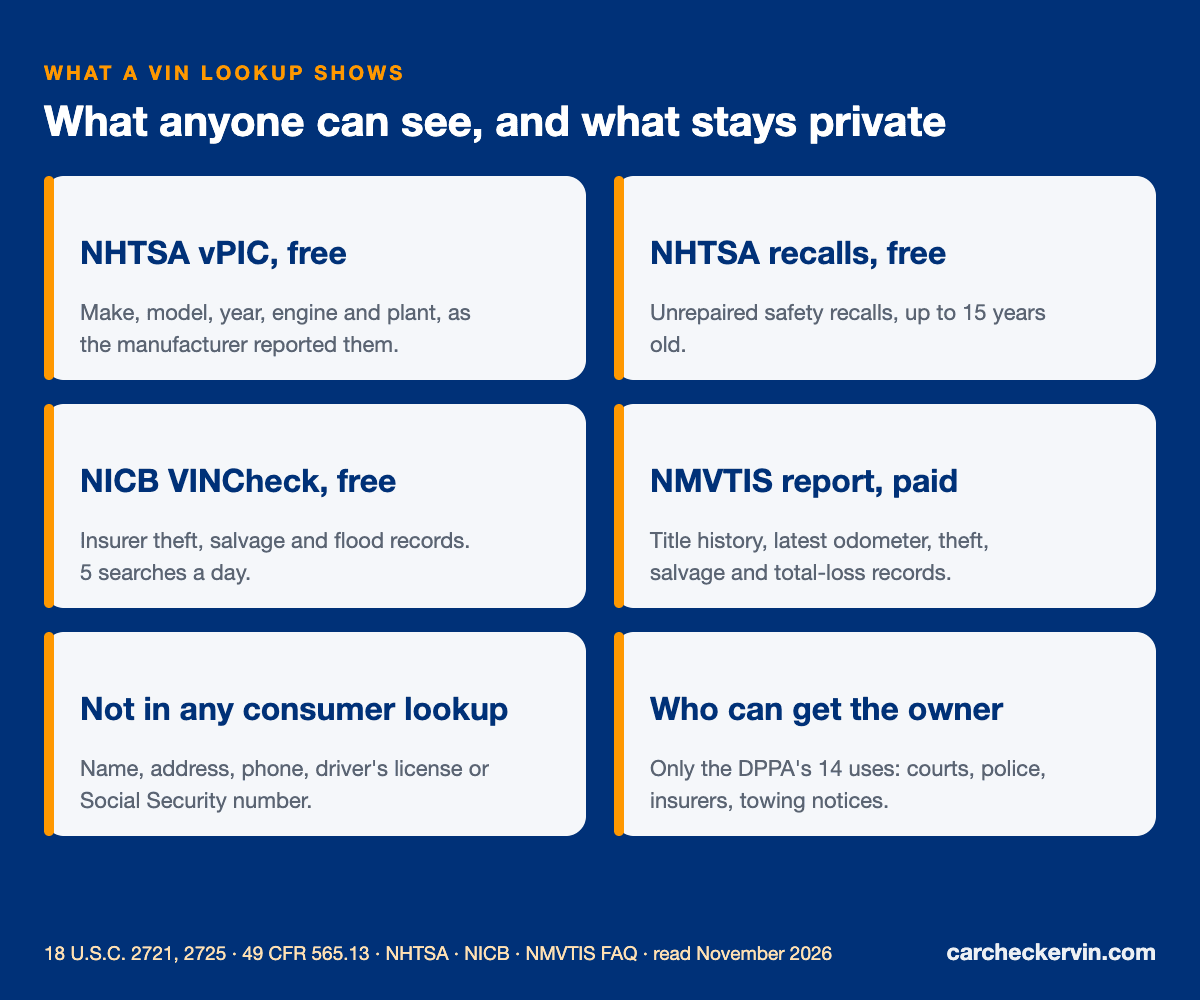
Free government tools cover the car's identity, recalls and insurer theft records. A paid report adds title and odometer history. None of them return the owner.
| Lookup | What it returns | Cost and limits |
|---|---|---|
| NHTSA vPIC decoder | Make, model, year, body, engine and plant, as reported by the manufacturer; partial VINs accepted | Free |
| NHTSA recall lookup | Unrepaired safety recalls for that VIN | Free; skips recalls more than 15 years old; up to 100 VINs at once |
| NICB VINCheck | Stolen-and-not-recovered, salvage and flood records from participating insurers | Free; 5 searches per IP address per 24 hours |
| NMVTIS report | Current and past title data, latest odometer reading, theft history, salvage and total-loss records | Paid, through an approved provider |
| Search engine | Pages that happen to contain the VIN: listings, auction pages, forum posts | Free; no title or theft check |
| State DMV owner record | Name, address and other personal information | Only for one of the DPPA's 14 permitted uses |
Read on each agency's own page in November 2026. NICB's participating insurers wrote 92.49% of US earned premium, by NICB's figure as of August 2026.
What a VIN Lookup Shows, and What It Hides
Every free and paid lookup draws from records about the vehicle: what the factory built, what recalls it's under, what insurers paid out on, and what each state's title office recorded. That's a lot. A history report can tell a buyer the car was branded salvage in one state and retitled in another.
What it can't tell anyone is who you are. NMVTIS, the federal title database behind approved history reports, says plainly that no personal identifying information is made available to individual consumers through it.
The Law That Keeps Owner Names Out: the DPPA
The Driver's Privacy Protection Act, 18 U.S.C. 2721, says a state DMV may not knowingly disclose personal information from a motor vehicle record to anyone, except as the law allows. Section 2725 defines personal information as anything that identifies a person: photograph, Social Security number, driver identification number, name, address (but not the 5-digit ZIP code), telephone number, and medical or disability information. It leaves out accident records, driving violations and driver's status.
Subsection (b) then lists 14 permitted uses. They include government agencies and courts, vehicle safety, theft, recall and emissions work, insurers handling claims and underwriting, notices to owners of towed or impounded cars, licensed private investigators acting for one of the listed purposes, and anyone who has the person's written consent. Curiosity about who owns a car isn't on the list.
Breaking the Act costs money. Anyone who knowingly violates it can be fined under federal criminal law (section 2723), and the person whose information was misused can sue for actual damages of at least $2,500, plus punitive damages for willful or reckless violations (section 2724). A state DMV with a policy or practice of substantial noncompliance faces a civil penalty of up to $5,000 a day.
Try It on Any VIN
Run any VIN through the free preview. You'll see the vehicle's title brands, salvage records and odometer readings, and no owner's name or address.
What Someone Can't Get From Your VIN
These are the items 18 U.S.C. 2725 classes as personal information. A consumer VIN lookup doesn't return any of them.
Your name
Owner names sit in state DMV records, which the DPPA closes to ordinary requests.
Your address
Street address is personal information under the Act. Only the 5-digit ZIP code isn't.
Your phone number
Listed in the definition alongside name and address.
Your license number
A driver identification number is personal information too.
Your Social Security number
Classed as highly restricted, with a photograph and medical information.
Your key code
Automakers release it only after checking photo ID and a registration that matches the VIN.
Sharing Your VIN: When It's Fine and When to Be Careful
Giving a buyer your VIN is normal and usually helps the sale. The risk is in what comes attached to the request.
Fine to share
- With a buyer who wants to run their own history check
- In a listing, so serious buyers can check before they call
- With your insurer, a repair shop or a parts counter
- It's already readable through your windshield
Be careful when
- A "buyer" insists you buy a report from a site they pick; the FTC warned in October 2018 about sites charging about $20
- The site is one you've never heard of and asks for card details
- Someone asks for your name, address or license along with the VIN
- Anyone offers to make a key from the VIN without asking for ID
The FTC's advice: ask why, and use vehiclehistory.gov, which lists NMVTIS-approved report providers.
How Often the Same VIN Is Looked Up by Different People
Plenty of VINs are checked by more than one person. Between August 1 and October 31, 2026, our site logged 6,650 VIN lookups covering 4,351 different vehicles. For 2,615 of those VINs we have a hashed network ID on the lookup, and 213 of them, about 8%, were looked up from two or more different networks. That fits a car for sale, with several shoppers running the same VIN.
None of those lookups showed anyone an owner's name. Our free preview reports on the vehicle, and the paid report's ownership section lists each owner by number, state, dates and type of use. It has no names or addresses, because the records behind it don't give them to consumers.
The Risks a VIN Does Carry
A VIN in the wrong hands isn't a route to your identity, but it can be used in a few scams.
Report-site scams
The FTC's October 2018 alert: fake buyers ask sellers to pay about $20 for a report on a site they name, then disappear.
VIN cloning
A thief copies a legitimate VIN onto a stolen car of the same model to sell it. Buyers protect themselves by checking that the VIN matches in several places on the car.
Lead generators
The FTC says some report sites exist to collect sellers' details and sell them for marketing.
Key requests
Dealers and registered locksmiths have to check ID and registration, so a VIN alone shouldn't get anyone a key.
Related Checks and Guides
Run the free checks, or read what each part of a VIN means.
Where These Facts Come From
Every legal point here comes from the statute or regulation text, and every tool description from the agency that runs it.
How we made this page: written by the CarCheckerVIN editorial team with AI assistance, from the statute, regulation and agency pages linked above, read in November 2026. The lookup figures are our own count from the site's lookup log, August 1–October 31, 2026; network IDs are stored hashed and only the totals are published.
Looking Up a VIN — Frequently Asked Questions
Privacy, the law and the free tools.
Is a VIN public information?+
The VIN itself, yes. Federal rules require it to be readable through the windshield, and it appears on registration and insurance cards. The owner information connected to it in DMV records isn't public: the DPPA restricts it.
Can someone find my address from my VIN?+
Not through a consumer lookup. Address is personal information under 18 U.S.C. 2725, and state DMVs may release it only for one of the 14 uses in 18 U.S.C. 2721(b), such as a court case, an insurance claim or a towing notice. NMVTIS gives consumers no personal information.
Is it safe to give out my VIN?+
Generally, yes. It's printed on your windshield anyway, and buyers use it to check the car's history. Be wary when someone pushes you to buy a report from a site they choose; the FTC flagged that scam in October 2018.
Can the police look up a VIN?+
Yes. Government agencies, including courts and law enforcement, are the first permitted use in 18 U.S.C. 2721(b), so police can get owner information that the public can't.
Is there a free VIN lookup?+
Several. NHTSA's vPIC decodes any VIN for free, NHTSA's recall lookup checks open recalls, and NICB VINCheck checks insurer theft and salvage records with 5 free searches per IP address per day. Our own preview is free too.
Can I find out who owns a car by the VIN?+
Only through a permitted DPPA route, such as a court proceeding, an insurance claim, or a licensed investigator acting for one of the listed purposes. Our VIN owner lookup guide walks through those routes.
Does a VIN show accident history?+
A VIN lookup shows what was reported against that VIN. NHTSA's tools don't cover accidents. NMVTIS covers title, odometer, theft and salvage records, and says it doesn't contain repair history. Some paid reports add other sources.
What can a thief do with my VIN?+
Mostly, use it to dress up a stolen car of the same model, which is called VIN cloning. They can't get your identity from it, and automakers won't release a key code without photo ID and a matching registration.
Run the VIN, Not the Owner
Enter any 17-character VIN for a free preview of the vehicle's record. The full report is $14.99 once and lists title brands, NMVTIS junk and salvage records, insurance total-loss records, odometer readings, and auction records with the damage the auction recorded and its photos.
This page summarizes federal privacy law and agency tools for general information and is not legal advice. Statutes and agency pages were read in November 2026. CarCheckerVIN does not provide owner names or addresses, and is not affiliated with NHTSA, NICB, the FTC or the Department of Justice. Records in our reports reflect what was reported to our data providers. Our reports do not include police or repair-shop accident entries.
Related VIN Checks
More tools to verify any vehicle's history