Car Key by VIN — what the VIN gets you, and the ID it takes.
Yes, a new key can be made from your VIN, but the VIN alone won't do it. A dealer or a registered locksmith uses the VIN to look up the car's key code and, on newer cars, the immobilizer data. Before they release it, they have to be sure the car is yours. GM tells its dealers to see photo ID and a registration that matches the VIN, and California law makes a locksmith check 3 things in person.
Check This Car's Record Free
Check the VIN before you pay for a second key. The free preview shows title brands, salvage records and odometer readings.
Free preview · No sign-up · No owner or personal data
Quick Answer
- Can I order a new key with my VIN number?
- Yes, through a dealer for your car's brand, as long as you can prove the car is yours. Toyota says a dealer will look up the key code from the VIN once you show photo identification and proof of ownership. GM's dealer rules ask for a valid picture ID and the registration, so the owner's name and the VIN can be checked. If the car has an immobilizer, the new key must then be programmed to the car before it will start the engine.
- Can a locksmith make a key from the VIN?
- A credentialed one can. Automakers release key codes and immobilizer PINs to locksmiths through NASTF's Secure Data Release Model, which needs a Vehicle Security Professional ID. GM tells its dealers not to hand codes to locksmiths at all and to send them to NASTF instead. In California, Vehicle Code § 9954 makes the locksmith check your driver's license, the registration and the VIN on the car before asking the manufacturer.
- Can you program a key fob with just the VIN?
- No. The VIN is how the dealer or locksmith finds the right key code and immobilizer data in the manufacturer's records. Programming happens at the car: Toyota says a car with an immobilizer has to have its computer programmed with a dealership scan tool before a new key will start it. A fob bought online still has to be cut, where it has a blade, and paired to the car.
Five steps to a replacement key
The order is the same at a dealer and at a registered locksmith. The paperwork is the part to get right.
- 1Read the VINIt's on the lower left of the windshield, the door jamb and your registration card.
- 2Bring ID and registrationPhoto ID plus a registration or title in your name that shows the same VIN.
- 3Pick a dealer or a registered locksmithA dealer for your brand, or a locksmith with a NASTF credential.
- 4They pull the key codeFrom the maker's system, using the VIN, once your ownership checks out.
- 5Cut it and program it at the carImmobilizer and smart keys have to be paired with the car before they work.
What Your VIN Actually Unlocks
A key code is the number a key-cutting machine needs to cut the blade for one particular lock. It isn't hidden in the 17 characters of the VIN. The manufacturer files it against the VIN when the car is built. GM's bulletin says the code is printed on the original dealer invoice and on a small bar-coded tag that comes with most new vehicles. After that, it lives in GM's key-code look-up system.
On many newer cars a blade isn't enough. The key also carries a chip the car has to recognise, which Toyota calls an immobilizer. California's key-access law treats both as one bundle: the "information" a manufacturer has to release covers the key code and, where the car has one, the immobilizer or access code. That's why the VIN gets you as far as the data, and the car itself has to be there for the last step.
What a key-code request needs
- Photo ID: a driver's license or other government picture ID (GM, Toyota).
- Registration: showing the owner's name and the same VIN as the car (GM).
- The VIN on the car: a California locksmith must check it matches the registration (§ 9954).
- If it isn't registered: the title, a current insurance policy or lien-holder details (GM).
- In person: GM's dealers may not take key-code requests by fax or over the internet.
Who Can Get Your Key Code, and What They Must Check
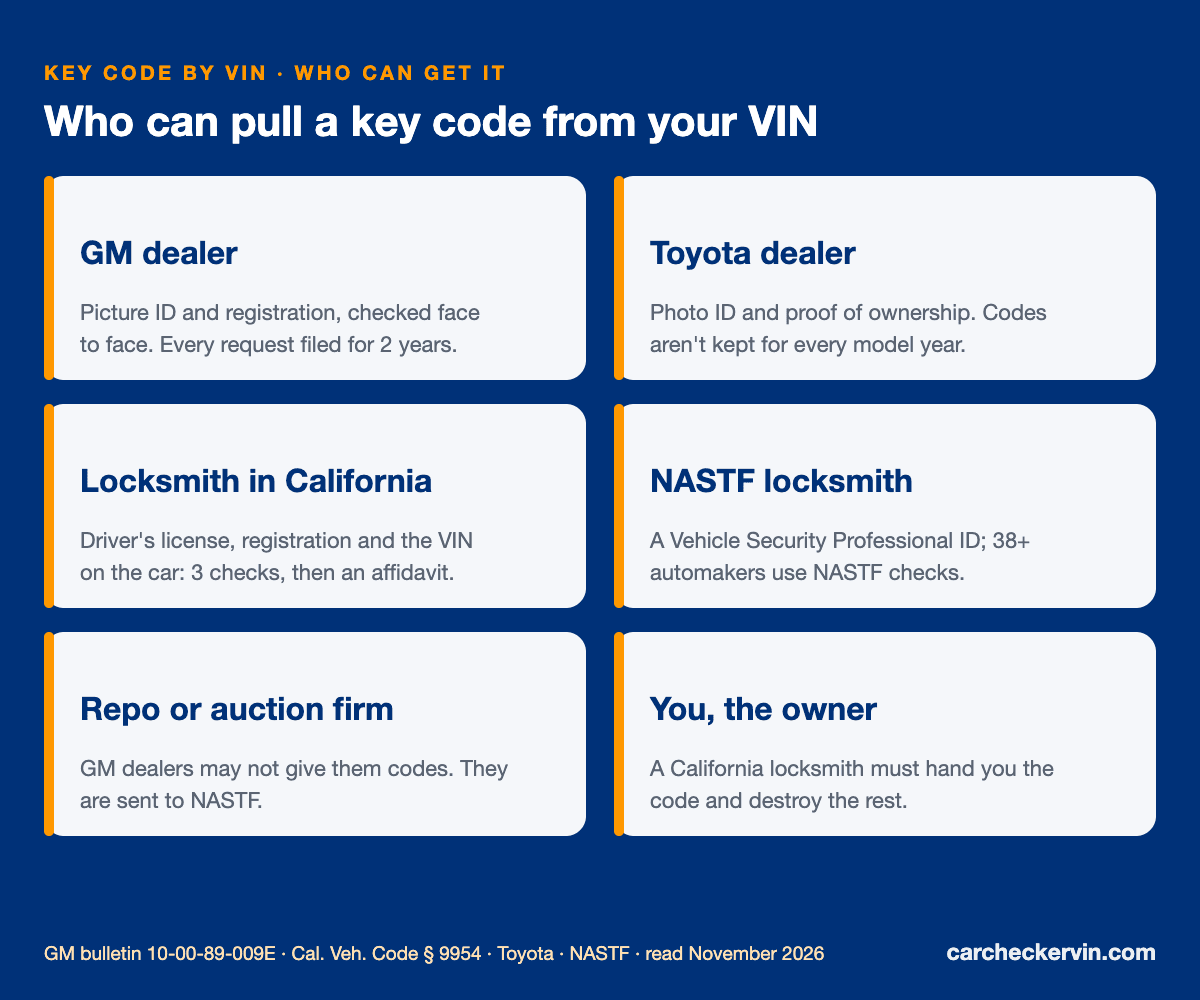
The VIN opens the record. These are the people allowed to open it, and the checks each source says they have to make first.
| Who | What they check | Source |
|---|---|---|
| GM dealer | Valid picture ID and the vehicle registration, matching the owner's name and VIN, face to face | GM Service Bulletin 10-00-89-009E |
| Toyota dealer | Photo identification and proof of ownership; the dealer needs the VIN | Toyota support article |
| Registered locksmith, California | Driver's license, a registration matching the person and address, and the VIN on the car matching the registration; then a signed affidavit | Cal. Veh. Code § 9954(b)(1) |
| Locksmith, any state | A Vehicle Security Professional credential, with D1 documentation for ownership where the automaker requires it | NASTF SDRM |
| Repossession or auction company | GM dealers may not give them codes at all; they're sent to NASTF | GM Service Bulletin 10-00-89-009E |
Read in November 2026. Other automakers set their own dealer rules; GM and Toyota are the two whose rules we could read in full.
Where the Key Code Comes From
Think of the code as sitting in three places. GM lists them: the original invoice to the dealer, a bar-coded tag that ships with the new car, and the GM KeyCode Look-Up application, which goes back 14 model years before the current one in the US (17 in Canada). Once the car is sold, GM says the key code belongs to the customer and to GM.
Toyota is blunter about the limits: it doesn't keep key codes for every model year. GM admits its look-up sometimes returns nothing for a valid VIN, and says that when no code can be found, "other measures" are needed. When a correctly cut key won't work, recoding the key or replacing the lock cylinder may be the fix.
California's Key-Code Law, Section 9954
California passed SB 1542 in 2006, and it now sits in the Vehicle Code as Section 9954. It applies to new passenger vehicles and pickups sold or leased in the state on or after January 1, 2008. Their makers have to let a registered owner, or a family member, get a replacement key made through a registered locksmith, by phone or online, 24 hours a day, every day of the week. The manufacturer must keep that information for at least 25 years from the date the car was built.
The locksmith's side is spelled out step by step. They check the requester's driver's license, check that the registration matches that person's name and address, and check that the VIN on the car matches the registration. Then they sign an affidavit and file it with the work order. When the job is done, they hand any key code they received to the owner and destroy everything they got from the manufacturer. A lessee named on the registration counts as the owner. Motorcycles and housecars are left out.
GM took the rule nationwide. Its bulletin says GM applies the California law in all 50 states and points every locksmith to NASTF for codes.
Why a Cut Key Still Might Not Start the Car
A key cut from the code will turn the lock. It won't necessarily start the engine. Toyota's answer for cars with an immobilizer, a computer chip built into the key, is that the car's computer has to be programmed with a dealership scan tool to accept the new key. Smart keys and remote fobs work the same way: the car has to learn them.
Sometimes the code itself is the problem. GM tells dealers that when a correctly cut key won't work, the lock cylinder may have been changed at some point, so the code on file no longer matches the lock. On a used car with unknown history, ask about the locks before you pay for a cut.
Bought a Used Car With Only One Key?
Run the VIN before you spend money on a second key. The free preview shows title brands, salvage records and odometer readings, so you know what you bought.
Metal Key, Chip Key or Smart Key: Who Can Replace It
The type of key decides where you go. This is what AAA, Toyota, GM and NASTF each say.
Plain metal key
AAA says a locksmith can make a replacement for a traditional key without the original, on the spot.
Chip (transponder) key
The car's computer has to accept the new chip. Toyota says that means programming with a dealership scan tool.
Smart key or fob
AAA's advice is to go to a dealer. NASTF-credentialed locksmiths also do immobilizer and module programming for participating automakers.
Motorcycle key
California's § 9954 covers passenger vehicles and pickups and leaves motorcycles out. Ask a dealer for the brand.
Car with no current registration
GM asks for the title, a current insurance policy or lien-holder details instead. Without proof, no code.
Code on file doesn't work
GM's bulletin says the lock cylinder may have been changed. The lock may need recoding or replacing.
Dealer vs Registered Locksmith
Both can get the code from the VIN. They get it through different doors, with different rules.
Brand dealer
- Looks the code up in the automaker's own system, using the VIN
- GM: valid picture ID and registration, checked face to face
- GM: keeps a file on every key request for at least 2 years
- Toyota: programs immobilizer keys with a dealership scan tool
Registered locksmith
- Gets codes through NASTF's Secure Data Release Model with a Vehicle Security Professional ID
- NASTF lists 38+ automakers using its credential checks and 57,000+ credentialed professionals
- California: licensed, bonded and registered with each manufacturer
- California: gives you the code, destroys the rest, files an affidavit
AAA notes a locksmith will usually come to you for a traditional key; for advanced keys it expects a tow to a dealer.
Red Flags When Someone Offers a Key From Your VIN
Key codes are guarded against theft. These are the signs a seller isn't playing by the rules the industry set for itself.
No ID asked for
GM, Toyota and California law all require proof of identity and ownership before a code is released.
Code by email or text
GM forbids its dealers from taking key-code requests, or giving codes, by fax or over the internet.
VIN only, nothing else
A VIN is printed on the windshield. Anyone who will cut a key from it alone would cut one for a stranger.
No credential
Ask a locksmith whether they're registered with NASTF. California requires them to be licensed, bonded and registered.
No paperwork for you
In California the locksmith signs an affidavit and files it with the work order. No paperwork means no record.
Pressure to pay upfront
Price the job once the source of the code is clear. A key that can't be programmed to your car is wasted money.
What Our Lookup Data Says About Key Codes
Most cars people check on CarCheckerVIN fall inside the key-code era. Between August 1 and October 31, 2026, 4,351 different VINs were looked up on the site. In a random sample of 1,000 of them decoded through NHTSA's vPIC, 736 of the 946 with a model year were 2008 or newer, about 78%. That's the model year from which GM applies the California rule. The other 210 were older, which is where codes are most likely to be missing: Toyota doesn't keep them for every year, and GM's look-up covers the last 14 model years.
Chevrolet, GMC, Buick and Cadillac, the brands GM's bulletin covers, made up 160 of the 986 sampled VINs with a decoded make (16%). Toyota was the most common single make in the sample, at 125.
Related Checks and Guides
Find the VIN, check the car, and see what else a VIN can and can't get you.
Where These Facts Come From
Every rule on this page comes from the automaker's own bulletin or support page, the statute, or the industry body that runs the locksmith registry.
How we made this page: written by the CarCheckerVIN editorial team with AI assistance, from the bulletin, statute and support pages linked above, read in November 2026. The model-year and make figures are our own: a seeded random sample of 1,000 of the 4,351 VINs looked up on the site from August 1 to October 31, 2026, decoded with NHTSA vPIC.
Car Key by VIN — Frequently Asked Questions
Key codes, programming and the paperwork.
Can I get a new key with my VIN number?+
Yes, from a dealer for your brand or a registered locksmith, once you prove ownership. The VIN lets them find the key code; your photo ID and registration let them release it. Cars with an immobilizer also need the new key programmed to the car.
Can I find my key code with my VIN number myself?+
Not directly. Automakers don't publish key codes. GM keeps them in a look-up system only authorized dealer staff can use, and locksmiths reach them through NASTF. A new car's code is also printed on the original invoice and a bar-coded tag, so check your purchase paperwork first.
Can a key be programmed by VIN number?+
The VIN finds the data, but the programming happens at the car. Toyota says a car with an immobilizer has to have its computer programmed with a dealership scan tool to accept the new key.
Can a spare key be made from the VIN number?+
Yes, the same way as a replacement: a dealer or registered locksmith looks up the code from the VIN after checking your ID and registration. If you still have a working key, a locksmith can often copy it instead.
What do I need to bring to get a key code?+
A government photo ID and a registration showing your name and the car's VIN. GM accepts the title, a current insurance policy or lien-holder details when the car isn't registered. In California a locksmith also has to see the VIN on the car itself.
Can you get a motorcycle key from a VIN number?+
Usually through a dealer for the brand. California's key-access law, Vehicle Code § 9954, covers passenger vehicles and pickups only and leaves motorcycles out, so the process is whatever the maker offers.
How far back do key codes go?+
It depends on the maker. GM's look-up covers the current model year and the 14 before it (17 in Canada). California requires makers to keep key information for at least 25 years for cars sold there from January 1, 2008. Toyota says it doesn't keep codes for every model year.
Can someone steal my car with my VIN?+
Not with the VIN alone. The VIN is printed on the windshield for anyone to read, which is exactly why automakers won't release a key code without photo ID and a registration matching the VIN. If a dealer or locksmith doesn't ask for both, go elsewhere.
Check the Car Before You Pay for the Key
Enter any 17-character VIN for a free preview. The full report is $14.99 once and lists title brands, NMVTIS junk and salvage records, insurance total-loss records, odometer readings, and auction records with the damage the auction recorded and its photos.
This page summarizes manufacturer rules and state law for general information and is not legal advice. Rules were read in November 2026; other automakers set their own dealer procedures. CarCheckerVIN does not cut keys or release key codes, and is not affiliated with any automaker, NASTF or AAA. Records in our reports reflect what was reported to our data providers. Our reports do not include police or repair-shop accident entries.
Related VIN Checks
More tools to verify any vehicle's history