Certified pre-owned? It's a warranty, not a past.
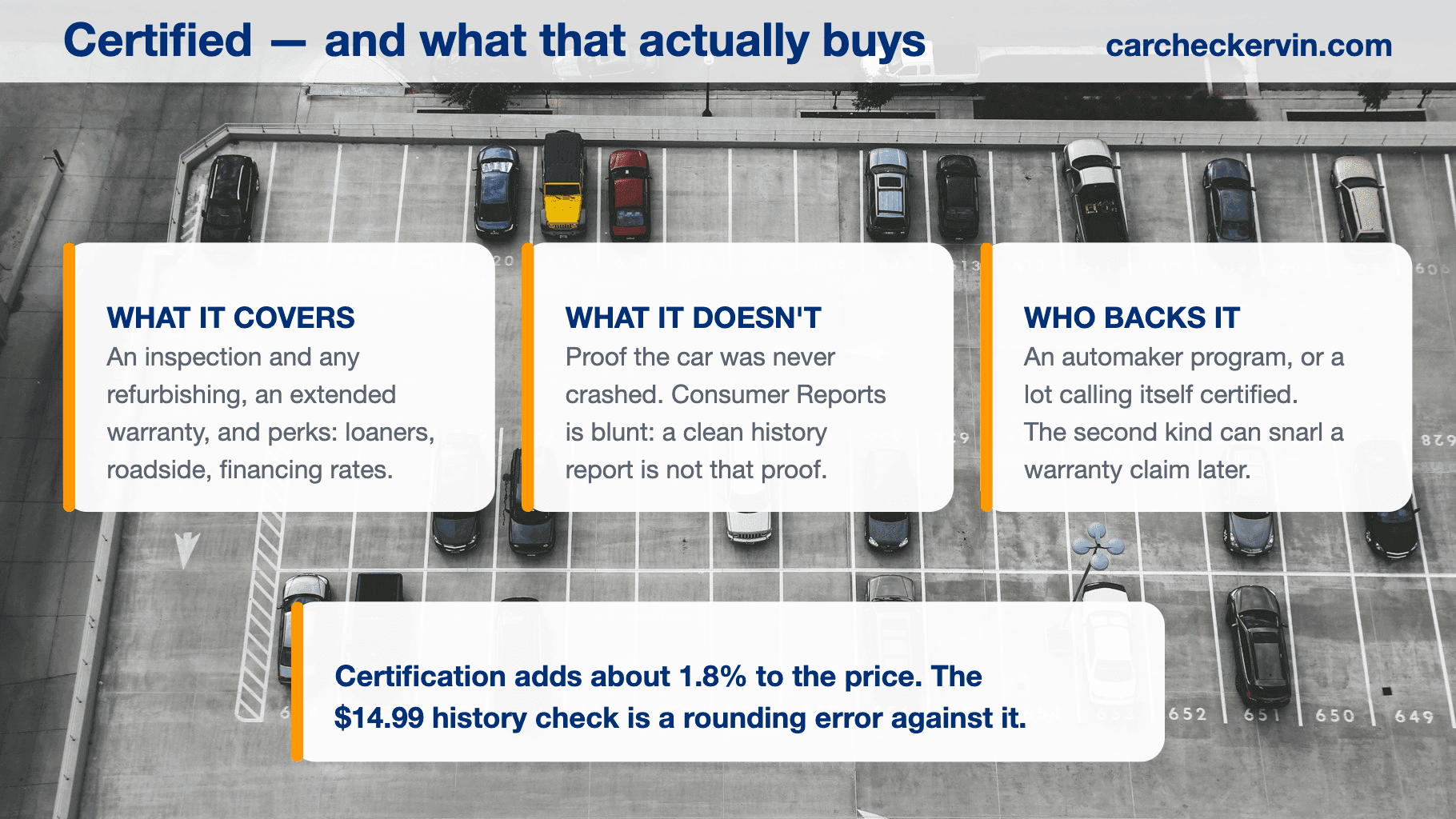
CPO buys you an inspection, refurbishing and an extended warranty — real value, at roughly a 1.8% premium. What it never buys is a clean history. That part still travels with the VIN.
Check the records behind any certified car
17 characters in — the free preview flags title brands, accident records and odometer issues in seconds.
Free preview · no card, no account
Quick Answer
- What does certified pre-owned mean?
- A used car a program has vetted and refurbished, sold with an extended warranty. Consumer Reports describes a CPO vehicle as one judged to be in better operating condition than its peers after extensive inspection and any needed refurbishing — usually bundled with perks like loaner cars, roadside assistance and discounted finance rates.
- Is certified pre-owned worth the extra money?
- Often, for the warranty alone. Kelley Blue Book data cited by Consumer Reports puts the CPO premium at roughly 1.8%over a comparable non-certified used car — hundreds to thousands of dollars depending on the model. Whether that's a bargain depends on the program backing it and what the car's records say.
- Does CPO mean the car was never in an accident?
- No.Certification is a condition-and-warranty program, not a clean-history guarantee — a car with a reported accident can still be certified. Consumer Reports goes further: even a clean history report isn't proof a vehicle was never crashed. Check the records yourself for $14.99, then judge the badge on top of them.
What the badge actually is
Strip the marketing and a CPO program is four promises — three about the car's present, none about its past:
| The promise | What it means | What it doesn't cover |
|---|---|---|
| An inspection | The car is checked against the program's standard and refurbished where needed | The inspector works for the seller, not for you |
| An extended warranty | Coverage beyond the original factory term — the core of the value | Terms, length and deductible vary enormously by program |
| Ownership perks | Typically loaner cars, roadside assistance and discounted finance rates | Nice, but not why the premium is worth paying |
| A condition judgement | The car is deemed to be in better operating shape than its peers | Says nothing about accidents, title brands or odometer history |
That last row is the whole reason this page exists. Certification grades how the car is today. The records say what happened to it — and the two can disagree completely.
Automaker CPO versus “certified” on a windshield
The single most valuable thing to establish before you pay a premium is who stands behind the badge:
Manufacturer-backed programs
The automaker sets the standard, the warranty is honored at any franchised dealer for that marque, and the paperwork is the automaker's. This is what the CPO premium is priced for.
Dealer or third-party “certified”
Consumer Reports puts it plainly: a car may be advertised as certified without the backing of an automaker's official program. These carry risks — including a paperwork snarl when you actually try to make a warranty claim.
Ask which program, in writing
One sentence settles it: which manufacturer program is this car certified under, and can I see the certification paperwork? A confident answer costs nothing. A vague one just told you what you're buying.
What certification does not prove
Three things a CPO badge is silent about — each of them a records question, and each capable of costing more than the premium saved:
A reported accident
Programs set damage thresholds, not accident-free requirements. A car repaired to standard can be certified while its file carries a reported collision that follows it to resale.
A brand in another state
Salvage, flood and rebuilt brands attach to the title across state lines. The badge on the windshield does not read the federal record; a history report does.
The odometer's story
Certification checks the mileage displayed. Recorded readings in sequence are what prove the number never went backwards — a paper trail, not a glance at the cluster.
Open safety recalls
Consumer Reports advises checking recalls independently rather than assuming certification cleared them. Open recalls are free to fix and free to look up — but only if you look.
Who owned it and how
Owner count and usage type — rental, fleet, commercial — sit in the records, not in the certification. They move resale value whether or not the badge mentions them.
What the auction saw
Cars that crossed a salvage lane were photographed there. A refurbished, certified car and its auction photo can be the same VIN on very different days.
The honest caveat runs both ways: Consumer Reports also warns that a clean history report is not itself proof a car was never crashed — unreported damage exists. Which is exactly why the answer is layered checks, not one badge and one document.
Certified is the seller's verdict. Get your own.
Free preview first: title brands, accident records and odometer flags for any 17-character VIN — the full report when the car deserves it.
Is the premium worth paying?
Kelley Blue Book data cited by Consumer Reports puts certification at about 1.8% over a comparable used car — hundreds to thousands, depending on the model. Three ways that math lands:
Worth it: the warranty carries the deal
On a complex, expensive-to-repair car with a manufacturer-backed program behind it, an extended warranty for a small percentage of the price is straightforwardly good value. One covered repair can return the premium several times over.
Marginal: the badge is doing the selling
When the certification is the dealer's own and the warranty terms are thin, you're paying a premium for a sticker and an inspection you didn't commission. Price the car as an ordinary used car and see whether it still looks good.
Wrong: the records say no
A branded title, an odometer that doesn't reconcile, or an accident record the seller never mentioned. No certification fixes any of those, and the premium buys you a warranty on a car you shouldn't be buying.
How to check a certified car in three steps
Free first — and most of the work happens before you visit the lot.
Preview the VIN
Enter the 17-character VIN from the listing. The free preview shows whether title brands, accident records or odometer flags exist before you drive anywhere or fall in love with a clean-looking car.
Read the full record
Every state title and brand, accident and total-loss records, auction sales with photos, owner history and open recalls — delivered in under 60 seconds. This is the half certification never speaks to.
Pin down the program and the warranty
Which manufacturer program certified it, what the warranty covers, how long it runs, what the deductible is — in writing. Then consider an independent inspection anyway: the certifying inspector was working for the seller.
Related checks before you pay the premium
The rest of the pre-purchase homework, in the same plain terms.
Always check the VIN before you buy
The free preview shows title brands, theft status and open recalls in seconds, and flags whether accident and odometer records exist. The full history is $14.99 — one-time, no subscription.
Certified pre-owned — the questions buyers ask
Straight answers, including the ones that favour buying the CPO car.
What does certified pre-owned actually mean?+
It means a used car has been through a program's inspection, refurbished where the standard required it, and sold with an extended warranty — Consumer Reports describes a CPO car as one judged to be in better operating condition than its peers. Most programs add perks such as loaner cars, roadside assistance and discounted finance rates. It is a statement about condition and coverage, not about the car's history.
How much more does a CPO car cost?+
Kelley Blue Book data cited by Consumer Reports puts CPO vehicles at approximately 1.8% more than comparable non-certified used cars — which works out to hundreds or thousands of dollars depending on the model. Whether that premium is worth paying turns almost entirely on whether an automaker stands behind the certification.
Can a certified pre-owned car have been in an accident?+
Yes. Certification programs set damage and condition thresholds; they do not require an accident-free history. A car repaired to the program's standard can carry a reported collision in its records and still wear the badge. That record follows the VIN and shows up again when you sell, which is why buyers should read it before paying a certified premium.
Is dealer-certified the same as manufacturer CPO?+
No, and the difference matters most at claim time. Consumer Reports warns that a used car may be advertised as certified without the backing of an automaker's official program, and that dealer or third-party certifications carry risks — including a paperwork snarl when you try to make a warranty claim. Ask which manufacturer program certified the car, and get the answer in writing.
Do I still need a vehicle history report on a CPO car?+
Yes — certification and history answer different questions. The badge grades the car's current condition; the records show title brands from every state, accident and total-loss entries, the odometer timeline and open recalls. Consumer Reports itself advises obtaining history reports and checking recalls independently rather than assuming the certification covered them.
Should I still get an independent inspection?+
On any car you're serious about, yes. The certifying inspection was commissioned by the seller and performed to the program's standard — useful, but not the same as a mechanic whose only customer is you. Records first, then your own inspection, then the premium. Each step is cheaper than the mistake the next one catches.
When is buying certified pre-owned clearly the right call?+
When the program is manufacturer-backed, the warranty is substantial, the car is expensive to repair, and the records come back clean. That combination is genuinely good value — you're buying a vetted car with real coverage for a small percentage over an ordinary used one. The premium only stops making sense when the badge is the dealer's own or the history contradicts it.
Judge the badge on top of the records.
Title brands, accident records, odometer history and open recalls for any VIN — in under a minute, for less than a tank of fuel.
Related VIN Checks
More tools to verify any vehicle's history