Dealer Plates — what they cost, who can drive on them and where they can't go.
Dealer plates let a licensed dealer drive the cars it has for sale without registering each one. Each of these five states ties them to the dealer license and limits what they go on: work trucks, rentals, loaded haulers and hire are the usual exclusions. The fees are small, $20 a year in Texas, $92 in California, a $17 license tax in Florida. The rules on who may drive and what for are where the states differ. Here is what five states' statutes say.
Check the Cars Before They Wear Your Plate
A dealer plate goes on inventory, and inventory comes from auctions and trade-ins. Enter a VIN for a free preview of its title brands and odometer records.
Free preview · No sign-up · No owner or personal data
Quick Answer
- What are dealer plates?
- License plates issued to a licensed dealer, not to a vehicle. Texas § 503.061 lets a dealer attach them "instead of registering" an inventory vehicle of a type it sells under its general distinguishing number; California § 11715 lets a dealer move unregistered vehicles it owns on "special plates" that show its dealer number; Florida § 320.13 makes them valid on inventory and business use, "but not valid for use for hire".
- How do you get dealer plates?
- Get the dealer license first: no state issues dealer plates without it. Then apply to the state with the fee: $20 a year in Texas, $92 a plate in California plus county fees, the $17 license tax in Florida, $60 for the first two in Virginia (form MVDB 9, with proof of insurance) and $30 a plate or pair in Arizona. California's DMV notes that dealer plates are not required to hold a license.
- Can anyone drive a car with dealer plates?
- No. Each state names who may. Texas allows demonstrations to prospective buyers and listed trips such as to a repair shop or another dealer; California lets a prospective buyer test-drive for up to 7 days; Virginia allows dealers, dealer-operators, their spouses and employees, for business, personal and family use; Arizona allows employees in the business, or a full-time employee the car is assigned to, with the assignment recorded.
Five rules dealer plates come with
The details differ; the pattern doesn't. Dealer plates follow the license, the inventory and the purpose.
- 1License firstTexas, California, Florida, Virginia and Arizona all issue dealer plates only to licensed dealers, and Texas plates expire with the license.
- 2Pay per plate, every year$20 in Texas, $92 in California, $17 in Florida, $30 in Arizona; Virginia charges $60 for the first two.
- 3Inventory onlyThe plate goes on a vehicle the dealer owns and has for sale, of a type its license covers, not on a customer's car or a sold one.
- 4No work trucks, rentals or loadsService and work vehicles, rented or leased vehicles and loaded commercial vehicles are barred, with narrow exceptions.
- 5Insure every plateVirginia makes the dealer certify liability insurance on each plate; Arizona applies its financial-responsibility chapter to them.
What Dealer Plates Are For
A dealer's inventory turns over constantly, and registering every car for the weeks it sits on the lot would be pointless. So states issue plates to the dealer instead. Texas § 503.061 puts it plainly: "Instead of registering under Chapter 502 a vehicle that the dealer owns, operates, or permits to be operated on a public street or highway, the dealer may apply for, receive, and attach dealer's license plates", but only to the type of vehicle the dealer sells and holds a general distinguishing number for. California § 11714 has the DMV issue "special plates" carrying the dealer's general distinguishing number, each with its own identifying number or symbol, and § 11715 lets the dealer operate an unregistered vehicle it owns or lawfully possesses on them.
Florida's § 320.13 frames it as a use test: dealer plates are "valid for use on motor vehicles or mobile homes owned by the dealer to whom such plates are issued while the motor vehicles are in inventory and for sale, or while being operated in connection with such dealer's business, but are not valid for use for hire". Virginia's § 46.2-1550 and Arizona's § 28-4532 say the same thing in their own words: the plate belongs on inventory, operated by the people and for the purposes the statute lists. Dealer plates are also different from the plates and paper tags a dealer hands a buyer at the sale, which the second half of this page covers.
Dealer Plate Fees in Five States
From each state's statute or licensing agency, read on 17 October 2026.
| State | Dealer plate fee | Other plate fees in the same law |
|---|---|---|
| Texas (§ 503.008) | $20 a year | $10 per temporary plate; personalized prestige dealer plates $40 a year extra |
| California (DMV) | $92 per plate | $94 per motorcycle plate; county fees may apply |
| Florida (§ 320.08(12)) | $17 flat license tax | $4.50 to move a regular plate between dealer vehicles (§ 320.13(3)) |
| Virginia (MVDB) | $60 for the first two | $26 for each additional plate |
| Arizona (§ 28-4533) | $30 per plate or pair | $10 for a motorcycle dealer |
So five plates cost a Virginia dealer $138 and a Texas dealer $100 a year. Florida dealers may buy specialty plates instead of the standard dealer plate, paying every specialty-plate fee themselves. Insurance on the plated vehicles is a separate cost.
Where Dealer Plates Can't Go
Every statute here lists vehicles and uses the plates don't cover. These are the ones that catch dealers.
Work and service vehicles
Barred in Texas (§ 503.068), California (§ 11715(d)) and Arizona (§ 28-4532). Texas lets an independent dealer use one to haul its own inventory to or from a sale; Arizona exempts a new-car dealer's manufacturer service-program vehicle.
Loaded commercial vehicles
Texas bars a metal dealer plate on a commercial vehicle carrying a load. California excludes unregistered vehicles hauling more than one load of vehicles for sale; Arizona allows a hauler only with up to three dealer-owned vehicles for resale.
Rented and leased vehicles
California excludes dealer-owned leased vehicles, except those leased to salespeople for display or demonstration. Arizona excludes leased or rented vehicles, and Virginia forbids lending, leasing or renting the plates out.
Anything for hire
Florida's plates are not valid for use for hire, and may not go on a tow truck or wrecker unless it is being demonstrated for sale, or on a vehicle hauling another vehicle for the dealer.
A vehicle that's been sold
Arizona says so outright. Everywhere, the plate is for inventory; once the car is sold, the buyer's registration or a dealer-issued buyer plate takes over.
A vehicle type you aren't licensed for
Texas ties dealer plates to the type of vehicle the dealer sells and has a GDN for. A motorcycle dealer's plates don't belong on a car.
Who May Drive a Car on Dealer Plates
Texas separates its metal dealer plate from the dealer's temporary plate. Under § 503.062 the dealer or its employees may use a temporary plate on an unregistered vehicle only to demonstrate it to a prospective buyer, to move it between the dealer's locations, to and from a repair or service shop, from the state line or an unloading point, to another dealer, from where the dealer bought it, for a road test, or for a charitable organization. The section does not stop a dealer letting a prospective buyer drive during a demonstration, or lending a customer a vehicle while the customer's is in for repair.
California's § 11715(a) lets a prospective buyer or lessee test-drive a dealer's vehicle on its special plates for "a period not to exceed seven days", and § 11715(f) requires the plate's registration card, or a copy, to stay with the vehicle. Virginia's § 46.2-1550 allows dealers, dealer-operators, their spouses and the dealer's employees to use the plates on inventory for "business, personal, and family purposes". Arizona's § 28-4532 allows the dealer or an employee in the business, a prospective buyer under the section's conditions, and personal use by the dealer or a full-time employee the vehicle is assigned to on a full-time basis, if the assignment is recorded.
Who may drive, by state
- Texas: dealer and employees for listed trips; buyers on a demonstration.
- California: a prospective buyer for up to 7 days.
- Florida: inventory and the dealer's business; never for hire.
- Virginia: dealers, dealer-operators, spouses, employees.
- Arizona: employees; full-time assigned staff if recorded.
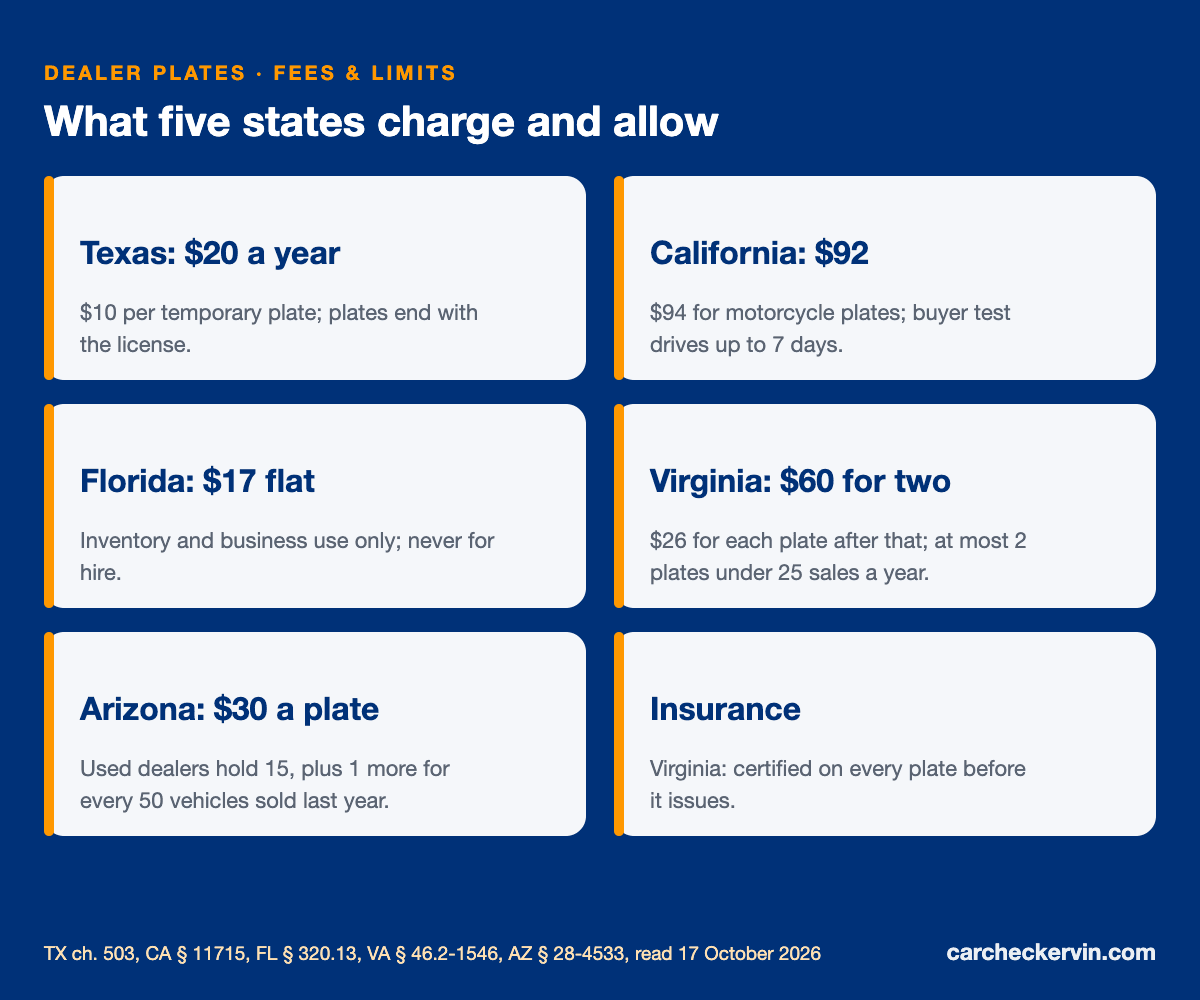
Dealer Plate Fees and Limits at a Glance
The five states' fees and plate counts on one card, with the use limits that apply in each.
Every figure comes from the statutes and agency pages listed under the sources, read on the date shown.
How Many Dealer Plates a Dealer Can Hold
Two of the five states put a number in the statute. The others leave it to the agency.
| State | Limit on dealer plates |
|---|---|
| Arizona, new-car dealer | Up to 150 |
| Arizona, used-car dealer | 15, plus 1 for every 50 vehicles sold last license year (200 sales: 19 plates) |
| Arizona, wholesale dealer | 2, plus 1 per 50 sales, never more than 10; at least 10 sales to dealers to keep them |
| Virginia | At most 2 if the dealership sold fewer than 25 vehicles in the last 12 months of the prior license year |
| Texas | No count for metal dealer plates in the sections read; TxDMV may cap buyer plates by rule, based on sales data |
| California, Florida | No count in the sections read; Florida issues "one or more" on payment of the tax |
Ask the agency before you order: a plate count the statute doesn't fix can still be set by rule or by the agency's form.
Insurance on Dealer Plates
Virginia is the most explicit. Section 46.2-1547 makes it unlawful to use or permit the use of any dealer plate without automobile liability insurance coverage (or a certificate of self-insurance), and no dealer plate is issued unless the dealer certifies to the DMV that each one is covered; the Board's form for plates, MVDB 9, asks for a copy of the policy showing the number of plates insured. Arizona's § 28-4533 says a dealer who obtains dealer plates "shall comply with chapter 9 of this title", the state's financial-responsibility chapter.
Florida ties insurance to the license rather than the plate: every applicant must show garage liability insurance of at least $25,000 combined single limit plus $10,000 of personal injury protection under § 320.27. Texas and California put no plate-specific insurance rule in the sections read here. Ask your garage-liability carrier how it covers plated vehicles, prospective buyers and employees' personal use.
Check Every Car You Plate
Enter the VIN for a free preview of the title brands, junk and salvage records and odometer readings on file before the car goes on your lot.
Dealer Plates vs. the Plates Dealers Give Buyers
Texas law now has dealers issue license plates to buyers at the sale. Section 503.063 requires a dealer to issue the buyer a plate or set of plates valid while the dealer-filed registration is pending, and § 503.0631 makes the dealer enter the buyer's information into TxDMV's real-time database before the plates may be displayed (or the next business day, on a signed form, if the dealer's internet is down). The dealer may charge up to $20 for that compliance, is liable for missing or misused plates, and may not sell or hand out dealer-issued plates except with a vehicle sale (§ 503.0671).
Two Texas variants cover out-of-state situations. A nonresident buyer whose vehicle will be titled and inspected at home can get a temporary plate valid for 60 days without a Texas inspection. And TxDMV can issue a $3 temporary metal plate, valid 60 days, to someone driving a new unregistered vehicle home from an out-of-state dealer or factory. None of these are dealer plates: they belong to the buyer's vehicle. A dealer plate stays with the dealer and goes back on the next car.
Texas plate types, side by side
- Dealer plate: $20/yr, on inventory (§ 503.061).
- Temporary plate: $10, for listed trips (§ 503.062).
- Buyer plate: issued at the sale, entered in the database first.
- Out-of-state buyer: $3, 60 days (§ 503.065).
Dealer Plates or Registering the Car
A dealer can still register an inventory car like anyone else. When each makes sense, from the statutes.
Dealer plates
- One plate serves car after car; no registration per vehicle.
- Only on inventory, of a type your license covers.
- Use limits: no work trucks, rentals, loads or hire.
- Texas plates expire with the dealer license.
Registering the inventory car
- The car carries its own registration and plate.
- No dealer-plate use limits on that car.
- Florida lets a dealer move that regular plate to a comparable dealer-owned vehicle after the sale for $4.50 (§ 320.13(3)).
- California lets a dealer drive a currently registered car it bought without special plates once the former owner's transfer notice is filed and a copy is displayed (§ 11715(e)).
Personalized plates are an option too: Texas sells personalized prestige dealer plates at $40 a year on top of the plate fee.
Related Checks and Guides
The dealer-license series state by state, and the auctions and tools a dealer uses next.
Where These Facts Come From
From each state's code as published by its legislature, and the California DMV's fee list, read on 17 October 2026. Plate fees and forms change; confirm with the issuing agency before you order.
CarCheckerVIN is not affiliated with any state motor vehicle agency, insurer or dealer association. This page is general information, not legal advice. Dealer plates can't be bought by anyone who isn't a licensed dealer; sellers of novelty or promotional plates are not selling registration.
Dealer Plates — Frequently Asked Questions
What dealers and buyers ask most.
How much are dealer plates?+
Per plate: $20 a year in Texas, $92 in California ($94 for motorcycle plates, plus county fees), a $17 flat license tax in Florida, $30 a plate or pair in Arizona, and $60 for the first two plus $26 each after that in Virginia.
Can you drive a car with dealer plates for personal use?+
Depends on the state. Virginia allows dealers, dealer-operators, spouses and employees to use them for business, personal and family purposes. Arizona allows personal use by the dealer or a full-time employee the car is assigned to, if the assignment is recorded. Florida limits them to inventory and the dealer's business, and never for hire.
Can I buy dealer plates without a dealer license?+
No. Each of these states issues dealer plates only to licensed dealers; Texas ties them to the dealer's general distinguishing number and ends them when the license expires. Texas also makes it unlawful to sell or distribute dealer-issued buyer plates except in connection with a vehicle sale.
Do dealer plates need insurance?+
Virginia requires the dealer to certify automobile liability insurance on every dealer plate before it is issued, and makes uninsured use unlawful. Arizona applies its financial-responsibility chapter to dealers who get plates. Florida requires garage liability insurance for the license itself. Check with your carrier how plated vehicles are covered.
How long can a customer test-drive a car on dealer plates?+
California sets the clearest limit: a prospective buyer or lessee may operate a dealer's vehicle on its special plates for no more than 7 days (§ 11715(a)). Texas lets a prospective buyer drive during a demonstration and a customer use a dealer vehicle while theirs is being repaired.
What's the difference between dealer plates and temporary tags?+
Dealer plates belong to the dealer and move from inventory car to inventory car. Temporary tags or buyer plates are issued for a specific sold vehicle until its registration is processed. In Texas, dealers now issue buyers plates entered in TxDMV's database, and a nonresident buyer's temporary plate is valid for 60 days.
Run the VIN Before It Goes on the Lot
Enter any 17-character VIN for a free preview. The full report lists title brands, NMVTIS junk and salvage records, insurance total-loss records, odometer readings, and auction records with the damage the auction recorded and its photos.
CarCheckerVIN is an independent vehicle-history service and is not affiliated with any state motor vehicle agency. Plate rules are summarized from the statutes and agency pages named on this page and are not legal advice. Records in our reports reflect what was reported to our data providers. Our reports do not include police or repair-shop accident entries.
Related VIN Checks
More tools to verify any vehicle's history