Wholesale Car Auctions — Who Gets In, and What You Give Up at the Door.
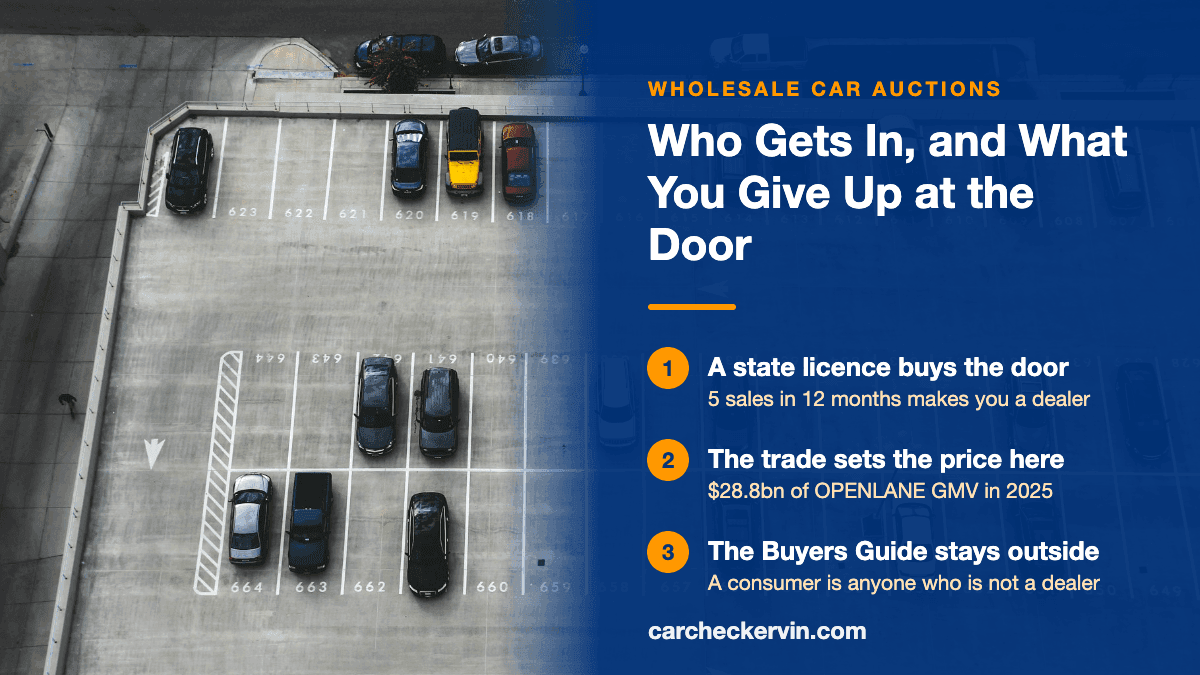
Dealer-only auctions move cars at trade money — OPENLANE alone reported $28.8 billion of gross merchandise value in 2025. The licence requirement is the famous barrier. The quieter one is that the FTC Buyers Guide never has to appear in a dealer-to-dealer sale. Enter a VIN to see what the condition report will not tell you.
Check a Wholesale Lot Before You Bid
Enter the 17-character VIN for title brands across all 50 states, total-loss records, odometer readings and open recalls — instantly, with no sign-up.
Free · No sign-up · NMVTIS-sourced title and brand data
Quick Answer
- What is a wholesale car auction?
- It is where dealers buy and sell cars from each other, away from the retail forecourt. The scale is not small: OPENLANE reported roughly 1.5 million vehicle transactions and $28.8 billion of gross merchandise valuein 2025, and says its buyers “primarily include franchise and independent dealer customers.”
- Is a dealer-only car auction really dealer-only?
- On the major wholesale platforms, yes — registration is gated on a state dealer licence. The FTC's test for who counts as a dealer is specific: someone who sells or offers a used vehicle after selling or offering five or more in the previous twelve months (16 CFR § 455.1(d)(3)).
- Do I lose any protection buying wholesale?
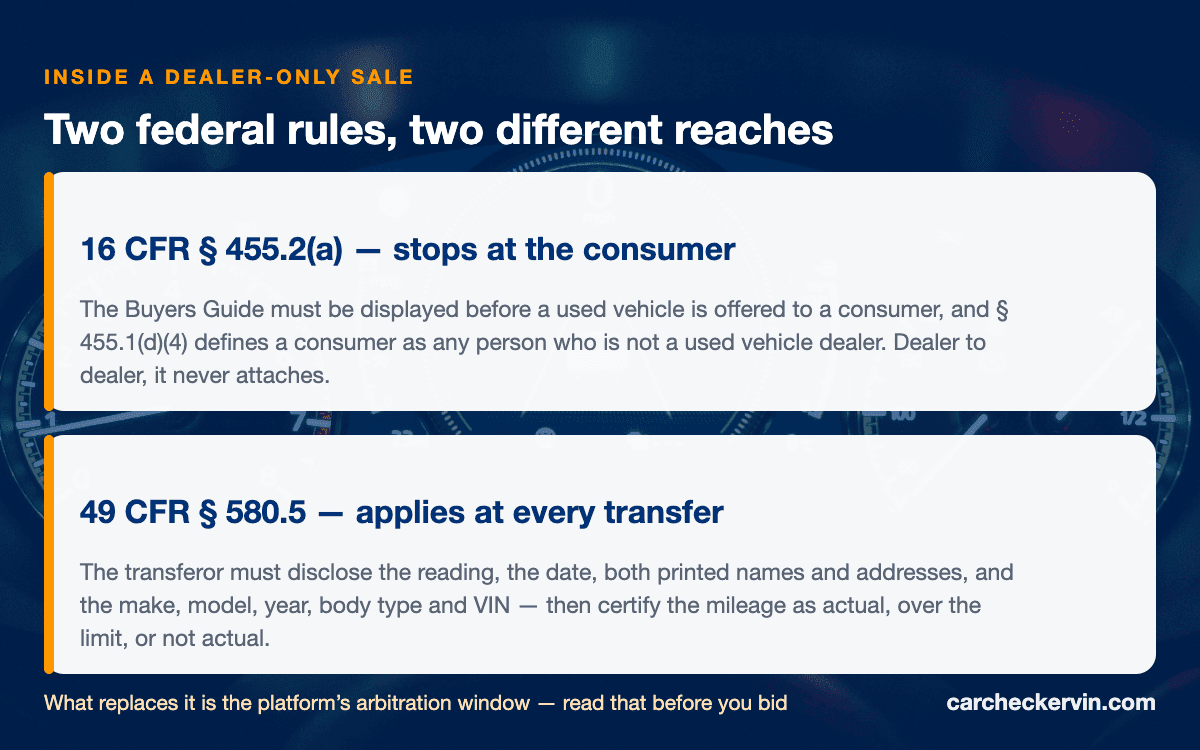
- Yes, and it is the least-discussed part. The FTC Used Car Rule defines a consumer as “any person who is not a used vehicle dealer” — so the Buyers Guide a dealer must display for you never has to appear in a dealer-to-dealer sale. Federal odometer disclosure under 49 CFR § 580.5 still applies.
The Wholesale Platforms, Side by Side
Five of these are wholesale marketplaces for trade-grade cars. The sixth is a salvage operator that ends up in the same search results and runs on a completely different premise. Every figure below is from the company's own annual filing.
OPENLANE (formerly ADESA / KAR)
A digital wholesale marketplace whose 10-K states that buyers on its platforms primarily include franchise and independent dealer customers. Its finance arm, AFC, floorplans independent used-vehicle dealers from roughly 90 branch locations. KAR bought OPENLANE in 2011, spun IAA off in 2019, sold ADESA's US physical auction sites in 2022, and took the OPENLANE name in 2023.
ADESA (now Carvana-owned)
Carvana's filing records that acquiring ADESA US Auction, LLC in 2022 provided 56 additional locations, of which 16 had been built out for inspection and reconditioning capability by 31 December 2025. The physical lanes and the OPENLANE digital marketplace are now separate businesses that share a family name — a real source of confusion when you are searching for one and land on the other.
ACV Auctions
A digital-first wholesale marketplace built around condition reports rather than a physical lane. Its FY2025 numbers show 829,276 marketplace units against 743,008 the year before, and $10.4 billion of GMV against $9.5 billion. Its registered base is genuinely trade-sized rather than public: 22,062 marketplace buyers and 14,905 marketplace sellers in 2025.
CarMax Auctions
Unusual in the sector because, in its own words, it owns all of the vehicles it sells in its auctions — these are the appraisal cars that did not meet its retail standard. CarMax purchased approximately 1.1 million vehicles from consumers and dealers in fiscal 2026 and says roughly half of appraised cars make the retail grade; the rest go to licensed dealers through the auctions, which have run primarily virtually since fiscal 2021 at an average sales rate of about 99%.
Manheim
The name most people mean when they say "the auction", and part of Cox Automotive — the same firm whose data Carvana cites for more than 37 million used-vehicle transactions in 2024. Access follows the same pattern as the rest of the wholesale sector: a dealer registration backed by a state licence, not a public sign-up.
Copart (salvage, not wholesale)
Included because it is constantly confused with this category and it is not the same market. Copart's FY2025 filing puts 81% of processed volume as insurance-sourced — these are written-off cars, not trade-grade retail stock. It also runs a Registered Broker programme letting the public buy through a member, which is precisely the door the dealer-only wholesale platforms do not open.
What “Dealer Only” Actually Means
There is no federal dealer licence. Every state issues its own, usually in classes — retail, wholesale-only, salvage — and the wholesale marketplaces verify that licence before they will let you register. That is the whole of the barrier, and it is why “dealer only” is a phrase about credentials rather than about who is standing in a room. Since fiscal 2021 CarMax has run its auctions primarily virtually; ACV was built digital from the start. The room mostly no longer exists.
The FTC's definition is worth reading, because it is narrower than people assume. Under 16 CFR § 455.1(d)(3) a dealer is a person who sells or offers a used vehicle for sale to a consumer after selling or offering for sale five or more used vehicles in the previous twelve months. Cross that line and you are a dealer for the purposes of the rule whether you hold a licence or not — which is a compliance problem, not an access route. The platforms want the licence.
The trade side of the market is genuinely trade-sized, not a mass audience wearing a badge. ACV reported 22,062 marketplace buyers and 14,905 marketplace sellers in 2025, up from 20,975 and 14,377 a year earlier. OPENLANE notes that vehicles it purchases for its own account represent approximately 2% of the total volume sold on its platforms — the marketplaces are intermediaries, not the counterparty.
Signals worth slowing down for
- A licence-for-hire or "auction access" service that wants payment before it will name the platform it registers you with
- A wholesale price far below comparable trade money, on a car whose condition report reads unremarkably
- A title in a state neither the seller nor the car has any obvious connection to, issued recently
- An odometer disclosure marked "not actual mileage" that the listing text does not mention
- Arbitration terms that close before you could realistically get the car inspected
- A seller pressing you to skip the VIN history because the condition report "already covers it"
Five Steps From No Access to a Bid
Wholesale access is a sequence, and each step is verified by somebody different — your state, then the platform, then your lender. The last one is the only step you control entirely.
- 1Get the state licenceWholesale registration is downstream of a dealer licence issued by your state — typically a bonded, insured, zoned business location and a background check. There is no federal dealer licence to apply for.
- 2Register with the platformEach marketplace verifies the licence separately. OPENLANE, ACV and CarMax all describe a registered, credentialed buyer base rather than open public bidding.
- 3Arrange floorplan or fundsTrade buyers rarely pay cash per car. OPENLANE's AFC subsidiary exists for exactly this, providing floorplan financing to independent used-vehicle dealers from around 90 branches.
- 4Read the condition reportDigital wholesale runs on inspection reports, not walk-arounds. The report is the seller's account of the car — useful, and not the same thing as an independent record.
- 5Run the VIN yourselfThe condition report describes today. The VIN describes every yesterday: title brands across all 50 states, total-loss events, odometer readings and open recalls.
Check the Lot Before the Hammer
Enter the VIN for title brands across all 50 states, total-loss records and open recalls — free. The full event timeline is one click further.
The Protections That Switch Off — and the One That Does Not
This is the part of dealer-only buying that nobody advertises. Trade-to-trade sales are deliberately outside the consumer-protection framework, because both sides are presumed to know what they are looking at. Read both columns before you decide the discount is worth it.
Does not reach a dealer-to-dealer sale
- The FTC Buyers Guide — § 455.2(a) requires it before a vehicle is offered to a consumer, and § 455.1(d)(4) defines a consumer as any person who is not a used vehicle dealer
- State used-car warranty and lemon statutes, most of which are written around a retail consumer sale
- Any implied "as is" disclosure duty, because the Buyers Guide is where that box lives
- Cars sold only for scrap or parts, which § 455.1(d)(2) excludes from the definition of a used vehicle entirely
Applies at every transfer regardless
- Federal odometer disclosure at transfer — 49 CFR § 580.5(c) requires the reading, the date, both parties' printed names and addresses, and the vehicle's make, model, year, body type and VIN
- The written warning under § 580.5(d) that federal law requires the disclosure and that false information may result in fines and/or imprisonment
- The § 580.5(e) certification that the reading is the actual mileage, exceeds mechanical limits, or is not the actual mileage
- Title branding itself, which is a matter of state record and follows the VIN whoever buys the car
In practice your recourse on a wholesale car is the platform's arbitration policy and the odometer record. Both are worth checking against the VIN's own auction history before you commit to a bid.
Wholesale Is Not Salvage — the Difference That Costs Money
The two words travel together in search results and describe different businesses. A wholesale lane sells running, titled cars between dealers: trade-ins, off-lease returns, fleet disposals, and the appraisal cars a retailer decided not to retail. CarMax states plainly that it owns all of the vehicles it sells in its auctions, and that they are the ones which did not meet its retail standards out of the approximately 1.1 million it purchased in fiscal 2026.
A salvage auction sells vehicles an insurer has already paid out and taken title to. Copart's filing puts 81% of its processed volume as insurance-sourced. Those cars usually cannot be sold at all until a salvage title issues, and the brand stays on the VIN permanently. If you are shopping for trade-grade stock and find yourself on a lot where every listing has a loss category, you are in the wrong market — and the pricing that looked extraordinary is priced correctly for what it is.
One family name, two companies
The ADESA name is now split across two owners and it confuses searches constantly. KAR sold ADESA's US physical auction sites in 2022 and renamed itself OPENLANE in 2023; Carvana's filing records that the acquisition of ADESA US Auction, LLC in 2022 provided 56 additional locations, 16 of them built out for reconditioning as of the end of 2025. When a page says “ADESA”, check whether it means the physical lanes or the digital marketplace.
What to Do Before You Bid
Wholesale rewards preparation more than instinct, because the arbitration window is short and the consumer safety net is not there. Four checks, in this order.
Confirm which market you are actually in
Wholesale and salvage get lumped together constantly and behave nothing alike. A dealer-only wholesale lane sells running retail stock between trade; a salvage auction sells insurer write-offs. Copart's 81% insurance-sourced share is the tell — check which kind of lot you are bidding on before anything else.
Treat the condition report as one input
It is prepared for the sale, by or for the party selling. Digital wholesale could not function without it, and it is still not an independent record. Read it, then check the VIN against it and note anything the two disagree about.
Price against the arbitration window
Your recourse on a wholesale car is the platform's arbitration policy, not a consumer statute. Work out how long you have and what it covers before you bid, because that window is the entire warranty on the purchase.
Run every VIN in the run, not just the ones you like
A brand you find on a car you were not going to bid on still tells you about the consignor. Buyers working volume use an API for this; buyers working one lane at a time can do it a VIN at a time for free.
Go Deeper
This page explains the access rules. These pages do the checking.
Where These Figures Come From
Every number on this page traces to a company's filed annual report or to codified federal regulation. Nothing is estimated.
Fiscal years do not line up across these companies: OPENLANE, Carvana and ACV report to 31 December, while CarMax's fiscal 2026 ended on 28 February 2026 and Copart's fiscal 2025 ended on 31 July 2025. Compare figures within a company over time rather than across companies on a single date.
Always check the VIN before you buy
The free preview shows title brands, theft status and open recalls in seconds, and flags whether accident and odometer records exist. The full history is $14.99 — one-time, no subscription.
Wholesale and Dealer-Only Auctions — Frequently Asked Questions
The questions buyers ask about access, licensing, pricing and what protection travels with a trade sale.
What is a wholesale car auction?+
It is the trade-to-trade market where dealers buy and sell vehicles among themselves rather than to the public, usually to move inventory that does not fit a particular forecourt. The volume is substantial: OPENLANE's FY2025 Form 10-K reports approximately 1.5 million annual vehicle transactions and $28.8 billion of gross merchandise value in 2025, and states that buyers on its marketplace platforms primarily include franchise and independent dealer customers. Most of it now happens online rather than in a physical lane.
Can the general public buy at a dealer-only car auction?+
Not at the dealer-only wholesale platforms, no. Registration is gated on a valid state dealer licence, and the FTC's test for who counts as a dealer is someone who sells or offers a used vehicle after selling or offering five or more in the previous twelve months (16 CFR § 455.1(d)(3)). The public-access routes people describe belong to a different market: Copart is a salvage operator, and it runs a Registered Broker programme so the public can buy through a registered member. Municipal and police auctions exist too, but they are not the wholesale lanes.
How do I get into wholesale car auctions?+
Through a state dealer licence first, then platform registration. Licensing is administered by each state, not federally, and typically involves a business location that meets local zoning, a surety bond, liability insurance, a background check and a fee, with separate classes for retail, wholesale-only and salvage dealers. Once licensed you register with each marketplace individually, since OPENLANE, ACV and CarMax all verify credentials separately. Most trade buyers also arrange floorplan financing rather than paying per car: OPENLANE's AFC subsidiary provides exactly that to independent used-vehicle dealers from roughly 90 branch locations.
Are cars cheaper at a wholesale auction?+
They transact below retail, which is not the same as being cheaper for you. The gap between wholesale and retail covers reconditioning, transport, floorplan interest, auction fees and the dealer's margin. CarMax illustrates the sorting: it purchased approximately 1.1 million vehicles from consumers and dealers in fiscal 2026 and says roughly half of the cars it appraises meet its retail standards, with the rest sold to licensed dealers through its wholesale auctions. Cars reach the lane for a reason, and buying at trade money without trade-cost repair capability erases the discount quickly.
What is the difference between a wholesale auction and a salvage auction?+
The inventory and its legal status. A wholesale auction sells running, generally titled retail-grade vehicles between dealers — trade-ins, off-lease and fleet returns. A salvage auction sells vehicles an insurer has paid out as total losses, which in most states can only be sold once a salvage title is issued. Copart's FY2025 filing reports 81% of its processed volume came from insurance companies, which is the clearest marker of which market you are in. The two are frequently confused because both are auctions and both are dominated by online bidding.
Do consumer protections apply at a dealer-to-dealer sale?+
Some of the important ones do not. The FTC Used Car Rule requires a Buyers Guide before a used vehicle is offered for sale to a consumer under 16 CFR § 455.2(a), and § 455.1(d)(4) defines a consumer as any person who is not a used vehicle dealer — so a trade sale sits outside it. Federal odometer disclosure is the counterweight that stays on: 49 CFR § 580.5(c) requires the reading, the date, both parties' printed names and addresses and the vehicle's make, model, year, body type and VIN, and § 580.5(e) requires the transferor to certify the mileage as actual, over the mechanical limit, or not actual. What you have instead of a consumer statute is the platform's arbitration policy.
Should I run a VIN check on a wholesale auction car?+
Yes, and separately from the condition report. The condition report is produced by or for the seller and describes the car as inspected on the day; it does not carry the vehicle's title history across state lines, prior total-loss events, or the odometer readings recorded at earlier transfers. A VIN check covers all 50 states' brand records and open recalls, which is the part a lane inspection structurally cannot see. If you are buying volume rather than single cars, the same lookups are available programmatically.
The Condition Report Describes Today. The VIN Describes Everything Else.
Enter any 17-character VIN for title brands across all 50 states, total-loss and salvage records, odometer readings and open recalls — free.
CarCheckerVIN is an independent vehicle-history service and is not an auction house, a dealer, a broker, or a licensing agency. We are not affiliated with, endorsed by, or sponsored by OPENLANE, Inc., ADESA, Carvana Co., ACV Auctions Inc., CarMax, Inc., Manheim, Cox Automotive, Copart, Inc., Carfax, or AutoCheck; those names are used only to identify the companies whose public filings are cited above. Title, brand and odometer data is sourced from NMVTIS, NHTSA and licensed vehicle-history providers. Nothing on this page is legal advice, and dealer-licensing requirements differ by state — confirm the rules with your own state licensing authority before applying or bidding.
Related VIN Checks
More tools to verify any vehicle's history