Insurance Car Auction — How Totalled Cars Are Sold, and What the Title Says After.
When an insurer writes a car off, it does not scrap it. It sells it — and Copart's fiscal 2025 filing shows 81% of everything it processed came from insurance companies. Those cars get a salvage title, a lot number, and a second life somebody eventually buys. Enter a VIN below to see whether the one you are looking at is one of them.
Check a VIN for Total-Loss and Auction Records
Enter the 17-character VIN to see the total-loss and salvage record, every title brand, and open recalls — instantly, with no sign-up.
Free · No sign-up · NMVTIS-sourced title and brand data
Quick Answer
- What is an insurance car auction?
- It is the wholesale marketplace where insurers resell the vehicles they have paid out as total losses. Copart reported in its fiscal 2025 Form 10-K that 81% of the vehicles it processed came from insurance companies. The other big operator is IAA, now part of RB Global.
- What title does a car have after an insurance auction?
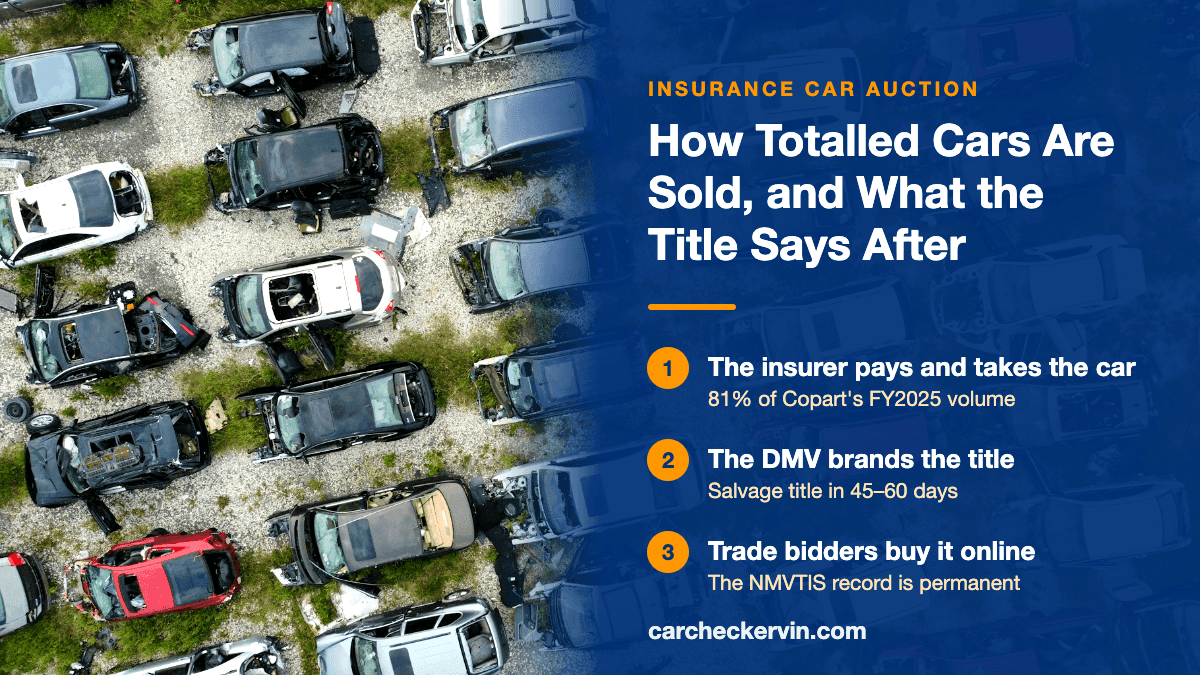
- Almost always a branded one. Copart states that in most US states a total-loss vehicle may be sold only after a salvage title has been obtained, generally received within 45 to 60 days of pick-up. Some cars later re-title as rebuilt; some are issued non-repairable paper and can never be registered again.
- Can the public buy at an insurance car auction?
- Partly, and it varies by state and by lot. Copart says its database of roughly 1 million registered members is drawn mainly from the dismantling, rebuilding, dealer and export trades, and it runs a Registered Broker programme so the public can buy through a member. Plenty of lots still require a licence.
What an Insurance Car Auction Actually Is
Six things happen to a written-off car between the claim and the forecourt. Five are commercial. The sixth survives on the VIN.
The payout that started it
A total loss is an accounting decision, not a verdict on whether a car can be driven. When repair plus salvage value beats what the vehicle is worth, the carrier writes the cheque and takes the car. CCC put total-loss frequency at a record 23.1% of claims in 2025 — close to one in four.
The loss category the lot carries
Listings are tagged collision, flood, fire, hail, theft-and-recovery. 28 CFR § 25.55(c) tells carriers to report why they took possession, and names flood, water, collision, fire and theft-recovery as its own examples. The category predicts what you cannot see.
The sale, and who was let in
Both major platforms bid online rather than in a ring. Copart describes its buyers as dismantlers, recyclers, rebuilders, used-vehicle dealers and exporters. Which of them wins tells you what the market thought the car was actually worth.
Where the car physically sat
Salvage needs land, and the acreage is public. RB Global reports 333 operating locations, 250 in the US, over 6,143 owned and 8,660 leased acres. Copart reports 281 facilities globally. Storage yards are why a wreck reappears two states away months later.
The export door
Much of this inventory never re-enters the American market. RB Global serves customers in roughly 170 countries from auction sites in 14. Exported cars leave US title records, so a quiet VIN after an auction is not automatically suspicious.
The record that cannot be deleted
Once a junk or salvage report reaches NMVTIS it is permanent. 28 CFR § 25.57(b) says that, to avoid the possibility of fraud, the operator may not allow any entity to delete a prior report of junk or salvage status. That sentence outlives every repaint.
The Same Journey, in Five Pictures
Every car on an insurance auction lot took this route. Knowing the order tells you which document should exist at which point — and where a missing one is worth asking about.
- 1Insurer pays, insurer ownsThe claim settles at actual cash value less the deductible and the wreck becomes the carrier's property. Nothing physical has changed; the legal status has changed completely.
- 2The car goes to a yardTowed, photographed, VIN-decoded, and tagged with a loss category. This is also the stage where a car left standing in water quietly gets worse than its photographs suggest.
- 3The DMV brands the titleCopart's filing sets out the sequence: in most states a total-loss vehicle may be sold only after a salvage title is obtained, generally received 45 to 60 days after pick-up.
- 4Trade bidders take itBidding is internet-first and skews heavily trade — rebuilders, dismantlers, exporters. A private buyer usually needs a broker, a state licence, or both.
- 5Three feeds report itCarriers file monthly under § 25.55, states send titling data every 24 hours under § 25.54, and § 25.57(b) forbids deleting a prior report. The seller controls none of them.
Was This Car Sold at an Insurance Auction?
Enter the VIN to see the total-loss record, every title brand across all 50 states, and open recalls — free. Upgrade to the full event timeline only if you need it.
What the Title Looks Like on the Far Side
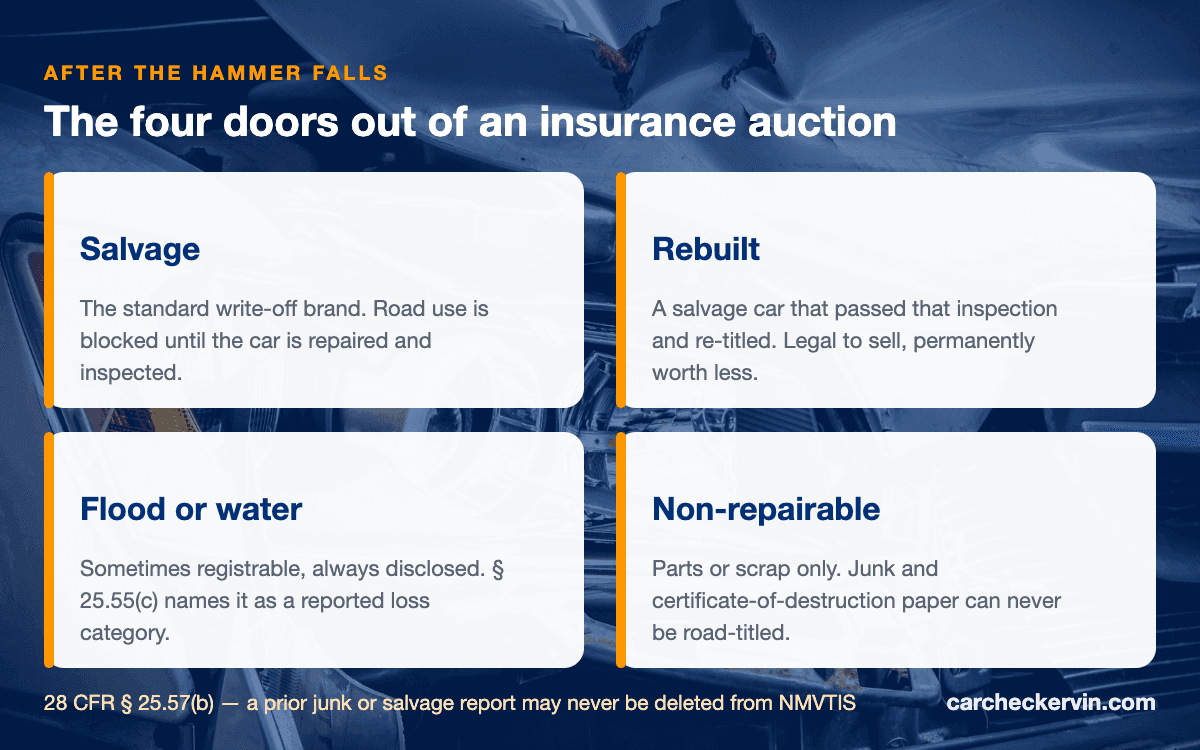
The brand a car leaves the auction with decides whether it can be registered, what an insurer will write on it, and how much of its clean-title value it recovers. These are the four outcomes.
Brands you can still register
- Salvage — the standard write-off brand; road use blocked until repaired and inspected
- Rebuilt or reconstructed — a salvage car that passed state inspection and re-titled
- Flood or water damage — sometimes registrable, always disclosed, always priced down
- Theft recovery — occasionally returns on a clean title if the claim was closed early
Brands that end the car
- Non-repairable — parts or scrap only, never registrable again
- Junk — reported into NMVTIS by a carrier or a salvage yard
- Certificate of destruction — the strictest version, in the states that issue it
- Any of these, once reported, cannot be deleted from NMVTIS
28 CFR § 25.57(b): to avoid the possibility of fraud, the operator may not allow any entity to delete a prior report of junk or salvage status.
Working out which brand you are looking at? Start with salvage vs rebuilt title, then run the total loss check on the VIN itself.
Who Is Allowed to Bid, and Who Actually Wins
The buyer list at an insurance auction is not a cross-section of the public. Copart describes its member database as roughly 1 million registered buyers drawn from the vehicle dismantling and recycling, rebuilding, used-vehicle dealer and export industries, with general-public members admitted where applicable. It also runs a Registered Broker programme through which the public can purchase through a registered member — the mechanism behind most of the broker services you will find advertised.
That composition matters more than the access rules do. A rebuilder bids what a car is worth after a repair they will perform themselves at trade cost. A dismantler bids what the parts fetch. An exporter — RB Global serves customers in roughly 170 countries — bids against a destination market where the brand is meaningless. None of them are paying what a retail buyer would for the same car with a clean title, and the gap between those two numbers is where the resale margin lives.
Three ways this catches buyers out
- You buy a re-titled auction car at clean-title money. A rebuilt title is legal to sell and easy to overlook on a listing; the VIN still carries the salvage event that produced it.
- The loss category never reaches you. A flood car and a light-collision car can look identical after a detail. The auction record separates them; the seller's photographs do not.
- The car is worth what the trade bid, not what you are asked. Rebuilders bid on parts-and-labour arithmetic. A public asking price far above that gap is the number to question.
Red Flags on a Car That Came Through an Insurance Auction
None of these prove anything on their own. Two together is a reason to check the VIN before the test drive rather than after it.
- The title was issued in a different state within the last few months, on a car more than a few years old
- A recent, complete respray on a vehicle with otherwise ordinary age-related wear inside
- Silt, water lines, or a musty smell in the spare-wheel well, seat rails, or under the carpet edges
- Seat belts that retract stiffly, or belt webbing stained a different shade near the anchor
- Airbag lights, ABS lights, or seat-occupancy faults that clear on a scan tool and return after a drive
- No paperwork trail between the auction sale date and the current title
Storms arrive in batches
Copart reports that most of its facilities process 5% to 20% more vehicles during the winter months, and describes remarketing tens of thousands of flood-damaged vehicles in South Florida after Hurricanes Helene and Milton in the autumn of 2024. Flood cars from a single named storm reach the market together — then scatter. Read the VIN's state history, not only its brand.
What to Do Before You Bid or Buy
An auction car is not automatically a bad buy — the trade rebuilds them profitably every day. It is a buy that requires the checks in a particular order.
Run the VIN before you look at the photographs
Photographs are chosen by the seller; the VIN record is not. Check for a total-loss event, a salvage or rebuilt brand, and any auction listing history first, then look at the pictures knowing what you are looking for.
Find the loss category, not just the brand
“Salvage” covers a hail car and a submerged one. Federal rules push insurers to report the reason they took possession, so the category is often recoverable — and it decides whether the car is a bargain or a liability.
Price it against the rebuilder's arithmetic
Trade buyers bid what the car is worth in parts plus what a repair costs them. Compare the asking price against clean-title examples and treat the gap as the opening position rather than the answer.
Get an insurance quote on the VIN before you commit
Carriers rate from the VIN and read the brand. A branded vehicle frequently comes back liability-only or declined outright, and finding that out while the car still belongs to somebody else costs nothing.
Go Deeper on the Auction Record
This page explains the market. These pages query it.
Where These Figures Come From
Every number on this page traces to a filed annual report, a codified federal rule, or a published industry study.
One reporting limit is worth knowing: § 25.55 requires carriers to report only vehicles of the current model year or any of the four prior model years, so an older total loss may reach NMVTIS through the state title feed rather than the insurer's monthly inventory.
Always check the VIN before you buy
The free preview shows title brands, theft status and open recalls in seconds, and flags whether accident and odometer records exist. The full history is $14.99 — one-time, no subscription.
Insurance Car Auctions — Frequently Asked Questions
The questions buyers ask about total-loss auctions, salvage titles, and who is allowed through the door.
What is an insurance car auction?+
It is the wholesale channel insurers use to resell vehicles they have paid out as total losses. The carrier settles the claim, takes ownership of the wreck, and consigns it to a salvage operator to recover part of the payout. Copart's fiscal 2025 Form 10-K reports that 81% of the vehicles it processed came from insurance companies. The other major US operator is IAA, owned by RB Global. Neither runs a physical ring for these cars: bidding is online, and buyers are mostly trade.
How does a car end up at an insurance auction?+
Through an accounting decision, not a mechanical one. The insurer weighs estimated repair plus salvage value against what the car is worth, and in many states against a statutory percentage threshold. If repair is the worse deal, it declares a total loss, pays actual cash value, and takes the car. Most states then require a salvage title before sale, and Copart says that paperwork is generally received within 45 to 60 days of pick-up. CCC put total-loss frequency at a record 23.1% of claims in 2025, so this is a well-worn path.
What kind of title does a car have after an insurance auction?+
Almost always a branded one, and the brand depends on the state and the severity. The common outcome is a salvage title, which blocks road registration until the car is repaired and inspected; pass that inspection and it re-titles as rebuilt or reconstructed. Either way the salvage history stays on the VIN permanently through NMVTIS. Badly burnt, flooded or dismantled vehicles get non-repairable, junk or certificate-of-destruction paper and can never be titled for the road again. A few lots do sell on clean titles, typically theft recoveries returned before the claim closed.
Can I buy a car at an insurance auction without a dealer licence?+
Sometimes, depending on the lot and the state. Copart says it maintains a database of approximately 1 million registered members, drawn primarily from the dismantling and recycling, rebuilding, used-vehicle dealer and export industries, with general-public members admitted where applicable. It also runs a Registered Broker programme through which the public can buy via a registered member. Other lots stay restricted to licensed dealers or dismantlers under state rules on salvage-titled vehicles. Run the VIN before you pay any broker fee.
Are insurance auction cars worth buying?+
Some are, and it turns almost entirely on the loss category and who does the repair. Light collision damage on a late-model car with a strong book value is the classic profitable rebuild, which is exactly why professional rebuilders bid those lots up. Flood and fire cars repay caution: water reaches wiring looms, control modules, pretensioners and airbag sensors in ways that surface months later. Keep the commercial logic in view — the winning bidder priced the car on parts value plus trade-cost labour.
Do insurance auction sales show up on a VIN check?+
The underlying total-loss and salvage events do, reliably, and often the lot listing too. Carriers report to NMVTIS monthly under 28 CFR § 25.55 an inventory of vehicles of the current model year or any of the four prior model years that they have taken possession of and decided are junk or salvage. States supply titling information, including every brand on the certificate, every 24 hours under § 25.54, and junk and salvage yards report monthly intake under § 25.56. Section 25.57(b) then provides that the operator may not allow any entity to delete a prior report of junk or salvage status.
Check the VIN Before the Auction History Matters
Enter any 17-character VIN to see total-loss and salvage records, every title brand across all 50 states, and open recalls — free. The full event timeline is one click further.
CarCheckerVIN is an independent vehicle-history service and is not an auction house, an insurer, or a broker. We are not affiliated with, endorsed by, or sponsored by Copart, Inc., IAA, RB Global, Inc., CCC Intelligent Solutions, Carfax, or AutoCheck; those names are used only to identify the companies whose public filings and reports are cited above. Title, brand and total-loss data is sourced from NMVTIS, NHTSA and licensed vehicle-history providers. Nothing on this page is legal advice, and salvage-titling and dealer-licensing rules differ by state — confirm the requirements with your own DMV before bidding.
Related VIN Checks
More tools to verify any vehicle's history