2018 Hyundai Elantra Reliability: What Used-Car Buyers Must Know Before Signing
The 2018 Elantra is affordable and fuel-efficient, but engine seizure recalls and transmission complaints deserve a hard look before you hand over cash.
Check the car you're reading about
Free VIN decode and recall check
Factory specs and open NHTSA recalls in seconds. No sign-up.
On this page· 9
- The Engine Recall Problem You Cannot Ignore
- 2018 Hyundai Elantra Engine Recall: What Buyers Often Miss
- Hyundai Elantra Transmission Problems: The Automatic vs. Manual Split
- Real-World Reliability Scores and Owner Data
- Cost vs. Risk: Running the Numbers on a 2018 Elantra Purchase
- Trims Worth Buying — and One to Approach Carefully
- Long-Term Ownership: Mileage Potential and Maintenance Schedule
- How the 2018 Elantra Compares to Key Rivals
- What Dealers and Private Sellers Won't Volunteer
You're staring at a used 2018 Hyundai Elantra on a dealer lot — clean CarFax, low-ish miles, and a price tag that fits your budget. The question nagging you is the right one: how solid is 2018 Hyundai Elantra reliability, really? Not the marketing version, but the one that shows up in NHTSA complaint databases, class-action settlements, and repair bills. This guide cuts through the noise so you can make a confident buy-or-walk decision, whether you're shopping at a franchise dealer, a buy-here-pay-here lot, or a private seller.
The short answer
The 2018 Elantra is a solid compact for most buyers — but only after you've confirmed the engine recall work was completed and the automatic transmission has been serviced; skipping those two checks can turn a bargain into a money pit.
The Engine Recall Problem You Cannot Ignore
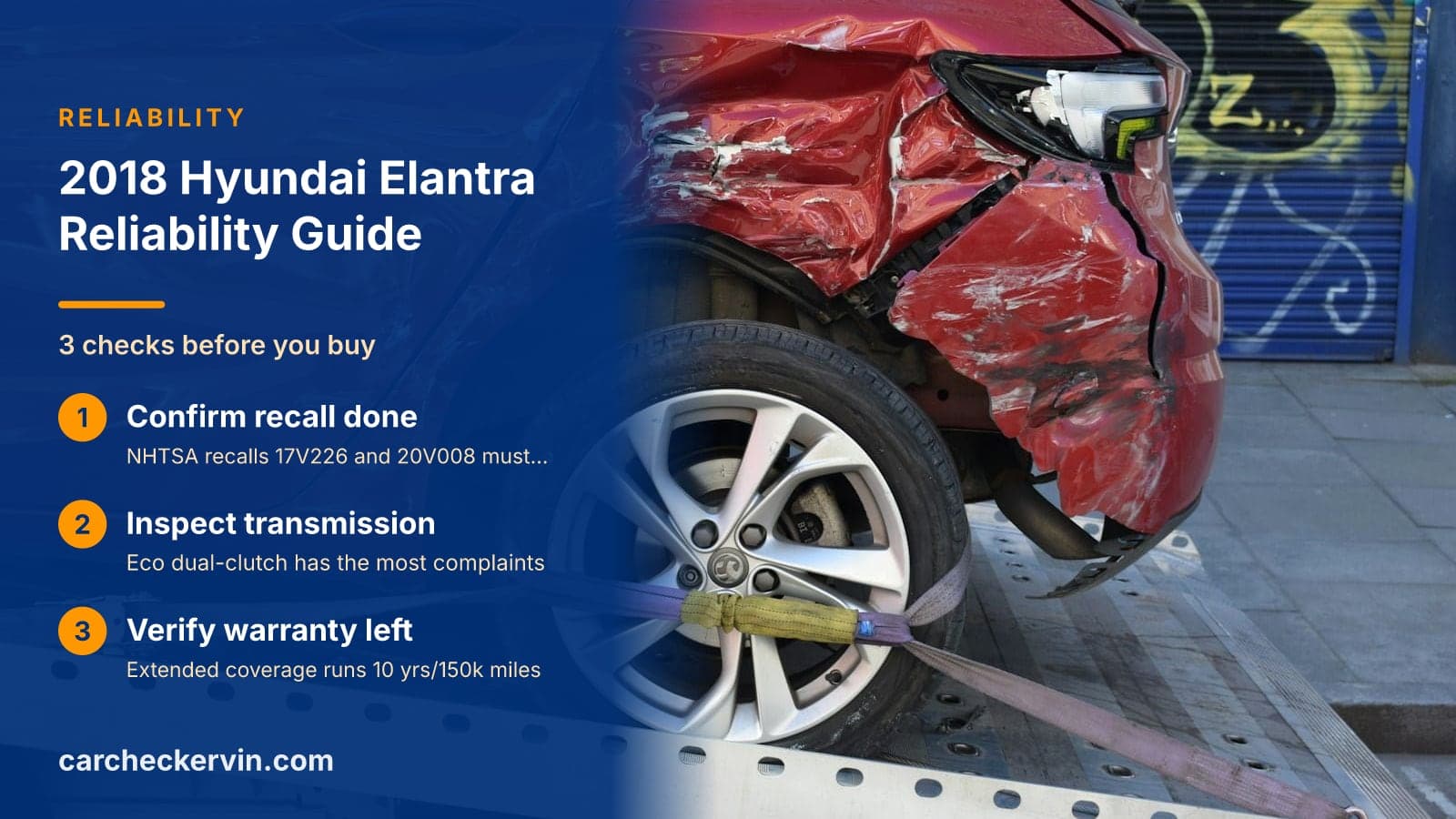
The single biggest cloud over 2018 Hyundai Elantra reliability is the Theta II GDI engine defect that Hyundai has been addressing since the mid-2010s. NHTSA opened a formal investigation, and Hyundai ultimately issued recall 17V226 — commonly called the 2017 Hyundai Elantra engine recall — covering 1.4 million vehicles in the US for connecting rod bearing failure that can cause engine seizure or fire without warning. The 2018 model year inherited a revised version of that engine, and while the most acute early failures were addressed, a subsequent recall campaign — covering certain 2018 units — extended the scope.
Specifically, NHTSA recall 20V008, announced by Hyundai in early 2020, added roughly 430,000 additional 2018–2019 vehicles to the engine knock sensor monitoring software fix. That software update programs the powertrain control module to detect pre-failure bearing wear and alert the driver rather than letting the engine fail silently. It does not replace a damaged engine — it gives you a warning light so you can pull over safely. If the engine is already worn beyond the threshold, Hyundai's remedy includes a short-block replacement under the recall.
How to Confirm Recall Completion Before You Buy
Run the VIN through NHTSA's free recall lookup at nhtsa.gov to see whether open recalls remain. A vehicle history report will often show dealer-recorded recall service events, though private-party completions may not appear. Ask the seller for a printed Hyundai recall completion certificate — dealers can pull this in minutes from Hyundai's dealer portal. Any seller who hesitates is a red flag.
2018 Hyundai Elantra Engine Recall: What Buyers Often Miss
The 2018 Hyundai Elantra engine recall situation is messier than a single campaign number suggests. Hyundai faced a separate NHTSA consent order in 2022, in which the automaker agreed to pay a $200 million civil penalty — the largest ever imposed by NHTSA at that time — partly for delayed recall reporting on exactly these engine fire issues, according to NHTSA's public enforcement documents. That penalty matters to you as a buyer because it confirms the agency's view that the problem was serious and the automaker's initial response was inadequate.
What this means practically: not every 2018 Elantra with completed recall paperwork is necessarily safe. The knock sensor software is a monitoring tool, not a cure. Hyundai extended the powertrain warranty on affected vehicles to 10 years or 150,000 miles from the original sale date, according to Hyundai's customer letters distributed under the recall campaign — but that warranty is tied to the original sale date, not yours. A 2018 model first sold in late 2017 could have that coverage expire as early as 2027 if it was purchased new. Verify the remaining coverage in writing before you close.
- Pull the VIN on NHTSA.gov — look for open recalls 17V226, 20V008, and any newer campaigns added after this article was published.
- Request Hyundai's recall completion printout; software updates take under an hour and should show a recent dealer visit in the service history.
- Ask for the extended powertrain warranty letter — Hyundai mailed these to original owners, and the coverage is transferable to subsequent buyers.
- Check oil change records carefully: Hyundai's recall remedy requires proof of regular oil maintenance or the engine warranty claim can be denied.
- If the engine was replaced under recall, confirm the replacement block's origin — Hyundai used both new and remanufactured short-blocks depending on availability.
Hyundai Elantra Transmission Problems: The Automatic vs. Manual Split
Hyundai Elantra transmission problems split sharply by gearbox type. The 6-speed manual in the Sport trim has earned consistently high marks — it's direct, durable, and inexpensive to service. The 6-speed automatic, offered on SE, SEL, Limited, and Eco trims, is where the complaints concentrate. NHTSA's vehicle complaints database lists over 200 filed reports for 2018 Elantra transmission concerns as of mid-2026, with the most common themes being harsh downshifts at low speed, hesitation when pulling into traffic, and intermittent shuddering on the freeway.
The Eco trim's 7-speed dual-clutch transmission — essentially a robotized manual — generates the loudest complaints among Hyundai Elantra transmission shifting problems. Dual-clutch gearboxes are notoriously jerky in stop-and-go traffic, and Hyundai's calibration on this unit drew early criticism. A technical service bulletin (TSB 17-AT-013) addressed shift hesitation with a software recalibration, but the fix did not satisfy all owners. If you're looking at an Eco, check whether that TSB was applied.
Is There a Hyundai Elantra Transmission Recall?
There is no NHTSA-mandated Hyundai Elantra transmission recall for the 2018 model as of this writing — the transmission issues were addressed through TSBs and software updates rather than a formal safety recall. That's a meaningful distinction: TSB work is only done if a customer complains and the dealer agrees it applies. A used Elantra that was traded in without the TSB applied may still exhibit the original shift hesitation. Ask for a full dealer service history and cross-reference TSB numbers before you buy.
Real-World Reliability Scores and Owner Data
Consumer Reports gave the 2018 Elantra a predicted reliability score of 4 out of 5, placing it above average for the compact sedan segment in that model year's ratings. J.D. Power's 2021 Vehicle Dependability Study — which surveys three-year-old vehicles, making 2018 models the cohort — awarded Hyundai's compact car lineup 136 problems per 100 vehicles, slightly better than the industry average of 140 problems per 100 vehicles for that study cycle. Those aggregate numbers look solid, but they predate the full scope of engine-related complaints that escalated in later filings.
RepairPal rates the Elantra's annual maintenance cost at approximately $452 per year, compared to a compact sedan segment average of $526 per year — a meaningful saving over a five-year ownership window. Routine items like brake pads, filters, and spark plugs are inexpensive because the Elantra uses widely available parts that any independent shop can source. The engine and transmission are the outliers: if either needs major work outside the recall or warranty window, you're looking at costs that can exceed the car's market value.
Cost vs. Risk: Running the Numbers on a 2018 Elantra Purchase
This is the section that actually helps you decide. A 2018 Elantra SE or SEL with 60,000–80,000 miles typically lists between $12,000 and $16,000 at franchise dealers and $9,000–$13,000 at independent or BHPH lots, based on recent Manheim wholesale auction data reported in Automotive News. That price spread reflects condition, not just mileage — auction units from Copart or IAA that have been repaired after a salvage title event can look identical on the surface. Pull a vehicle history report on any used Elantra to check for NMVTIS title brands like salvage, rebuilt, or junk before you negotiate.
Now layer the risk. A short-block replacement on a 2.0-liter Theta II engine, if done outside warranty, runs $3,500–$5,500 at an independent shop, according to RepairPal's labor and parts estimator. A dual-clutch transmission replacement on the Eco trim can reach $4,000–$6,000. If you're buying at $11,000 and either of those repairs lands in the first two years, you've paid $15,000–$17,000 for a car whose private-party value may not recover. The math only works if the recall was completed, the extended warranty is still active, and a pre-purchase inspection shows no signs of oil sludge or erratic shifting.
- Confirm all open recalls are closed on NHTSA.gov before you visit the seller — don't do this after you've fallen in love with the car.
- Pay $100–$150 for an independent pre-purchase inspection at a shop that specializes in Korean makes; ask them specifically to check for oil sludge and bearing knock.
- Request the extended powertrain warranty transfer letter from Hyundai customer care (1-800-633-5151) and verify remaining time and mileage in writing.
- Run the VIN through a vehicle history report to flag title brands, odometer rollbacks, and unreported accidents.
- Negotiate at least $500–$1,000 off the asking price to fund a transmission fluid flush and any deferred maintenance the inspection uncovers.
- If buying from a dealer, review the FTC Buyers Guide sticker — it discloses whether the car is sold as-is or with a warranty and is legally required on every dealer-sold used vehicle in the US.
Watch out for auction-sourced inventory
Used Elantras that passed through Copart or IAA often reappear on independent lots within weeks. An NMVTIS title brand — even 'rebuilt' — can disqualify the vehicle from Hyundai's extended powertrain warranty coverage, and many extended service contracts exclude branded-title cars entirely. Always check the title history before you negotiate price.
Trims Worth Buying — and One to Approach Carefully
The SE and SEL trims with the 6-speed automatic represent the sweet spot of the 2018 lineup. They carry the 147-horsepower 2.0-liter engine, the transmission complaints are manageable, and parts availability is excellent. The SEL adds heated seats and blind-spot monitoring without pricing itself out of used-car value territory. The Limited adds a sunroof and leather but also adds complexity — more electronics that can develop gremlins after 80,000 miles.
The Sport trim with the 6-speed manual is genuinely fun and sidesteps the automatic's issues entirely — but finding one with a clean history is harder because sport-oriented buyers often push cars harder. The Eco trim's dual-clutch transmission requires more caution than any other variant in the lineup. Its 128-horsepower 1.4-liter turbocharged engine also uses a different oil specification than the 2.0-liter, and some owners skipped the correct oil grade, accelerating wear. Verify the Eco's oil change records specifically for the right viscosity.
Long-Term Ownership: Mileage Potential and Maintenance Schedule
Properly maintained 2018 Elantras regularly reach 150,000–200,000 miles without catastrophic failures — provided the engine recall work was done and the oil was changed on schedule. Hyundai's owner's manual specifies a 7,500-mile oil change interval under normal driving conditions, but independent mechanics who work on high-mileage Korean cars often recommend dropping to 5,000 miles, especially on the 2.0-liter Theta II given its documented sensitivity to oil degradation.
At 100,000 miles, budget for spark plugs, a coolant flush, and an inspection of the engine's direct-injection fuel injectors — a known minor issue on the Theta II that causes rough idle if the injectors aren't cleaned periodically. Timing chains on this engine are designed to last the life of the car, but a stretched or rattling chain at startup is a warning sign worth taking seriously. Transmission fluid on the automatic should be changed every 45,000 miles regardless of what the owner's manual says — Hyundai's 'lifetime' fluid claim has not held up well in real-world use beyond 80,000 miles.
How the 2018 Elantra Compares to Key Rivals
The 2018 Honda Civic and Toyota Corolla are the obvious alternatives. Consumer Reports' reliability data consistently rates both the Civic and Corolla above the Elantra for the 2018 model year — the Civic earned a 5-out-of-5 predicted reliability rating that year, versus the Elantra's 4. That gap matters if you're buying without an extended warranty and plan to keep the car past 100,000 miles. However, Civics and Corollas from the same vintage command $1,500–$3,000 more at retail, according to comparable Manheim auction transaction data.
The Mazda3 is another strong alternative — it has no equivalent engine scandal — but finding a well-maintained 2018 Mazda3 at Elantra prices is increasingly difficult as that car's reputation has driven resale values up. The Chevrolet Cruze was discontinued after 2019, making long-term parts supply a concern. For a buyer who does their homework, verifies the recall completion, and budgets for a pre-purchase inspection, the 2018 Elantra can represent genuine value — it's not a gamble so much as a calculated bet that requires specific due diligence that most buyers skip.
What Dealers and Private Sellers Won't Volunteer
Dealers are required by the FTC Used Car Rule to post a Buyers Guide disclosing warranty status on every used vehicle they sell — but that rule does not require them to disclose open recalls or known defects beyond the warranty box. A private seller has even fewer obligations in most states. Neither party is likely to mention that the knock sensor software was applied three years ago but the car has since logged 40,000 additional miles under marginal oil maintenance practices.
The burden of discovery falls entirely on you. A VIN check surfaces title history, odometer readings, and sometimes service records. A pre-purchase inspection surfaces mechanical condition. The NHTSA database surfaces recall status. None of these tools is expensive relative to the cost of a bad purchase — and together they give you the negotiating leverage to either walk away clean or buy at a price that reflects the actual risk. Don't skip any of them on a vehicle with this particular history.
What to do next
Before you make an offer on any 2018 Elantra, go to NHTSA.gov and enter the full 17-digit VIN to check for open recalls — specifically 17V226 and 20V008 — then schedule a $100–$150 independent pre-purchase inspection with a shop familiar with Hyundai engines; those two steps cost less than one month's payment and can save you thousands.
About the author
CarCheckerVIN Editorial Team
In-house automotive research team
The CarCheckerVIN editorial team combines decades of automotive industry, dealer, and journalism experience to produce trustworthy buying, selling, and ownership guidance backed by NMVTIS, NICB, and manufacturer data.
See more of our guides on Google
Add CarCheckerVIN as a preferred source and Google will show our guides more often in your results.

Frequently asked questions
- Are 2018 Hyundai Elantra SEL reliable?
- The SEL trim is one of the more reliable 2018 Elantra configurations because it pairs the 2.0-liter engine with a conventional 6-speed automatic rather than the dual-clutch unit found in the Eco. Consumer Reports gave the 2018 Elantra a 4-out-of-5 predicted reliability score. Confirm the engine recall software was applied and the transmission fluid has been serviced, and the SEL is a reasonable used-car buy at current market prices.
- Is the Hyundai Elantra 2018 fuel efficient?
- Yes — the 2018 Elantra SE and SEL earn an EPA-rated 28 mpg city and 37 mpg highway with the 6-speed automatic. The Eco trim does better at 32 city and 40 highway thanks to its turbocharged 1.4-liter engine, but the dual-clutch transmission adds complexity. For most daily drivers, the SE or SEL's fuel economy is competitive with comparable compact sedans without the Eco's transmission trade-offs.
- Which Hyundai Elantra to stay away from?
- The fourth-generation Elantra (2011–2016) has the shakiest long-term record due to the original Theta II GDI engine failures that triggered the largest recall campaigns. Within the 2018 lineup, the Eco trim's dual-clutch transmission has the most documented shift complaints. Any 2018 Elantra with an open engine recall, no oil change history, or signs of sludge on inspection is one to walk away from regardless of trim level or price.
- What is considered high mileage for a Hyundai Elantra?
- A properly maintained Elantra can reach 150,000–200,000 miles without major mechanical failure. Most used-car buyers and lenders start treating Elantras as high-mileage around 100,000 miles, which is also where extended service contracts often become harder to obtain or more expensive. Below 80,000 miles with documented maintenance and confirmed recall completion represents the best value window for a 2018 model today.
Keep reading

Second Hand Car Buying Advice: The No-Nonsense Guide for US Buyers
From title brands and auction lots to financing traps and the best used EVs, this guide gives US buyers the specific, skeptical second hand car buying advice they need before spending a dollar.
Oct 27, 2026 · 11 min read

Bumper to Bumper Warranty: What It Covers, What It Doesn't, and Whether to Buy Extra
A bumper to bumper warranty sounds complete, but the exclusions can cost you thousands. Here's exactly what's covered, what isn't, and how to decide if extended coverage is worth the price.
Oct 26, 2026 · 8 min read
2008 Mazda 3 Reliability: What Every Buyer Needs to Know Before Handing Over Cash
The 2008 Mazda 3 has a strong reliability record, but a handful of recurring problems can turn a bargain into a money pit. Here's exactly what to check before you buy.
Oct 26, 2026 · 10 min read