Honda CR-V Years to Avoid — what the federal complaint data shows.
Avoid the 2017 and 2018 CR-V if you can: they drew 1,782 and 2,169 complaints to NHTSA, more than any other year, with the 1.5-liter turbo engine the component owners named most. Below is every model year, the faults behind each spike, and what owners say.
Found a CR-V You Like?
Enter its VIN for a free preview of title brands, salvage and total-loss records and odometer readings before you look at the oil.
Free preview · No sign-up · No owner or personal data
Quick Answer
- What Honda CR-V years should you avoid?
- The 2017 and 2018, then the 2019. They drew 1,782, 2,169 and 1,110 NHTSA complaints, the three highest totals of any CR-V year. Hundreds describe gasoline getting into the engine oil of the 1.5-liter turbo. The 2007 and 2008 come next, mostly for door locks and airbags.
- What are the best years for a used CR-V?
- Among CR-Vs old enough to have a track record, 2021, 2020, 2013 drew the fewest complaints. Owners on Reddit and YouTube most often point to the 2016, the last year before the 1.5-liter turbo arrived, which drew 396 complaints against 1,782 the year after.
- Is the 2017 CR-V oil dilution problem real?
- Owners report it in their own words. 158 of the 1,782 complaints filed on the 2017, and 174 of 2,169 on the 2018, describe fuel in the oil, a rising oil level or oil that smells of gas. Honda published its own video on oil dilution in 2017–2018 CR-Vs with the 1.5-liter engine.
Five checks that sort a good CR-V from a bad year
The model year tells you which faults to look for. The VIN and the car tell you whether this one has them.
- 1Read the year from the VINThe 10th character is the model year; a 2018 and a 2019 look alike.
- 2Smell the dipstick on a 2017–2019Gas smell or oil above the full mark points to fuel dilution.
- 3Look up open recallsRear frame, steering and airbag campaigns are tied to the VIN.
- 4Run the A/C on a 2007–2011Warm air or a grinding compressor is a common repair on that generation.
- 5Check title and mileage recordsA clean-looking CR-V can still carry a salvage brand or an odometer gap.
Every Honda CR-V Model Year Compared
NHTSA complaints and recall campaigns for every CR-V model year from 1997 to 2026, read from NHTSA's public records on 12 November 2026. The component is the one owners named most often.
| Year | Generation | Complaints | Crash · fire reports | Recalls | Most-cited component |
|---|---|---|---|---|---|
| 1997 | 1st | 109 | 10 · 1 | 2 | Electrical System |
| 1998 | 1st | 143 | 16 · 1 | 3 | Electrical System |
| 1999 | 1st | 138 | 10 · 0 | 3 | Electrical System |
| 2000 | 1st | 142 | 12 · 5 | 2 | Air Bags |
| 2001 | 1st | 153 | 13 · 3 | 1 | Air Bags |
| 2002 | 2nd | 527 | 52 · 17 | 16 | Air Bags |
| 2003 | 2nd | 494 | 49 · 26 | 14 | Air Bags |
| 2004 | 2nd | 501 | 34 · 39 | 13 | Engine And Engine Cooling |
| 2005 | 2nd | 479 | 40 · 18 | 14 | Air Bags |
| 2006 | 2nd | 398 | 27 · 16 | 13 | Exterior Lighting |
| 2007 | 3rd | 888 | 34 · 4 | 12 | Air Bags |
| 2008 | 3rd | 963 | 44 · 3 | 11 | Air Bags |
| 2009 | 3rd | 386 | 29 · 2 | 12 | Air Bags |
| 2010 | 3rd | 483 | 31 · 2 | 15 | Air Bags |
| 2011 | 3rd | 555 | 29 · 2 | 13 | Air Bags |
| 2012 | 4th | 403 | 27 · 4 | 3 | Engine |
| 2013 | 4th | 382 | 22 · 0 | 2 | Engine |
| 2014 | 4th | 588 | 36 · 7 | 1 | Engine |
| 2015 | 4th | 674 | 38 · 4 | 3 | Engine |
| 2016 | 4th | 396 | 40 · 4 | 3 | Engine |
| 2017 | 5th | 1,782 | 42 · 4 | 7 | Engine |
| 2018 | 5th | 2,169 | 46 · 2 | 5 | Engine |
| 2019 | 5th | 1,110 | 31 · 2 | 8 | Forward Collision Avoidance |
| 2020 | 5th | 363 | 22 · 2 | 7 | Forward Collision Avoidance |
| 2021 | 5th | 342 | 14 · 1 | 4 | Steering |
| 2022 | 5th | 272 | 5 · 1 | 3 | Steering |
| 2023 | 6th | 518 | 21 · 1 | 3 | Steering |
| 2024 | 6th | 396 | 29 · 0 | 2 | Steering |
| 2025 | 6th | 271 | 29 · 5 | 1 | Steering |
| 2026 | 6th | 184 | 14 · 4 | 0 | Electrical System |
Complaints are reports owners file with NHTSA; they are not verified and are not divided by sales, so a best-seller collects more of them. Recall counts include multi-model campaigns, such as the airbag-inflator recalls, that name the CR-V among many cars. CR-V Hybrid models are filed separately by NHTSA and are not in this table.
Avoid: the 2017 and 2018 CR-V (and Check a 2019 Carefully)
The fifth-generation CR-V arrived for 2017 with a 1.5-liter turbocharged engine in most trims, and the complaint count jumped from 396 for the 2016 to 1,782 for the 2017 and 2,169 for the 2018. The engine is the component owners named most for the 2017 (533 complaints).
The complaint everyone has heard of is oil dilution: on short trips, especially in cold weather, unburned fuel slips past the piston rings into the oil. Owners describe the oil level rising above the full mark and the dipstick smelling of gasoline. Some complaints go further and describe warning lights across the dash and a sudden loss of power on the highway.
The 2019 drew fewer complaints (1,110) but is not clear of it: 29 of its complaints still describe fuel in the oil. If you are set on a 2017–2019, check the oil level and smell it before you buy, and ask for service records showing regular oil changes.
What the 2017–2019 complaints say
- 158 · 174 · 29 complaints on the 2017, 2018 and 2019 describing fuel in the oil or a rising oil level.
- 530 on the 2018 cite the engine, the most-named component that year.
- Recall 18V663000: 2017–2018 CR-Vs, a steering-sensor magnet that can come loose; the steering gearbox is replaced.
- Recall 19V865000: 2019–2020 CR-Vs, rear subframe bolts that may loosen.
Other CR-V Years With a Known Weak Spot
No CR-V generation is free of complaints. These are the clusters that stand out in NHTSA's records.
2007–2008: door locks
248 and 217 complaints describe failing door-lock actuators; the 2008 drew 963 complaints in all.
2007–2011: rear frame rust
Recall 23V228000 covers CR-Vs from salt-belt states, where corrosion can detach a rear trailing arm.
1997–2016: airbag inflators
21 recall campaigns on the airbag inflator module name CR-Vs from these years; check each VIN for one left open.
2007–2010: transmission
Recall 11V395000 updated the automatic transmission software over a bearing that could break.
2015: engine and power train
The 2015 drew 674 complaints against 588 for the 2014, with the engine named most.
2023: steering
325 of the 2023's 518 complaints name the steering; recall 24V744000 covers 2023–2025 CR-Vs.
What CR-V Owners Say on Reddit, YouTube and to NHTSA
Complaint counts tell you where problems cluster. Owners tell you what living with them is like, and they do not all agree. Here is a cross-section, good and bad, each linked in the sources below.
Two patterns run through it. Owners who mostly drive short trips in cold weather are the ones describing gasoline in the oil, while owners with long highway commutes often report nothing at all. And the older 2.4-liter CR-Vs get far more praise than the early turbos.
In owners' words (paraphrased)
- r/crv: a commenter who says they spent nine years as a Honda dealer technician calls 2006–2015 a nearly bulletproof run for the CR-V.
- r/Honda, 2019 CR-V: an owner with a five-to-seven-minute commute says the oil reeks of gas and the frequent changes are getting expensive.
- YouTube, 2018 CR-V (before the update): an owner says the dipstick read about two and a half quarts over full with 40% oil life left, and a January 2019 software update helped.
- YouTube, 2019 CR-V: an owner says 3.8 quarts go in and about 5.1 come out after roughly 1,000 miles, with a strong smell of gasoline.
- YouTube, 2018 CR-V (highway commuter): an owner in the South who drives the highway to work daily reports no problems at all.
- NHTSA, 2017 CR-V EX-L: an owner reports every dash light coming on and a sudden loss of acceleration on the highway; the dealer blamed oil dilution.
- YouTube, 2006 CR-V: an owner at 126,000 miles complains of loud wind noise and vibration at idle and says they won't buy another Honda.
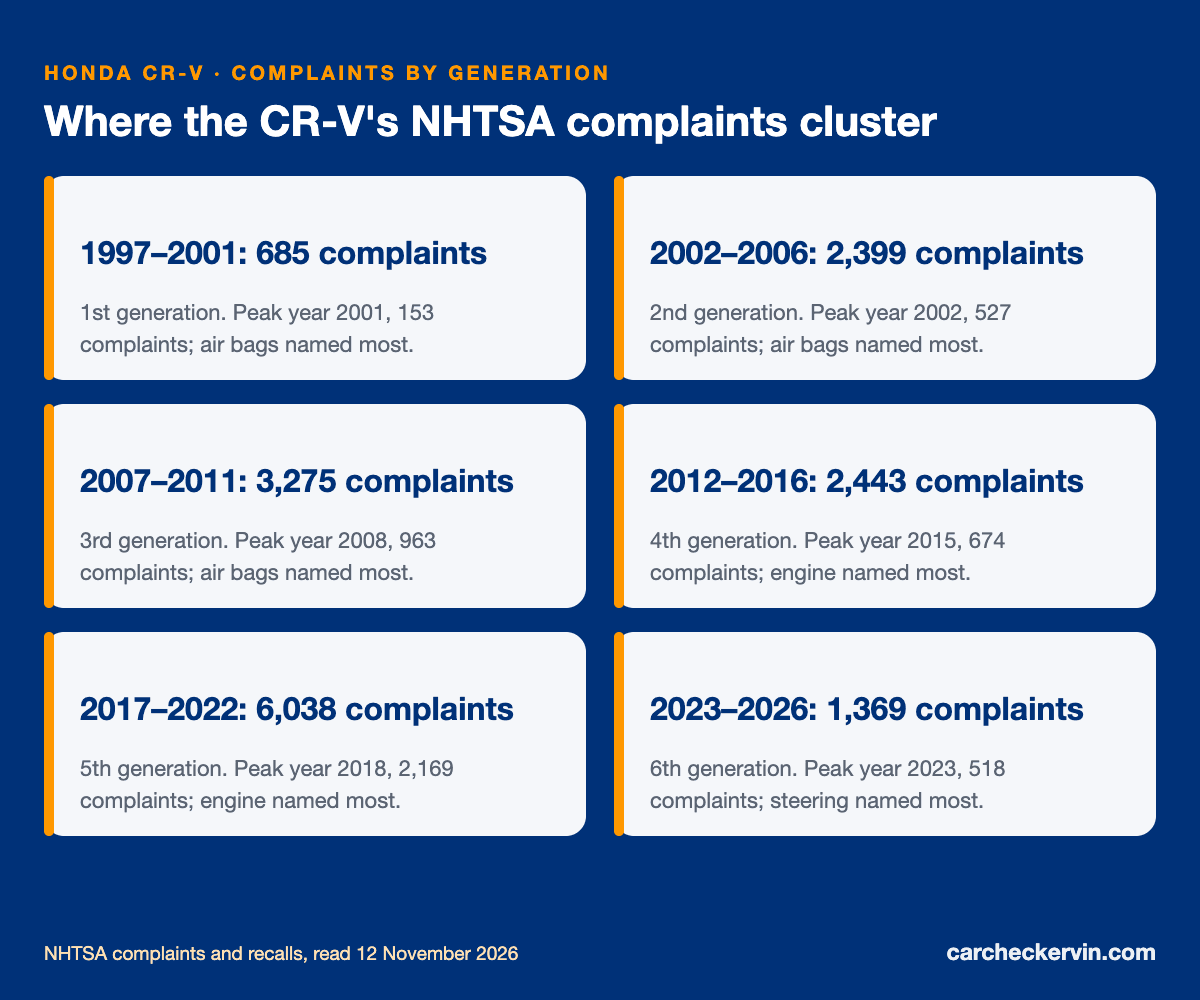
CR-V Complaints by Generation
Grouped by generation, the picture is clear: the fifth generation (2017–2022) carries the most complaints, most of them on its first three years. The sixth generation (2023 on) has had less time on the road, so its totals will grow.
Fewest vs. Most Complaints
The five CR-V years from 2002 to 2021 with the fewest NHTSA complaints, against the five years with the most. Newer years are left out of the "fewest" list because they have had less time to collect complaints.
Fewest complaints (2002–2021)
- 2021: 342 complaints, 4 recalls
- 2020: 363 complaints, 7 recalls
- 2013: 382 complaints, 2 recalls
- 2009: 386 complaints, 12 recalls
- 2016: 396 complaints, 3 recalls
Most complaints
- 2018: 2,169 complaints, 5 recalls
- 2017: 1,782 complaints, 7 recalls
- 2019: 1,110 complaints, 8 recalls
- 2008: 963 complaints, 11 recalls
- 2007: 888 complaints, 12 recalls
Recall counts include multi-model campaigns.
Looking at a Used CR-V?
Enter the VIN for a free preview: title brands, junk and salvage records, total-loss records and odometer readings, before you hand over a deposit.
Which CR-Vs Our Visitors Check
Between 11 June 2026 and 11 November 2026, visitors ran 1,835 different Honda CR-V VINs through our free preview. 318 of them (17%) were 2017, 2018 or 2019 models, the three years with the most NHTSA complaints. The single most-checked used year was the 2018, at 113 VINs.
In other words, plenty of people are shopping exactly the years this page warns about. That is not a reason to walk away from every 2017–2019. It is a reason to check the oil and the records on the one in front of you rather than the model's reputation.
Checks Before You Buy a Used CR-V
What to look at, by the year you are considering.
2017–2019: the oil
Pull the dipstick cold. Above full, or a fuel smell, means dilution.
2017–2019: service history
Regular oil changes matter more on these than on the 2.4-liter.
2007–2011: the A/C
Make sure it blows cold and the compressor doesn't grind.
2007–2011: every door lock
Lock and unlock each door from the fob and the switch.
Salt-belt cars: the rear frame
Ask whether recall 23V228000 was done on a 2007–2011.
Any year: recalls and records
Run the VIN for open recalls, title brands and mileage.
How to Read These Numbers
NHTSA complaints are reports owners type in themselves. NHTSA does not verify each one, and it does not divide them by how many cars were sold, so a year when Honda sold more CR-Vs will collect more complaints for the same fault rate. Treat a jump between neighboring years as the signal, as with 396 for the 2016 against 1,782 for the 2017, rather than the raw total.
Age cuts both ways. A 2002 has had over two decades to collect complaints, while a 2025 has had a year or two. That is why the "fewest complaints" list above stops at 2021.
The fault counts in this page come from searching the words owners used. 158 complaints on the 2017 mention fuel in the oil, but others describing the same fault in different words are not counted, so treat those figures as a minimum.
Related Checks and Guides
Recalls, warranties and the history checks that matter on any used CR-V.
Where These Facts Come From
Complaint and recall figures are NHTSA's own records. Owner experiences are linked so you can read them in full.
NHTSA records read 12 November 2026. Written by the CarCheckerVIN editorial team with AI assistance, from NHTSA's complaint and recall records, our own preview logs and the owner posts linked above; figures checked November 2026. CarCheckerVIN is not affiliated with Honda.
Honda CR-V Years to Avoid — Frequently Asked Questions
Model years, oil dilution and what to check.
What is the worst year for the Honda CR-V?+
By NHTSA complaint count, the 2018: 2,169 complaints, followed by the 2017 at 1,782. The 1.5-liter turbo engine and oil dilution account for much of both.
What is the most reliable CR-V year?+
No single year is proven most reliable, because complaints are not divided by sales. Among years old enough to judge, 2021 (342), 2020 (363), 2013 (382) drew the fewest complaints, and owners often recommend the 2016.
Did Honda fix CR-V oil dilution?+
Honda addressed it in its own video for 2017–2018 owners, and owners describe software updates from early 2019. Complaints fell for the 2019 (1,110) but 29 still describe fuel in the oil, so check any 2017–2019 you are considering.
Are 2007–2011 CR-Vs still worth buying?+
They can be, at the right price. Check the A/C, every door lock, and whether recall 23V228000 for rear frame corrosion was done if the car lived where roads are salted.
Is the 2023 CR-V a year to avoid?+
It is too new to judge on complaint totals, but 325 of its 518 complaints name the steering, and recall 24V744000 covers a steering gearbox that can make the car hard to steer. Make sure that recall has been done.
Does your report show CR-V problems?+
No report shows mechanical faults. Ours lists title brands, NMVTIS junk and salvage records, insurance total-loss records, odometer readings, and auction records with the damage the auction recorded and its photos for the specific VIN. Recalls are free to check on NHTSA's site.
Check the CR-V, Not Just the Year
A good 2018 beats a bad 2016. Enter the VIN for a free preview; the full report is $14.99 and lists title brands, NMVTIS junk and salvage records, insurance total-loss records, odometer readings, and auction records with the damage the auction recorded and its photos.
Complaint and recall figures are NHTSA's public records as read on 12 November 2026; complaints are unverified owner reports. Owner quotes are paraphrased from the linked posts. CarCheckerVIN is not affiliated with Honda. Records in our reports reflect what was reported to our data providers. Our reports do not include police or repair-shop accident entries.
Related VIN Checks
More tools to verify any vehicle's history