What is traction control?
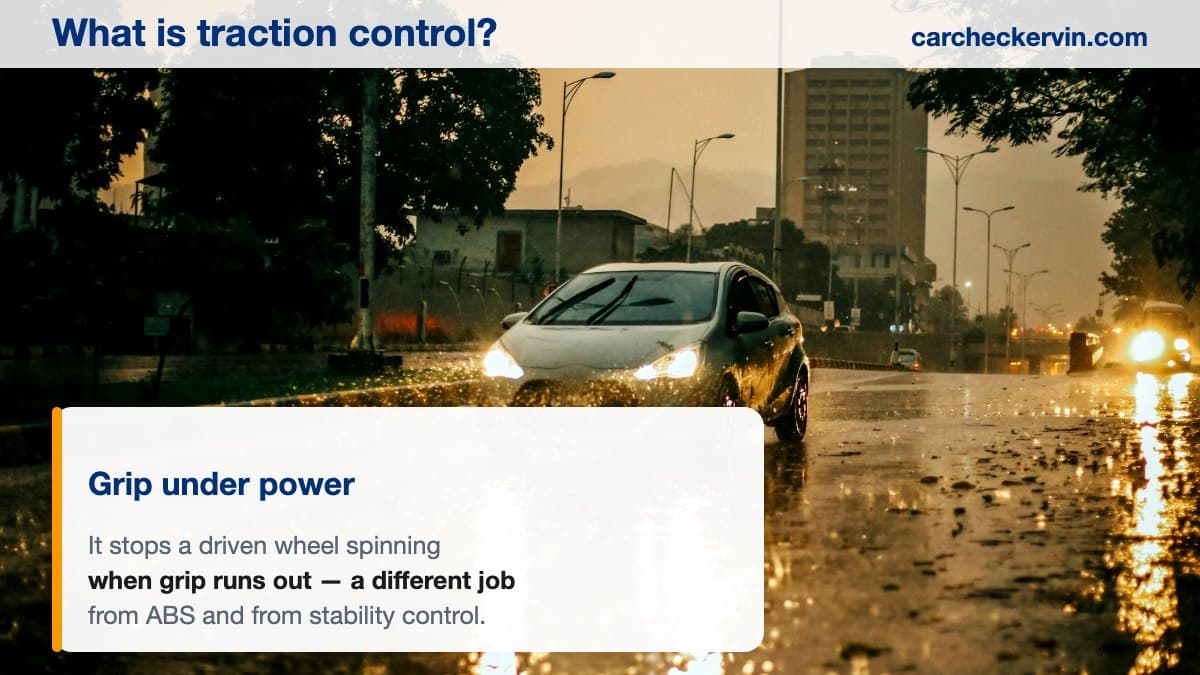
It stops a driven wheel spinning when grip runs out. That is a different job from ABS and a different job again from stability control — and only one of those three is something federal rules actually require a car to have.
Warning light on in a car you are viewing?
Find out what else the car is not telling you before you commit.
No account · Nothing stored · $14.99 only for the full report
Quick Answer
- What is traction control?
- A system that stops a driven wheel from spinning when it loses grip — by cutting engine torque, braking that wheel, or both. It acts when you are accelerating, which is what separates it from the other two systems on the same dashboard.
- How is that different from stability control?
- Stability control acts when the car is going somewhere you did not steer it — sliding wide or rotating. It brakes individual wheels to push the car back onto your intended line. Traction control is about grip under power; stability control is about direction.
- Which one does the law require?
- Electronic stability control. The federal standard sets requirements for ESC and does not require traction control at all — the phrase appears three times in it, never as a requirement.
Three systems that share a dashboard
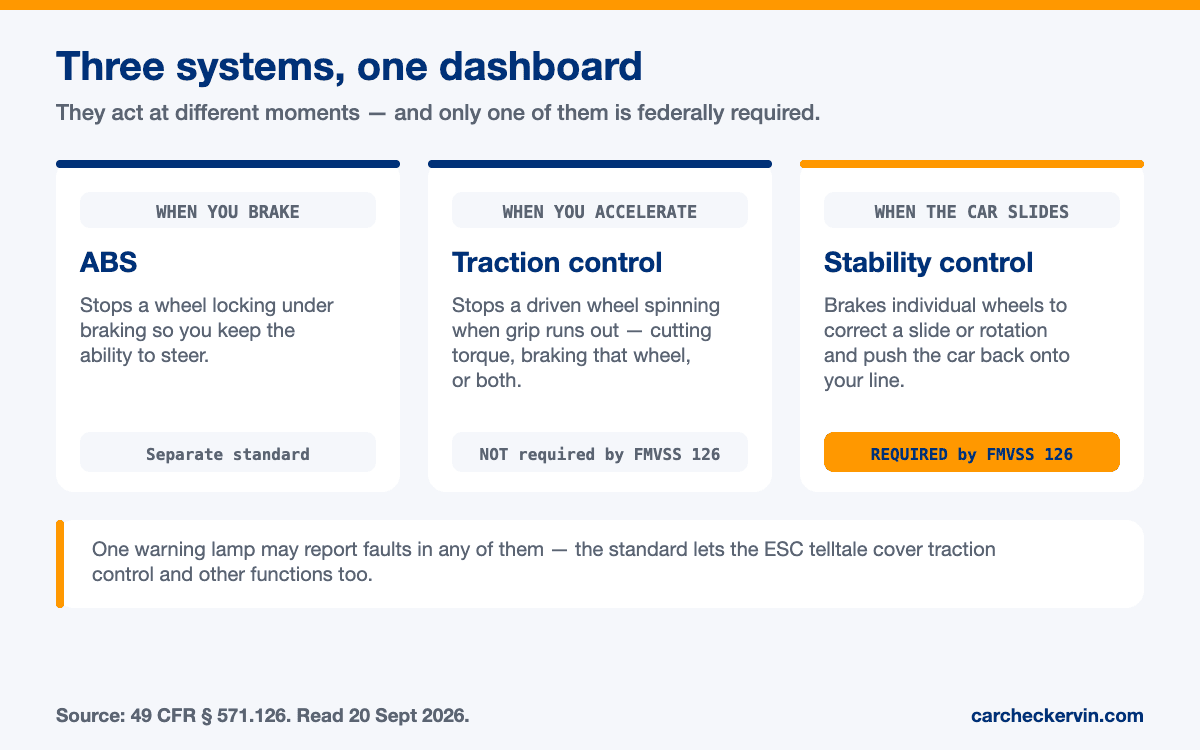
They are routinely treated as one thing with three names. They are not, and each acts at a different moment:
1ABS — when you brake
Stops a wheel locking under braking so you keep the ability to steer. It acts in the deceleration phase.
2Traction control — when you accelerate
Stops a driven wheel spinning when grip runs out, by cutting torque and braking that wheel. It acts in the acceleration phase.
3Stability control — when the car goes where you did not point it
Brakes individual wheels to correct a slide or a rotation. It acts whenever the car's actual direction stops matching your steering.
The standard itself confirms the separation in a single clause, requiring stability control to keep working when the other two are busy: “Remains capable of activation even if the antilock brake system or traction control system is also activated.”
Only one of them is required
People assume all three are mandatory safety equipment. One is:
FMVSS 126 requires electronic stability control. It does not require traction control. The phrase appears three times in the standard and never as a requirement — once confirming ESC must work even when traction control is active, once permitting the ESC malfunction telltale to also cover traction-control faults, and once in a documentation requirement.
In practice most cars with stability control also have traction control, because the hardware overlaps almost completely — a system that can brake one wheel to correct a slide can brake one wheel to stop it spinning. But that is engineering convenience, not a legal requirement, and the distinction matters when you are reading a specification sheet or a warning lamp.
“The purpose of this standard is to reduce the number of deaths and injuries that result from crashes in which the driver loses directional control of the vehicle, including those resulting in vehicle rollover.”
A warning lamp is a question, not a diagnosis
Title brands, accident and salvage records, reported mileage and open recalls — $14.99, no account.
What counts as stability control
The definition is strict: a system must have all 6 of these attributes before it may be called ESC. This is why a car with traction control alone does not qualify.
- 1
Augments vehicle directional stability by applying and adjusting the vehicle brake torques individually to induce a correcting yaw moment to a vehicle.
- 2
Is computer-controlled with the computer using a closed-loop algorithm to limit vehicle oversteer and to limit vehicle understeer.
- 3
Has a means to determine the vehicle's yaw rate and to estimate its side slip or side slip derivative with respect to time.
- 4
Has a means to monitor driver steering inputs.
- 5
Has an algorithm to determine the need, and a means to modify engine torque, as necessary, to assist the driver in maintaining control of the vehicle.
- 6
Is operational over the full speed range of the vehicle, with defined exceptions.
When stability control is not helping you
It is not on all the time, and the exceptions are specified rather than left to the manufacturer:
“Is operational during all phases of driving including acceleration, coasting, and deceleration (including braking), except when the driver has disabled ESC, the vehicle speed is below 20 km/h (12.4 mph), the vehicle is being driven in reverse, or during system initialization.”
Below 12.4 mph, in reverse, during start-up, or when you have switched it off — in each of those the system is standing down by design. When it is working, the standard requires that the system “Is capable of applying brake torques individually to all four wheels and has a control algorithm that utilizes this capability.”
Why one lamp can mean several things
This is the part with practical consequences when you are looking at a used car. The standard explicitly permits the stability control warning to double up:
“Manufacturers may use the ESC malfunction telltale in a steady-burning mode to indicate malfunctions of ESC-related systems and functions including traction control, trailer stability assist, corner brake control, and other similar functions that use throttle and/or individual torque control to operate.”
So a lit lamp does not tell you which system has failed, and the cheap repairs and the expensive ones look identical from the driver's seat. Get the car scanned before agreeing a price rather than after. The same “one lamp, more than one meaning” trap applies to the tire pressure warning — see what TPMS is.
Sources
- 49 CFR § 571.126 — FMVSS No. 126 — Electronic stability control systems for light vehicles
The standard that requires electronic stability control on light vehicles: the 6-part definition, the conditions under which the system stands down, and the malfunction telltale that may also report traction-control faults. Read 2026-09-20.
- NHTSA Recalls by VIN
The federal safety-recall lookup: free, by VIN, covering unrepaired recalls.
Always check the VIN before you buy
The free preview shows title brands, theft status and open recalls in seconds, and flags whether accident and odometer records exist. The full history is $14.99 — one-time, no subscription.
Keep reading
Frequently asked questions
What does traction control actually do?+
It prevents a driven wheel spinning up when grip runs out, typically by reducing engine torque and applying brake to that wheel. It is an acceleration-phase system: it matters pulling away on a wet road, not mid-corner.
What is electronic stability control?+
A system defined by 6 attributes it must ALL have, including that it "augments vehicle directional stability by applying and adjusting the vehicle brake torques individually to induce a correcting yaw moment to a vehicle." and that it is "is computer-controlled with the computer using a closed-loop algorithm to limit vehicle oversteer and to limit vehicle understeer."
Is traction control required by law?+
FMVSS 126 requires electronic stability control. It does not require traction control. The phrase appears three times in the standard and never as a requirement — once confirming ESC must work even when traction control is active, once permitting the ESC malfunction telltale to also cover traction-control faults, and once in a documentation requirement. We checked by counting occurrences against the text of the standard on 2026-09-20, so that is a finding rather than an impression.
Which vehicles must have stability control?+
"This standard applies to passenger cars, multipurpose passenger vehicles, trucks, and buses with a gross vehicle weight rating of 4,536 kilograms (10,000 pounds) or less, according to the phase-in schedule specified in S8 of this standard." So the rule reaches passenger cars and most light trucks, and stops at 10,000 pounds gross vehicle weight rating.
Does ESC ever switch itself off?+
It stands down in defined situations: "Is operational during all phases of driving including acceleration, coasting, and deceleration (including braking), except when the driver has disabled ESC, the vehicle speed is below 20 km/h (12.4 mph), the vehicle is being driven in reverse, or during system initialization." So it is not working when you are reversing, nor below 12.4 mph — which is why it cannot save you from a low-speed slide in a car park.
Can ABS, traction control and ESC all work at once?+
Yes, and the standard requires ESC to keep working when the others are active: "Remains capable of activation even if the antilock brake system or traction control system is also activated." That single sentence is the clearest statement that these are three separate systems rather than three names for one.
Why does one light seem to mean several things?+
Because it is allowed to. "Manufacturers may use the ESC malfunction telltale in a steady-burning mode to indicate malfunctions of ESC-related systems and functions including traction control, trailer stability assist, corner brake control, and other similar functions that use throttle and/or individual torque control to operate." So a lamp you think of as the traction control light may be reporting a fault somewhere else entirely.
Where is the warning light and what must it do?+
"The vehicle must be equipped with a telltale that provides a warning to the driver of the occurrence of one or more malfunctions that affect the generation or transmission of control or response signals in the vehicle's electronic stability control system." From September 1, 2011 it "must be mounted inside the occupant compartment in front of and in clear view of the driver."
What does a lit stability light mean on a used car I'm viewing?+
That something in a safety system is reporting a fault, and that you do not yet know which one — the same lamp can cover several functions. It is a reason to have the car scanned before buying, not a reason to accept a small discount. The car's recorded history, including open recalls on these systems, is the $14.99 check.
Check the car's history
Title brands, accident records and open recalls — $14.99.
Related VIN Checks
More tools to verify any vehicle's history