Buy Here Pay Here: How It Works, What It Really Costs, and What to Check Before You Sign
A buy here pay here lot is the dealer and the lender in one building. That changes the price, the paperwork and the risk. Here is how the deal works, and the two checks that protect you before you sign.
Buy here pay here means the dealership that sells you the car is also the company lending you the money. There is no bank in the middle. You pick the car on the lot, you sign the loan at the same desk, and you make the payments to that same dealer, often in person. It exists for people a bank has already said no to, and it works exactly as advertised: you drive away. The catch is everything that happens after.
This guide explains how a buy here pay here (BHPH) deal is put together, why it costs more than it looks, where the traps are, and the two checks that take ten minutes and change the outcome: reading the federal Buyers Guide on the window, and running the VIN before you sign a single page.
The short answer
Buy here pay here dealers finance the loan in-house, usually for buyers with no credit or poor credit. The Consumer Financial Protection Bureau notes the interest rates tend to be higher than a bank or credit union, and that many of these dealers report only your missed payments to the credit bureaus, not the ones you make on time. The car itself is the other half of the risk, and a vehicle history report is how you see it.
What buy here pay here actually means
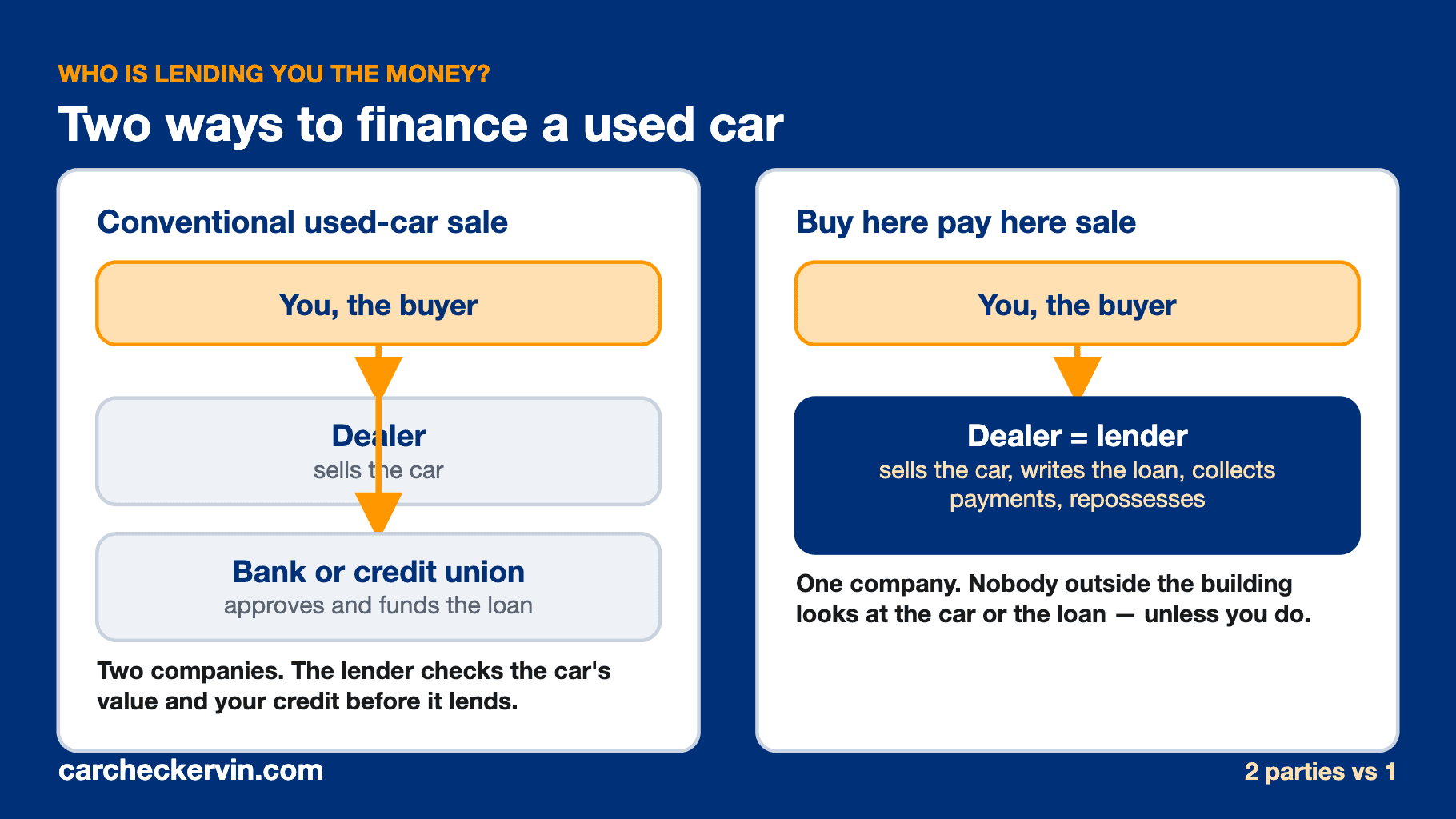
A normal used-car purchase involves two separate businesses. The dealer sells the car. A lender, whether a bank, a credit union or a finance company the dealer arranges, provides the loan, decides whether to approve you, and collects the payments. If the loan goes bad, the lender eats it, so the lender is picky.
A buy here pay here dealer collapses those two businesses into one. The dealer owns the inventory and carries the loan on its own books. That is why the sign says what it says: you buy the car here, and you come back here to pay for it. The CFPB describes these dealers plainly: they "typically finance auto loans 'in-house' to borrowers with no credit or poor credit." Because the dealer is the one taking the risk, it also sets the terms, and it prices that risk into the deal.
You will see the same model under other names. "In-house financing," "we finance," "no credit check," "your job is your credit" and "tote the note" all describe a dealer lending its own money. Whatever the sign says, the mechanics below are the same.
How a buy here pay here deal works, step by step
Most BHPH transactions follow the same path. Knowing the order lets you slow it down at the two points where you still have leverage.
- The car comes first, then the loan. You are shown vehicles the dealer has already decided it can finance, typically older, higher-mileage cars bought at auction. The inventory is the product and the loan is the wrapper.
- The dealer qualifies you on income, not credit. Expect to show pay stubs, proof of address, references and a phone bill. A credit report may not be pulled at all. What the dealer wants to know is whether the payment fits your paycheck.
- A down payment is set. It is often tied to what the dealer paid for the car, so the dealer is protected from day one even if the loan later fails.
- You sign the retail installment contract at the dealership. This is the loan. It states the price, the down payment, the finance charge, the annual percentage rate and the total of payments. Every one of those numbers is negotiable until you sign.
- Payments are scheduled around your paydays. Weekly or every two weeks is common, and many lots still want the payment made in person or through their own app rather than by bank transfer.
- Miss payments and the dealer repossesses. There is no third-party lender to call, and the dealer already knows where the car is parked.
Why it costs more than the sticker suggests
The money side is where a buy here pay here deal earns its reputation. Three things stack up.
The interest rate
The CFPB's guidance is blunt: rates at no-credit-check and buy here pay here dealers "tend to be higher than loans from a bank, credit union, or other lenders," and "higher interest rates ultimately increase the amount of money you'll pay over the life of your loan." The dealer is lending to people other lenders declined, and the rate reflects that.
The price of the car
Because the dealer controls both the car price and the loan, a lot has two levers to reach the same monthly number. It can quote a low-looking payment on a car priced well above what it would fetch for cash. The Federal Trade Commission's advice for any financed purchase applies with double force here: "make sure you know the total cost with financing, not just the monthly payment amount." Ask for the total of payments, the finance charge in dollars, and the cash price, and compare the cash price to what similar cars sell for elsewhere.
The credit reporting that does not happen
Many buyers choose a BHPH lot because it is pitched as a way to rebuild credit. The CFPB warns that these dealers "often only report or furnish negative information like late payments, and not positive payment information to the credit reporting companies." In other words, a late payment can hurt you while a year of on-time payments may not help at all. The Bureau's suggested fix is simple: ask the dealer to put in writing that it will report your on-time payments. If it will not, you have learned something about the deal.
Enforcement history is part of the picture
The CFPB's first-ever action against a buy here pay here dealer, in 2014, required DriveTime to pay $8,000,000 over its collection and credit-reporting practices. In 2015 it ordered CarHop to pay a $6,465,000 penalty for reporting inaccurate information to the credit bureaus, and in 2016 Herbies Auto Sales agreed to $700,000 in restitution after hiding finance charges from customers. Plenty of BHPH lots operate honestly. These cases show what the model looks like when one does not.
The Buyers Guide on the window is a legal document, so read it
Federal law requires nearly every used-car dealer to post a Buyers Guide on each vehicle it offers for sale. The FTC's Used Car Rule applies to dealers that sell or offer more than five used vehicles in a 12-month period, which covers essentially every buy here pay here lot in the country. The Guide has to be in plain view, hanging from a mirror, in a side window or under a wiper. A Guide in the glove box does not count.
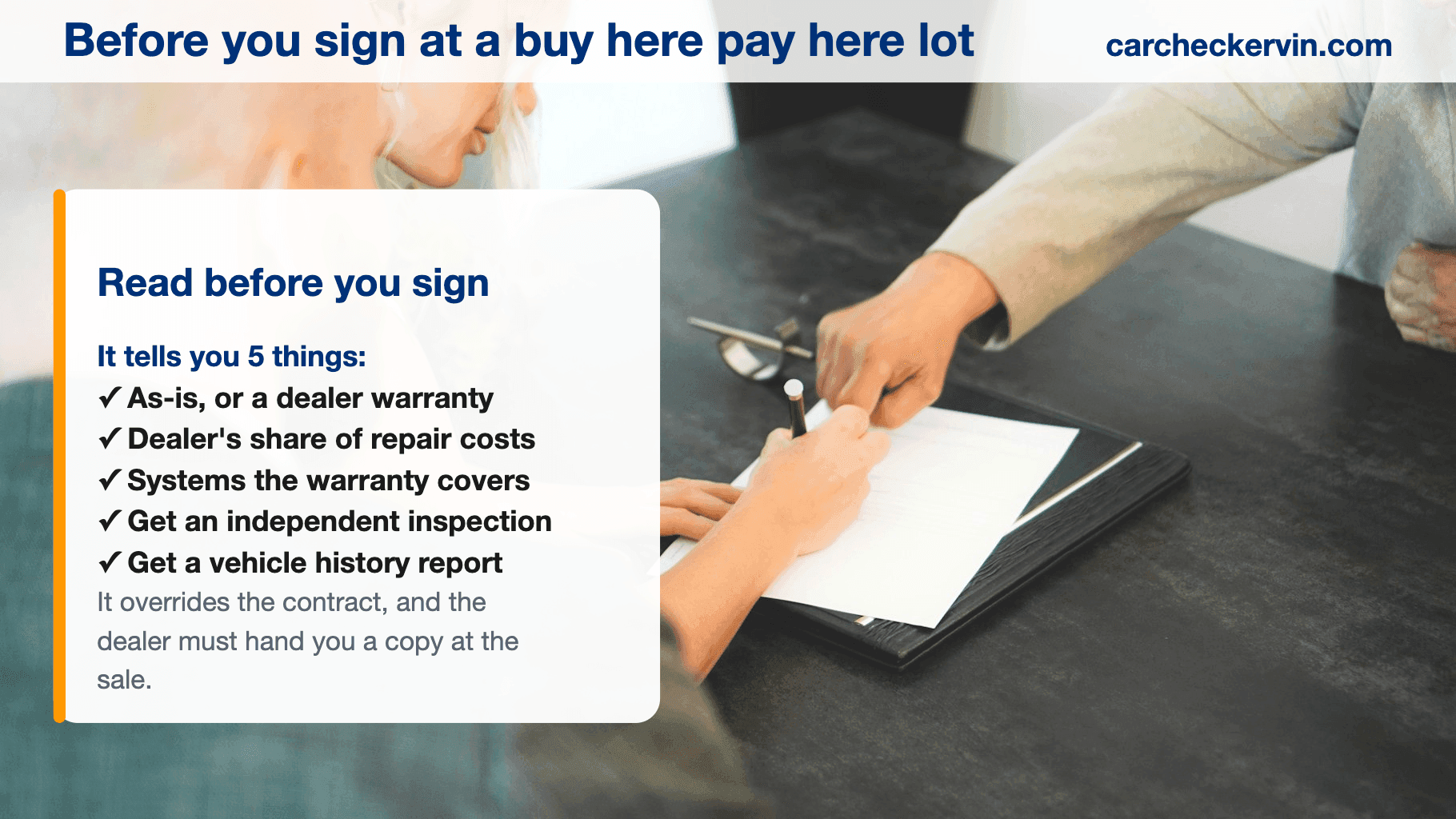
The Guide tells you whether the car is sold "As Is - No Dealer Warranty" or with a warranty, and if there is a warranty, what percentage of parts and labor the dealer pays and which systems are covered. It also tells you to get an independent inspection and to get a vehicle history report. Those two lines are printed on the form by federal requirement, which should tell you how seriously regulators take them.
Two rules matter most at a BHPH desk. First, the dealer must give you the original or a copy of the Guide at the sale, reflecting any changes you negotiated. Second, the Guide overrides the sales contract. If the Guide says warranty and the contract says as-is, the FTC's position is that the dealer owes you the warranty described in the Guide. So if the salesperson promises to fix the brakes or cancel the deal if you are not happy, get it written on the Guide, not spoken across the desk.
The car is the other half of the risk
Most coverage of buy here pay here stops at the loan. The vehicle deserves equal attention, because BHPH inventory is bought to a price. These are usually older cars, often sourced at wholesale auction, and a lot that finances its own paper has every reason to keep acquisition cost low. Some of those cars are fine. Some carry a history that would stop a bank from lending against them, which is precisely why they ended up on a lot that does not need a bank.
A vehicle history report built on federal title data shows you what the seller may not. Four things in particular decide whether a BHPH car is a bargain or a trap.
- Title brands. Salvage, rebuilt, flood and junk brands travel with the vehicle in the National Motor Vehicle Title Information System, the federal title database administered by the U.S. Department of Justice, even when a transfer to another state has washed the brand off the paper title. A branded car is worth far less than the loan you are about to sign for it.
- Odometer readings over time. NHTSA estimates that more than 450,000 vehicles are sold each year with false odometer readings, and digital odometers that have been rolled back leave no visible trace. The report lists every recorded reading, so a number that falls, or a five-year-old car with implausibly low miles, shows up as a break in the sequence.
- Open liens. A lender that still holds a lien on the car can claim it regardless of what you paid. A car that has already been through a repossession is exactly the kind of inventory that circulates through the auction lane and onto a BHPH lot.
- Theft and total-loss records. A vehicle reported stolen, or written off by an insurer and resold, should never be financed at any rate.
Run the VIN check before you negotiate, not after. It is the one piece of information in the transaction that the dealer does not control, and it tells you whether the price conversation is even worth having.
Why the report matters more here than at a franchise dealer
A bank underwriting a loan on a late-model certified car has already looked at the vehicle's value and history. At a buy here pay here lot, nobody outside the building has looked at anything. The report you pull is the only independent check the deal will ever get, and it costs a small fraction of a single weekly payment.
Warning signs at a buy here pay here lot
Not every BHPH dealer is a problem, and some serve their customers well for years. These are the signals that a particular lot is not one of them.
- No Buyers Guide on the car, or one that does not match what you are told. The Guide is mandatory. Its absence is a compliance failure before the deal has even started.
- The dealer will not let you take the car to an independent mechanic. The FTC's advice is to consider walking away. If insurance rules keep the car on the lot, a mobile inspection service can come to it.
- The dealer refuses to give you the VIN, or discourages a history report. There is no honest reason to hide a 17-character number that is stamped on the dashboard.
- Only the monthly or weekly payment is discussed. Ask for the cash price, the APR, the finance charge and the total of payments. If those numbers are hard to get, they are unfavorable.
- Add-ons appear at signing. The FTC notes that products like gap insurance, VIN etching and rustproofing "can cost thousands of dollars" and are often introduced at the end of a long day. You can decline them.
- A GPS tracker or starter-interrupt device is a condition of the loan and nobody explains it. Many BHPH lenders use them. Ask what it does, who can disable the car, and what happens if it fails.
Buy here pay here compared with the alternatives
If a bank has declined you, the choice is rarely between a BHPH lot and a prime loan. It is between the BHPH lot and a handful of options that take a little more effort.
- A credit union. Credit unions routinely lend to members with thin or damaged credit, and a pre-approval letter turns you into a cash buyer on any lot. Our guide to buying a car with bad credit walks through the application.
- A subprime loan through a franchise dealer. Franchise dealers work with finance companies that specialize in lower scores. The rate may still be high, but the car is usually newer and the loan is reported to the bureaus.
- A cheaper car for cash. A running car bought outright from a private seller, checked with a VIN report for private-party buyers, carries no interest at all. Our checklist for buying from a private seller covers the meeting, the paperwork and the payment.
- Waiting. A few months of paying down other debt can move you from a decline to an approval. The car you buy with a lower rate is effectively cheaper than the same car today.
None of these is guaranteed to work. But each is worth a phone call before you accept a loan whose terms exist because you had no other choice.
If you decide to buy: the sequence that protects you
Sometimes the BHPH lot is the realistic option. A job depends on transport, the credit repair will take years, and the car needs to be in the driveway this week. Done carefully, the deal can work. Do it in this order.
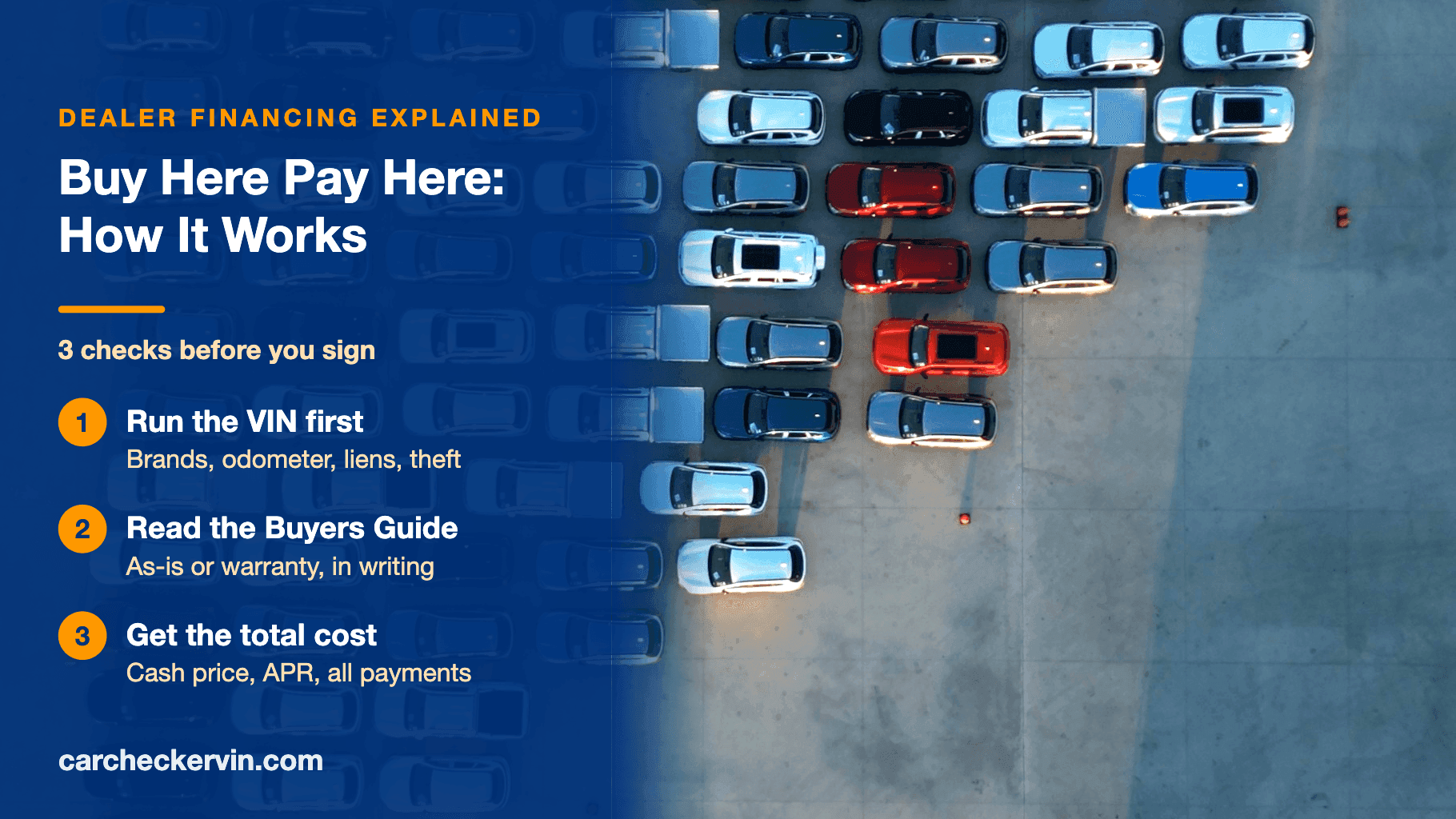
- Get the VIN from the dashboard, not the paperwork, and run the report. Reject anything with a title brand, an odometer break, an open lien or a theft record before you spend another minute on the lot.
- Read the Buyers Guide and photograph it. Note whether the sale is as-is, and get any verbal promise written on the Guide itself.
- Get an independent inspection. The FTC is explicit that a history report "is not a substitute for an independent vehicle inspection": the report shows the past, the mechanic shows the present. Use the written repair estimate to negotiate the price.
- Negotiate the cash price first, then the financing. Settle what the car costs before anyone mentions a payment. Then ask for the APR, the finance charge and the total of payments in writing.
- Ask, in writing, for on-time payments to be reported. The CFPB's recommendation, and a fair test of the dealer's intentions.
- Decline add-ons you did not ask for, and read the repossession terms. Know how many days late triggers a repossession and what it costs to get the car back.
- Keep every receipt. With in-person payments and in-house records, your receipts are the only proof of what you have paid.
Questions people ask about buy here pay here
Is buy here pay here a good idea?
It is a last resort that works for some buyers and costs others dearly. The CFPB's position is that rates tend to be higher and credit-building benefits are often absent. If you can qualify anywhere else, do. If you cannot, a buy here pay here deal done on a car with a clean history, a written Buyers Guide and a known total cost is far safer than one done on trust.
What is the difference between buy here pay here and in-house financing?
None in substance. Both mean the dealer is the lender. "In-house financing" is the more polite label; "buy here pay here" describes the payment routine.
Do buy here pay here dealers check your credit?
Many do not pull a credit report, or pull one without letting it decide the outcome. Approval rests on income and stability. That is the appeal, and also why the rate is what it is.
Does buy here pay here build credit?
Only if the dealer reports your payments to the credit bureaus, and the CFPB warns that many report only late payments. Ask for a written commitment to report on-time payments before you sign.
What happens if I miss a payment?
The dealer can repossess under the terms of the contract, and because it is both the seller and the lender, it can act quickly. Read the default clause before signing so the timeline and the reinstatement cost are not a surprise.
Can I run a VIN check on a buy here pay here car?
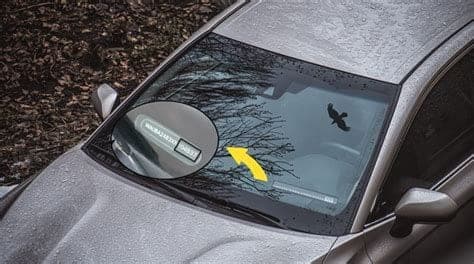
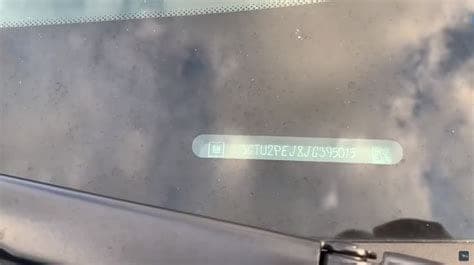
Yes, and you should. The VIN is on the dashboard at the base of the windshield and on the driver's door jamb sticker. Enter it in a VIN check to see title brands, the title history, odometer readings, lien records and theft records before you negotiate.
The bottom line
Buy here pay here is not a scam by definition. It is a business model that lends to people banks refuse, and it charges for that. The problems come from the two things the buyer cannot see across the desk: what the loan will really cost over its life, and what the car has really been through. The Buyers Guide answers the first question if you read it. A vehicle history report answers the second. Get both before you sign, and the deal becomes what it should be, a car you can afford, on terms you understand.
CarCheckerVIN Editorial Team
In-house automotive research team
The CarCheckerVIN editorial team combines decades of automotive industry, dealer, and journalism experience to produce trustworthy buying, selling, and ownership guidance backed by NMVTIS, NICB, and manufacturer data.
Ready to check a VIN?
Run a free VIN check
Decode any vehicle in under 60 seconds.