Best Midsize SUV Mileage: Which Models Save You the Most at the Pump
Fuel costs add up fast. This field guide ranks midsize SUVs by real-world MPG, breaks down ownership costs, and flags the lease deals worth considering right now.
Check the car you're reading about
Free VIN decode and recall check
Factory specs and open NHTSA recalls in seconds. No sign-up.
On this page· 9
- Why MPG Still Matters More Than You Think
- Best Midsize SUV Mileage Rankings: The Top Contenders
- Gas-Only Midsize SUVs: The Best of the Rest
- Buying vs. Leasing: Running the Numbers
- Best Lease Deals on High-MPG Midsize SUVs Right Now
- The Used-Market Angle: Pre-Owned Hybrids and What to Check
- Cost vs. Risk: Hybrid vs. Gas-Only Midsize SUV Decision Table
- What the Dealer Won't Tell You About MPG Claims
- How to Lock In Your Best Deal at the Dealership
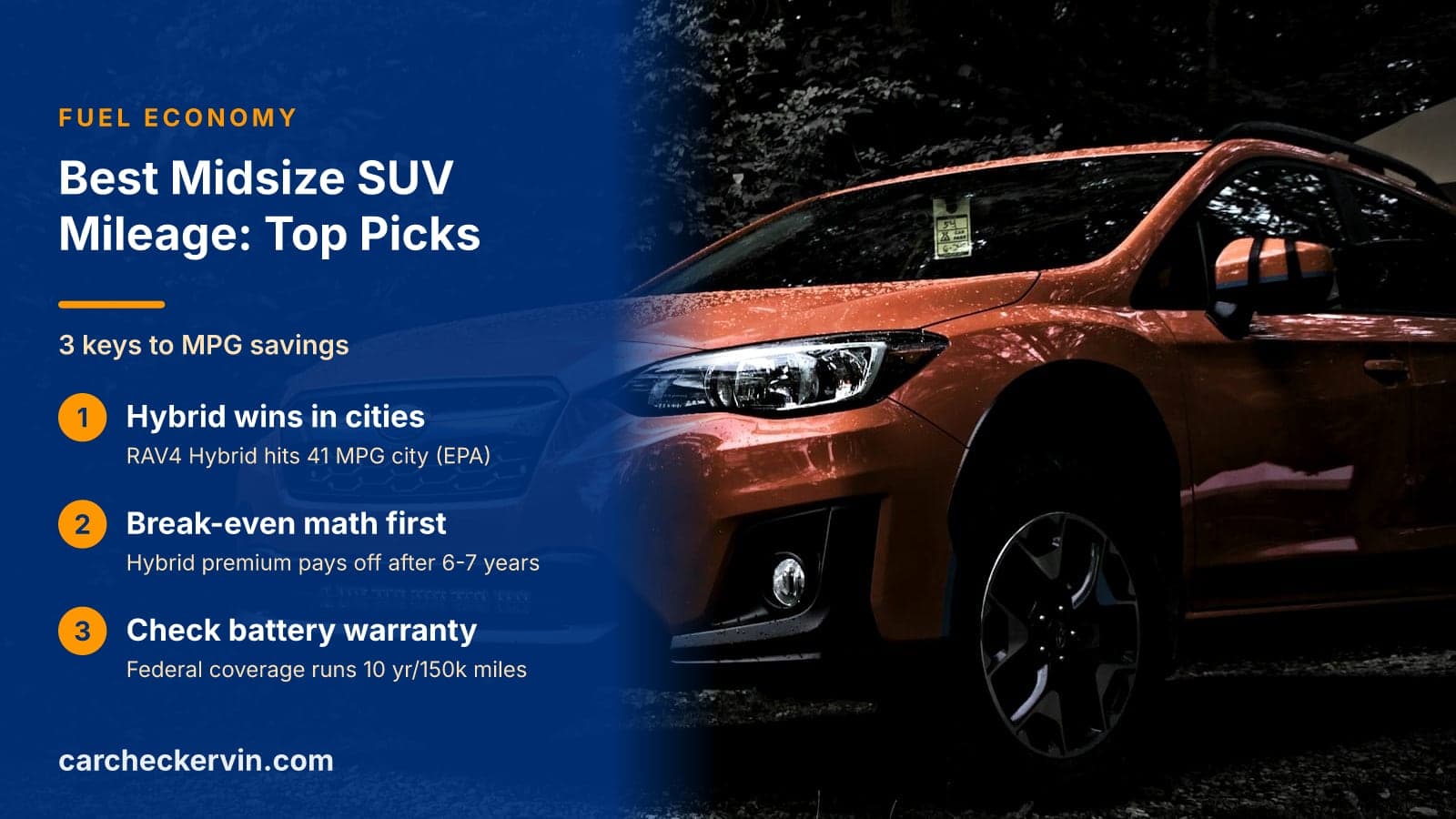
If you're shopping for the best midsize SUV mileage, you already know the math: a difference of 5 MPG between two vehicles adds up to hundreds of dollars a year, especially with gas prices still above $3.00 per gallon in most US regions according to the U.S. Energy Information Administration's weekly retail survey. This guide is for the buyer who wants to pick a midsize SUV that won't punish them at the pump — whether you're buying outright, financing, or looking at the best suv lease deals right now. We rank the real contenders, flag the traps, and help you weigh the decision before you sign anything.
The short answer
The Toyota Venza Hybrid and Ford Escape Hybrid consistently top the EPA's midsize SUV fuel-economy ratings, both clearing 37–41 MPG combined. If pure efficiency is your priority, either one should be your starting shortlist.
Why MPG Still Matters More Than You Think
Many buyers fixate on sticker price and forget running costs. The EPA estimates that over five years, a vehicle rated at 25 MPG combined costs roughly $3,250 more in fuel than one rated at 35 MPG combined, assuming 15,000 miles driven per year at average national prices (EPA Fuel Economy Guide, 2025 edition). That gap can wipe out a lower purchase price entirely. When you're comparing two models with a $2,000 difference in MSRP but an 8 MPG gap, the cheaper car is often the more expensive choice over time.
Real-world performance matters too. EPA lab ratings don't always translate to the road. The website fueleconomy.gov — maintained jointly by the EPA and the U.S. Department of Energy — aggregates driver-reported MPG for thousands of models. Cross-check there before you commit. Hybrid midsize SUVs typically land within 2–4 MPG of their EPA estimates in driver reports, while turbocharged four-cylinder gas models often run 3–5 MPG below their sticker ratings in heavy city traffic.
The Hybrid Premium: Is It Worth Paying?
Hybrid midsize SUVs typically carry a $2,500–$4,000 premium over their non-hybrid counterparts, according to Kelley Blue Book's market analysis for model-year midsize crossovers. That sounds steep, but if you drive 15,000 miles a year and save $700 annually in fuel, you recover the premium in under six years — and hybrids tend to hold residual value better at auction, which matters if you sell or trade in.
Best Midsize SUV Mileage Rankings: The Top Contenders
These are the models that consistently top the EPA's ratings for the midsize SUV class. All figures below are EPA combined MPG from the official fueleconomy.gov database for current model years. Trim level affects MPG, so treat these as the best available configuration for each nameplate.
- Toyota Venza Hybrid: 40 MPG combined (EPA), FWD configuration — one of the highest-rated non-plug-in midsize SUVs on the market.
- Ford Escape Plug-In Hybrid: 105 MPGe electric / 37 MPG combined on gas (EPA) — best for buyers who charge at home.
- Toyota RAV4 Hybrid: 38 MPG combined (EPA) — the bestselling hybrid SUV in the US by volume, according to Toyota sales data.
- Hyundai Tucson Hybrid: 38 MPG combined (EPA) — competitive pricing and a strong 5-year/60,000-mile powertrain warranty from Hyundai.
- Ford Escape Hybrid (non-PHEV): 41 MPG combined (EPA) in FWD trim — the highest combined rating in the mainstream midsize hybrid segment.
- Kia Sportage Hybrid: 38 MPG combined (EPA) — shares its platform with the Tucson and offers competitive lease pricing.
Gas-Only Midsize SUVs: The Best of the Rest
Not every buyer wants a hybrid. If you prefer a simpler powertrain or find the hybrid premium unjustifiable for your mileage pattern, some gas-only midsize SUVs still deliver respectable fuel economy. The Mazda CX-5 with its 2.5-liter naturally aspirated four-cylinder returns up to 28 MPG combined (EPA, FWD configuration). The Honda CR-V with the standard 1.5-liter turbocharged four reaches 30 MPG combined (EPA) in AWD trim, which is strong for an all-wheel-drive crossover.
The turbocharged engines in this segment are efficient at highway speeds but can drop noticeably in stop-and-go driving. If most of your driving is city or suburban, run the numbers carefully using fueleconomy.gov's city and highway split ratings, not just the combined figure. A vehicle rated 25 city / 32 highway combined at 28 MPG can feel very different in your driveway than it looks on paper.
What AWD Does to Your MPG
Adding AWD typically costs you 1–3 MPG combined compared to the FWD version of the same model, according to EPA fuel economy data across midsize crossover configurations. If you live in a state with mild winters and mostly paved roads, FWD with a good all-season tire is often the smarter choice for fuel economy. AWD adds weight and drivetrain friction — both enemies of efficiency.
Buying vs. Leasing: Running the Numbers
Before you decide how to acquire your high-MPG midsize SUV, it helps to understand what a lease actually is. Auto lease meaning, in plain terms: you pay for the depreciation of the vehicle during the lease term — not the full purchase price — plus interest (called the money factor) and fees. At lease end, you return the car or buy it at a pre-set residual value. Define car lease another way: it's a long-term rental with a structured buyout option. You don't own the vehicle during the term.
Whether buying or leasing makes sense depends on your miles and how long you keep vehicles. Leases typically cap annual mileage at 10,000–15,000 miles and charge $0.15–$0.25 per excess mile (typical terms from major captive lenders, per Edmunds lease market data). If you drive 20,000 miles a year, leasing usually costs more than financing. But if you drive under 12,000 miles and want to swap into a new model every three years, a lease keeps you in the latest efficiency hardware without a large down payment.
Lease residual values and fuel economy
High-MPG models tend to hold residual value better, which lowers your effective lease payment. But always read the Buyers Guide required by the FTC Used Car Rule before signing anything on a pre-owned vehicle — it discloses whether the vehicle comes with a dealer warranty or is sold as-is, a critical distinction on ex-lease returns.
Best Lease Deals on High-MPG Midsize SUVs Right Now
The best suv lease deals right now tend to cluster around models with strong residual values and manufacturer incentives. Hyundai and Kia have historically offered aggressive money factors on their hybrid Tucson and Sportage, sometimes subsidizing rates below 2% APR equivalent (money factor near 0.00083) during promotional periods — check with your regional dealer for current offers, as these change monthly. Toyota's captive lender (Toyota Financial Services) tends to support RAV4 Hybrid leases with above-market residuals, meaning lower monthly payments relative to MSRP.
When you're evaluating the best car lease deals right now, compare total lease cost (all monthly payments plus cap cost reduction plus fees) against the vehicle's purchase price times your expected depreciation over the same period. A lease that looks cheap at $399/month can cost more over 36 months than a financed purchase if you factor in no equity at the end. Use the FTC's consumer lease disclosure form — required under the Consumer Leasing Act (15 U.S.C. § 1667) — to see the full picture before you sign.
The Used-Market Angle: Pre-Owned Hybrids and What to Check
Buying a two- or three-year-old hybrid midsize SUV off-lease can get you top-tier fuel economy at a significant discount. RAV4 Hybrids and Escape Hybrids from recent model years routinely show up at Copart and IAA salvage auctions and at BHPH (buy-here-pay-here) lots, as well as through conventional dealers. The NMVTIS title brand system — administered under the National Motor Vehicle Title Information System, a federal program — will flag vehicles with salvage, rebuilt, or flood titles. Always run a vehicle history report before bidding or buying.
The main risk with used hybrids is battery health. Toyota's hybrid battery warranty is 10 years / 150,000 miles (federally mandated emissions-related component coverage under EPA regulations), which covers many used examples still within that window. Ford's hybrid battery warranty runs 8 years / 100,000 miles for the same federal coverage. Ask the seller for service records and, if possible, have an independent technician pull live battery state-of-health data before you pay.
Private Party vs. Dealer on Used Hybrids
Private-party sales skip the dealer markup — often $1,500–$3,000 on popular hybrid models in tight inventory markets — but you lose the FTC Buyers Guide disclosure and any dealer reconditioning. In a private sale, do your own pre-purchase inspection (PPI) at a shop you choose, and always do a VIN check to surface any open recalls, title brands, or odometer discrepancies the seller may not disclose.
Cost vs. Risk: Hybrid vs. Gas-Only Midsize SUV Decision Table
Here is where the decision gets real. The hybrid costs more upfront but saves fuel. The gas model costs less to buy and repair but costs more to run. Let's put numbers on it.
- Calculate your annual fuel cost for each option: take your expected annual miles, divide by the EPA MPG, multiply by your local gas price. At 15,000 miles/year and $3.30/gallon, a 28 MPG gas SUV costs $1,768/year in fuel; a 40 MPG hybrid costs $1,238/year — a $530 annual saving per U.S. Energy Information Administration price benchmarks.
- Add the hybrid premium to your break-even math: if the hybrid costs $3,500 more, divide that by $530 annual savings — break-even is roughly 6.6 years at those prices. If you keep cars 8–10 years, the hybrid wins. If you trade every 3–4 years, the gas model may come out ahead.
- Factor in maintenance: hybrid models typically skip alternator and starter replacements and use regenerative braking that extends brake pad life by 30–50% compared to conventional vehicles, according to Consumer Reports reliability data. That offsets some of the repair complexity premium.
- Check the extended warranty market: third-party extended warranty providers often exclude hybrid battery coverage or price it separately. Get that exclusion in writing before you buy a used hybrid from a BHPH lot or independent dealer, where warranty terms vary widely.
- Run a VIN check on any specific vehicle you're serious about — this surfaces NMVTIS title brands, open recalls, and odometer roll-back flags that can completely change the cost picture.
- Get competing loan or lease quotes from at least three sources (your bank or credit union, the manufacturer's captive lender, and one independent finance company) before you sit down at the dealer's finance desk.
What the Dealer Won't Tell You About MPG Claims
Dealers are required to display the EPA fuel economy label (Monroney sticker) on every new vehicle under 49 C.F.R. Part 575. But window sticker MPG is a test-cycle figure, not a real-world guarantee. The EPA has acknowledged that real-world results can be 10–20% lower than sticker figures for turbocharged gas engines under aggressive driving conditions. Hybrids tend to be more consistent because their efficiency advantage is largest exactly where gas engines struggle most — in stop-and-go traffic, where regenerative braking captures energy that would otherwise be wasted.
On pre-owned vehicles, the dealer may cite the original EPA rating for the model year, but actual mileage performance can degrade with age, especially if the previous owner skipped air filter changes or ran incorrect tire pressures. A tire underinflated by 10 PSI can reduce fuel economy by 0.2% per PSI under-inflated, according to the U.S. Department of Energy's fueleconomy.gov guidance — not catastrophic, but worth correcting before you benchmark a used car's real-world MPG.
How to Lock In Your Best Deal at the Dealership
You've done the research. Here's how to execute at the lot. Get the out-the-door price in writing before discussing financing or leasing — dealers often offset a low purchase price with inflated finance products. If you're leasing, ask the finance manager for the money factor and residual percentage in writing; under the Consumer Leasing Act (15 U.S.C. § 1667), you have the right to these figures before you sign. Compare at least two dealers on identical trim levels, not just similar-sounding packages.
For used vehicles, pull a vehicle history report before you negotiate — a salvage or rebuilt title brand found through NMVTIS can drop a vehicle's fair market value by 20–40% compared to a clean-title equivalent, according to data from major auction platforms. Use that information as negotiating leverage, not just a screening tool. If you find the car checks out clean, you're in a stronger position to pay a fair price with confidence.
What to do next
Pull fueleconomy.gov right now, enter the specific trim and drivetrain of each SUV you're considering, and run the 'Compare side-by-side' tool with your actual annual mileage — this single step gives you a real five-year fuel cost estimate and prevents you from being sold on a headline MPG figure that doesn't apply to how you drive.
About the author
CarCheckerVIN Editorial Team
In-house automotive research team
The CarCheckerVIN editorial team combines decades of automotive industry, dealer, and journalism experience to produce trustworthy buying, selling, and ownership guidance backed by NMVTIS, NICB, and manufacturer data.
See more of our guides on Google
Add CarCheckerVIN as a preferred source and Google will show our guides more often in your results.

Frequently asked questions
- What are the best gas mileage cars?
- Among all vehicle types, battery-electric cars and plug-in hybrids lead on per-mile energy cost. For gas-only vehicles, compact and midsize hybrid SUVs like the Ford Escape Hybrid (41 MPG combined, EPA) and Toyota RAV4 Hybrid (38 MPG combined, EPA) top the charts. Sedans like the Toyota Camry Hybrid reach 46 MPG combined (EPA), making them the most efficient conventional option if cargo space isn't a priority.
- What SUV has the worst gas mileage?
- Large body-on-frame SUVs with V8 engines consistently rank at the bottom. The Ford Expedition with the standard V6 manages only 18 MPG combined (EPA), and some V8-powered trim levels of the Chevrolet Suburban and GMC Yukon XL land at 16–17 MPG combined (EPA). If you want the worst of the worst, look at performance-tuned trims of large three-row SUVs — they often fall below 15 MPG in city driving.
- What is the best SUV for city driving?
- Hybrid midsize SUVs have the biggest advantage in city traffic because regenerative braking recaptures energy on every stop. The Toyota RAV4 Hybrid gets 41 MPG city (EPA), actually beating its combined rating in urban conditions. The Ford Escape Hybrid shows a similar pattern. For city buyers, a hybrid's city MPG rating matters more than the combined or highway figure — check both on fueleconomy.gov before deciding.
- Which AWD SUV is the best value for money?
- The Toyota RAV4 Hybrid AWD combines 38 MPG combined (EPA), strong residual value, and Toyota's 10-year/150,000-mile federally mandated hybrid battery warranty — making it the most defensible choice on total cost of ownership. The Hyundai Tucson Hybrid AWD comes close, with 38 MPG combined (EPA) and Hyundai's 5-year/60,000-mile bumper-to-bumper warranty, often at a lower purchase price. Both reward buyers who hold the vehicle long term.
Keep reading

What Are the Best SUVs to Buy: A Buyer's Guide to Finding the Right One
From $28,000 compact crossovers to $80,000 full-size haulers, finding the best SUV means weighing reliability data, total ownership cost, and title history — not just trim badges.
Oct 28, 2026 · 10 min read
2018 Hyundai Elantra Reliability: What Used-Car Buyers Must Know Before Signing
The 2018 Elantra is affordable and fuel-efficient, but engine seizure recalls and transmission complaints deserve a hard look before you hand over cash.
Oct 27, 2026 · 10 min read

Second Hand Car Buying Advice: The No-Nonsense Guide for US Buyers
From title brands and auction lots to financing traps and the best used EVs, this guide gives US buyers the specific, skeptical second hand car buying advice they need before spending a dollar.
Oct 27, 2026 · 11 min read