Used Car Lemon Law: Which States Protect Used-Car Buyers, and What to Do When a Dealer Sold You a Bad Car
Most lemon laws cover new cars only. A few states, New York and Massachusetts among them, force dealers to warranty used cars by mileage. Everywhere else you are relying on the federal Buyers Guide and implied warranties. Here is what applies to you, and the sequence that gets a refund.
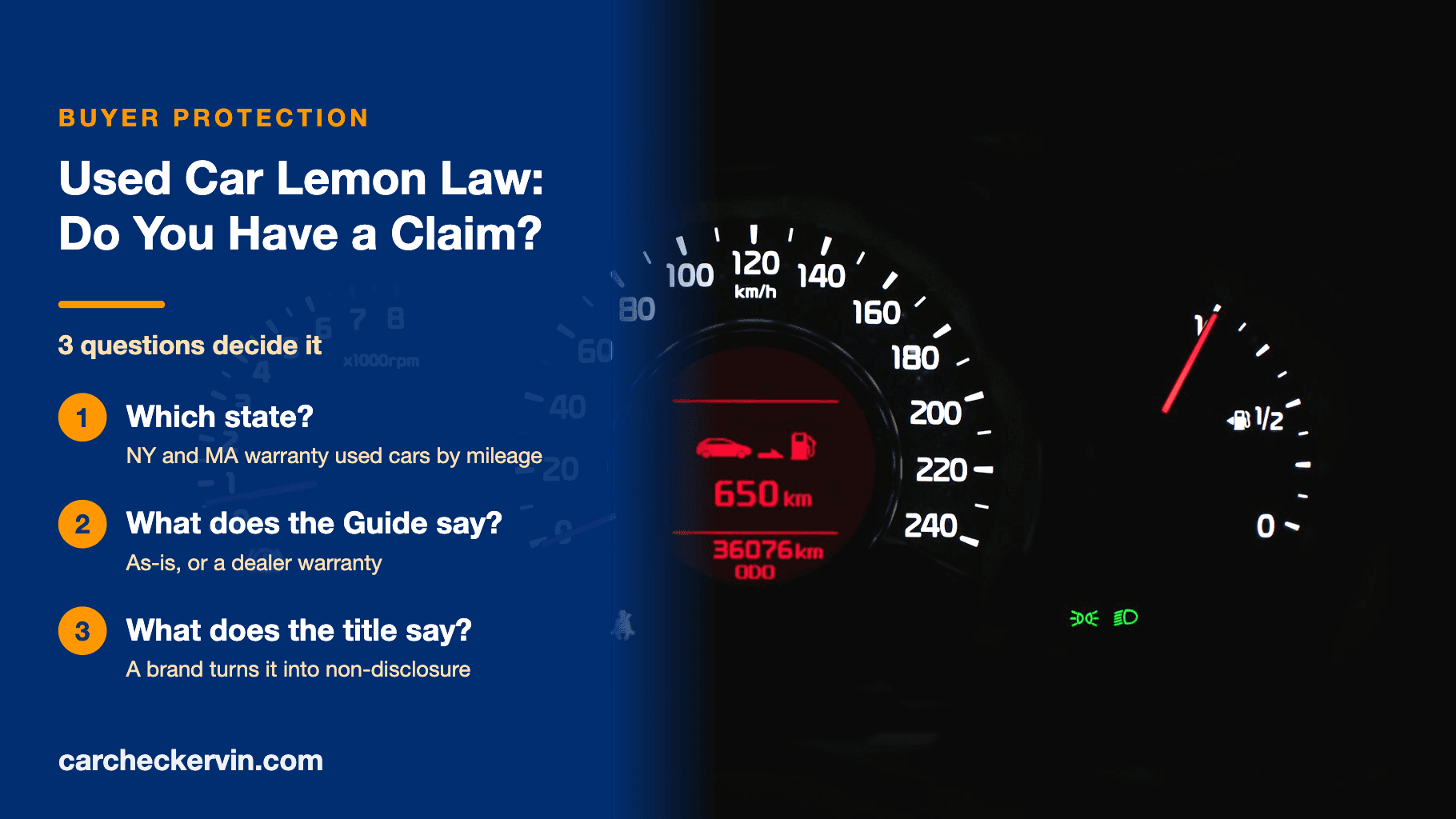
The phrase used car lemon law describes two different things, and which one applies to you depends entirely on the state you bought the car in. In a handful of states, the law itself forces a dealer to give you a written warranty on a used car and to take it back if it cannot be fixed. In most states, there is no such law: the word "lemon" in the statute refers to new cars, and a used-car buyer's protection comes from the federal Buyers Guide, the state's implied warranties, and whatever the dealer wrote down.
This guide sorts out which is which. It covers the two clearest used-car lemon laws in the country, New York's and Massachusetts's, in enough detail to know whether your car qualifies; the federal rules that apply on every dealer lot in the United States; the sequence to follow when a dealer has sold you a bad car; and the one check that makes all of it unnecessary, which is reading the car's title history before you buy.
The short answer
New York and Massachusetts require dealers to warranty used cars for a period set by the odometer reading, and give you a refund if the dealer cannot fix a covered defect after a reasonable number of tries. In other states, look first at the Buyers Guide that federal law required the dealer to post on the window: if it says "As Is - No Dealer Warranty", your remedies are narrow; if it lists a warranty, the dealer owes you that warranty. Whatever state you are in, keep every repair record and put every complaint in writing.
Does lemon law apply to used cars?
Every state has a lemon law for new vehicles: a manufacturer that cannot repair a defect within a set number of attempts has to replace the car or refund it. Those laws are built around the manufacturer's warranty. A used car bought from a dealer usually has no manufacturer's warranty left, so the new-car lemon law has nothing to attach to.
A minority of states solved that by writing a separate used-car statute. The two best-documented are New York's Used Car Lemon Law and Massachusetts's Used Vehicle Warranty Law. Both work the same way in outline: the dealer must provide a written warranty whose length depends on how many miles the car had when you bought it, the dealer must repair covered defects at its own expense during that period, and if the dealer fails after a reasonable number of attempts, you can return the car for a refund through a state arbitration program.
Elsewhere, your protection is the federal floor described further down. Several other states have used-car warranty or dealer-repair rules of their own, and the rules change, so the reliable move is to check your state attorney general's consumer page or the state motor vehicle agency before assuming either way. What follows is what the two clearest statutes actually say, taken from the agencies that enforce them.
New York's used car lemon law
New York's Attorney General runs the state's Lemon Law Unit and publishes the rules. A used car is covered if it meets all of these conditions: it was bought, leased or transferred after 18,000 miles or two years from original delivery, whichever came first; you bought or leased it from a New York dealer; the price or lease value was at least $1,500; it had been driven fewer than 100,000 miles when you bought it; and it is used primarily for personal purposes.
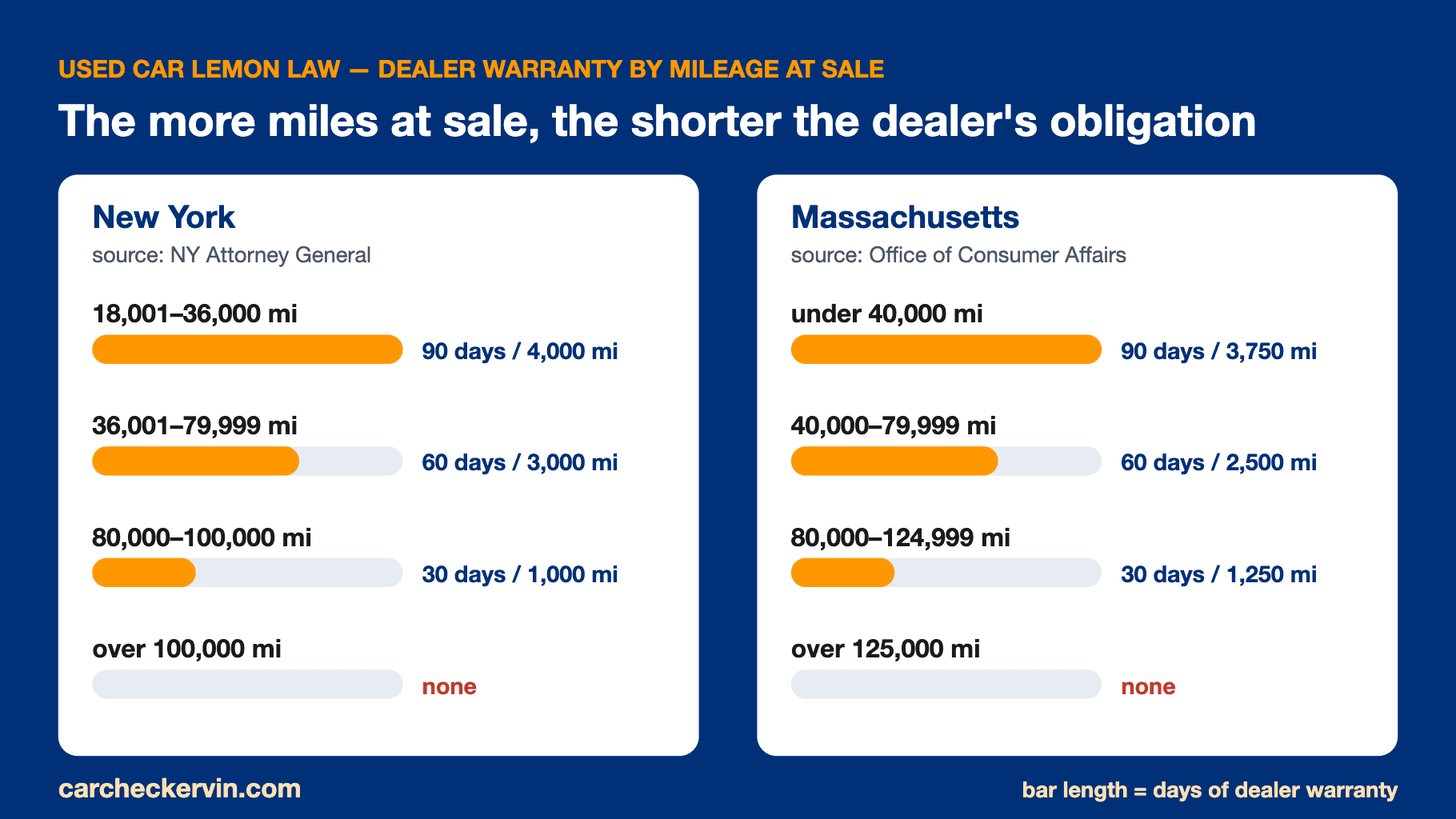
The dealer must give you a written warranty, and its minimum length depends on the mileage at sale:
- 18,001 to 36,000 miles: 90 days or 4,000 miles, whichever comes first.
- 36,001 to 79,999 miles: 60 days or 3,000 miles.
- 80,000 to 100,000 miles: 30 days or 1,000 miles.
The warranty has to cover the parts that make the car go and stop: the engine's lubricated parts, water pump, fuel pump, manifolds, block, cylinder head and flywheel; the transmission case, internal parts and torque converter; the drive axle; the brake master cylinder, booster, wheel cylinders, lines and calipers; the steering gear, power steering pump and rack; and the radiator, alternator, starter and ignition system, excluding the battery.
The dealer is deemed to have had a reasonable chance to repair the car if "the problem continues after three or more repair attempts" or if the car is out of service "for a total of 15 days or more." At that point you can request arbitration through the Attorney General's office and may be entitled to a full refund. Two exceptions: the dealer may not owe a refund if the problem does not substantially lower the car's value to you, or if it was caused by abuse, neglect or unauthorized alteration.
Massachusetts's used vehicle warranty law
Massachusetts's Office of Consumer Affairs and Business Regulation administers what the state calls the Used Vehicle Warranty Law, and it reaches further than New York's in one important respect: it defines a dealer as "someone who sells more than three cars in a 12-month period, even if they do not have a valid used car dealer license." A curbstoner flipping cars from a parking lot is a dealer under this law whether he likes it or not.
The law covers used cars, vans and trucks bought from a Massachusetts dealer for personal or family use, costing at least $700, with fewer than 125,000 miles at the time of sale. Motorcycles and commercial vehicles are excluded. The dealer must give you a written Limited Used Vehicle Warranty, signed and dated, and the warranty cannot be waived: if the dealer fails to provide it or gets it wrong, you are still entitled to repairs, and your protection period does not start until you receive a correct copy.
The term of protection, again by mileage at sale:
- Under 40,000 miles: 90 days or 3,750 miles driven since purchase.
- 40,000 to 79,999 miles: 60 days or 2,500 miles.
- 80,000 to 124,999 miles: 30 days or 1,250 miles.
- Over 125,000 miles: no lemon-law warranty.
Once you report a covered defect, the dealer must accept the car for repair within three business days and may not charge you more than $100 in total for lemon-law repairs. If the same defect survives three repair attempts, or the car is out of service for a cumulative 11 business days, you have the right to return it at the repurchase price. Each repair carries its own 30-day warranty. The refund includes the contract price, doc fees, finance charges, registration, towing up to 30 miles and up to $15 a day for alternative transport from the third day out of service, less a use allowance of 15 cents per mile driven.
If the dealer refuses, you can apply for state-certified arbitration. The request must be made within six months of the sale; applying is free, but the consumer pays $300 to the arbitrator once a hearing is scheduled.
Why the details matter
Both statutes turn on numbers the buyer controls: the mileage on the day of sale, the date of the first repair request, the count of repair attempts, the days the car sat at the shop. A buyer with a folder of dated work orders wins these cases. A buyer with a memory of phone calls does not.
What protects you in every other state
Outside the states with a used-car statute, three federal rules apply to every dealer that sells or offers more than five used vehicles in a 12-month period, which is essentially every dealer.
The Buyers Guide
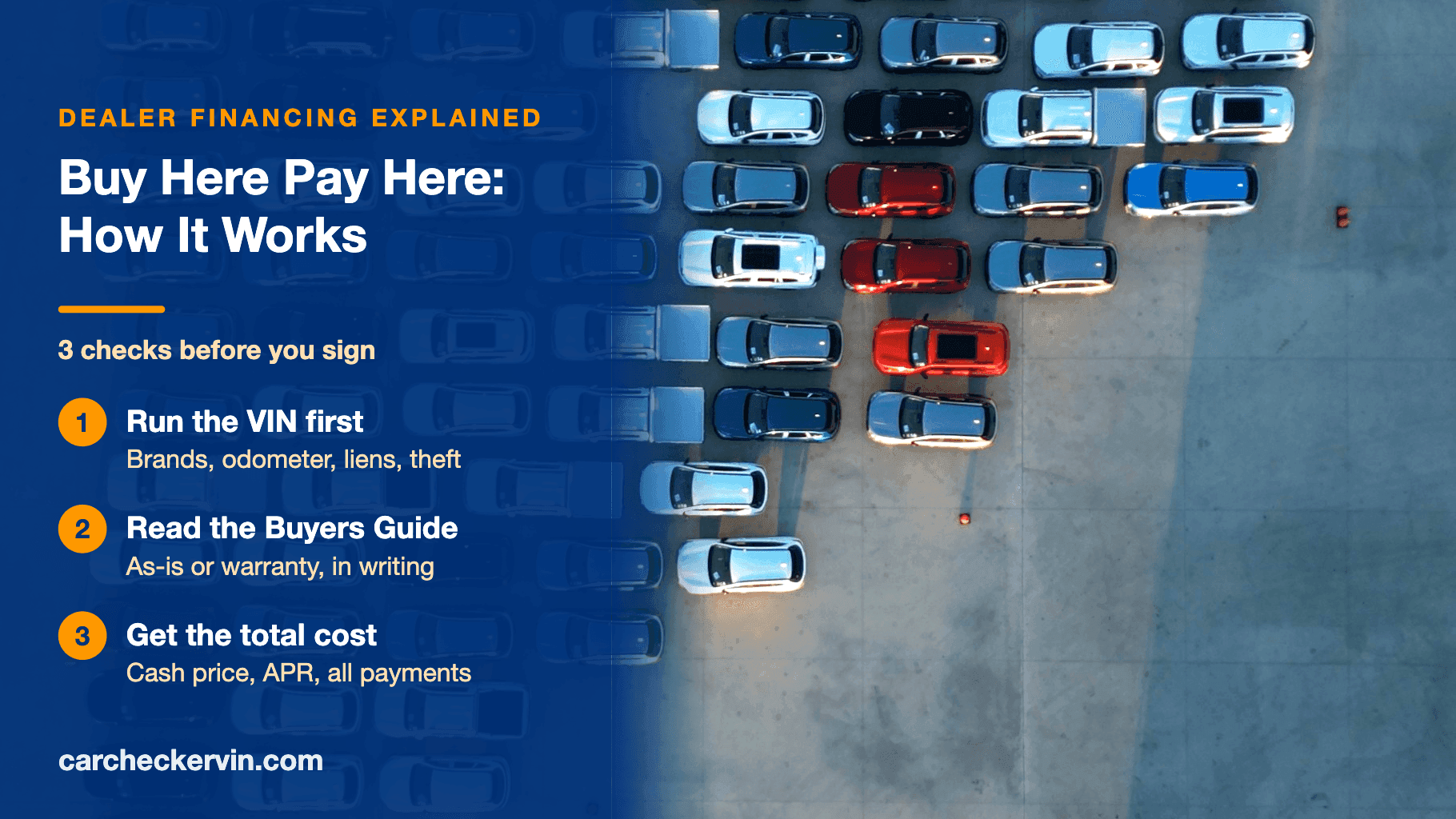
The FTC's Used Car Rule requires the dealer to post a Buyers Guide on every used car and to give you a copy at the sale. It states whether the car is sold "As Is - No Dealer Warranty" or with a warranty, and if there is a warranty, what share of parts and labor the dealer pays and which systems are covered. The FTC's position is that the Guide overrides the sales contract: if the Guide says warranty and the contract says as-is, the dealer owes you the warranty. Any verbal promise the salesperson made, from "we'll fix that noise" to "bring it back if you're not happy", is enforceable only if it is written on the Guide.
Implied warranties
If the car was not sold as-is, it carries the state's implied warranties even with no written warranty. The FTC describes the main one, the warranty of merchantability, as a promise that "the car will do what it's supposed to do: it will run," and notes that implied warranty coverage "can last as long as four years, although the length of the coverage varies from state to state." You will need to show the defect existed at the time of sale, and the dealer may dispute it, but the protection is real.
As-is sales
"As Is - No Dealer Warranty" means, in the FTC's words, "the dealer won't pay for any problems or needed repairs. You're assuming the risk of anything that goes wrong after the sale." Some states limit or prohibit as-is sales; the FTC's advice is to contact your state attorney general to find out what disclosures your state requires. An as-is sale does not license fraud, though: a dealer that hid a known defect, or a title brand, may still be liable under state consumer protection law, which is a different claim from a lemon-law one.
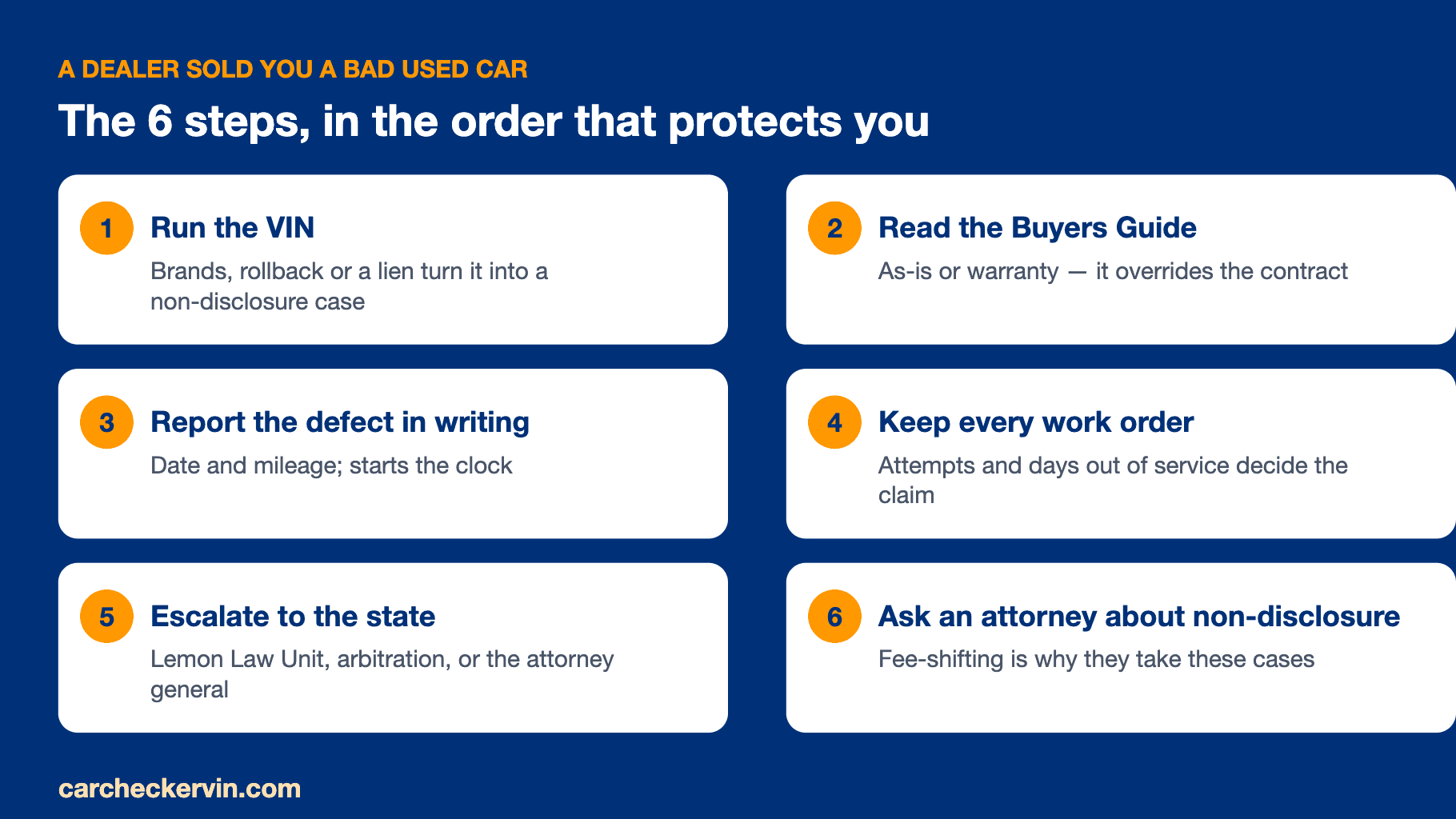
A dealer sold you a bad used car: the sequence
Whether you are in a lemon-law state or not, the same order of operations protects your position.
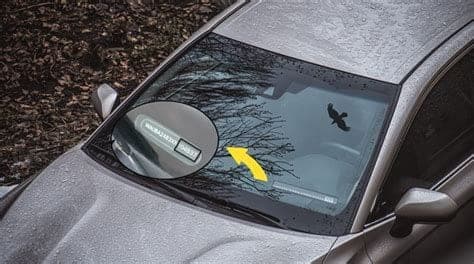
- Pull the vehicle history now. Run the VIN through a VIN check. If the report shows a salvage, rebuilt, flood or lemon-buyback brand, an odometer rollback or an open lien that the dealer never disclosed, you are no longer in a warranty dispute; you are in a non-disclosure case, which is stronger and has different remedies.
- Find the Buyers Guide and read it. As-is or warranty; which systems; what percentage. Photograph it. If the dealer never gave you one, note that, because it is a violation in itself.
- Report the defect to the dealer in writing, with the date and mileage. Email is fine. In New York, notifying the dealer within the warranty period obligates it to repair even if the warranty expires before the work is done.
- Keep every work order, invoice and message. The count of repair attempts and days out of service is what a lemon-law claim is decided on.
- Escalate through the state. New York's Lemon Law Unit and Massachusetts's arbitration program take used-car claims directly. Elsewhere, file with the state attorney general's consumer protection office and the agency that licenses dealers.
- Consider an attorney for a non-disclosure claim. Fraud and consumer-protection cases often carry fee-shifting, which is why lemon-law attorneys advertise. Ask about the fee structure before you sign.
The check that makes the lemon law unnecessary
Lemon laws exist for the buyer who did everything right and still got a bad car. Most bad used cars, though, announce themselves in the title record before the sale. A car that a manufacturer bought back under a new-car lemon law carries a buyback brand in the National Motor Vehicle Title Information System, the federal title database run by the U.S. Department of Justice, and our lemon check reads it for any VIN. Salvage, rebuilt and flood brands, odometer discrepancies and open liens are in the same record.
That report costs a fraction of the arbitration fee in Massachusetts and takes minutes rather than months. Read it before you sign, walk away from anything branded, and the used car lemon law becomes a subject you read about rather than a process you live through. Our guide to reading a vehicle history report explains each section.
Questions people ask about used car lemon laws
Can I do lemon law on a used vehicle?
In New York and Massachusetts, yes, if the car meets the mileage, price and dealer conditions above. In most other states the new-car lemon law does not apply, and your claim rests on the Buyers Guide, implied warranties and consumer-protection law.
Can you return a used car if it has problems?
Only if a law or the dealer's own written policy gives you that right. New York and Massachusetts provide a refund after failed repairs. Elsewhere there is no general right to return a used car after signing, which is why the Buyers Guide and the history report have to be read before, not after.
How long do I have to return a used car after purchase?
It depends on the state statute and the mileage at sale: in New York the dealer warranty runs from 30 to 90 days, in Massachusetts from 30 to 90 days, and a Massachusetts arbitration request must be filed within six months of the sale. In states without a used-car law, there is no fixed return window.
Can I sue a dealership for selling me a lemon used car?
You can pursue arbitration or court under a used-car statute where one exists, and a consumer-protection or fraud claim in any state if the dealer misrepresented the car or hid a title brand. A history report is the fastest way to find out which kind of case you have.
What happens if I buy a used car and it breaks down the next day?
Check the Buyers Guide first. If it shows a warranty, or you are in a state that requires one, report the defect in writing immediately and let the dealer repair it. If it was sold as-is, look at whether the defect was disclosed and whether the title history shows anything the dealer should have told you.
Does the used car lemon law apply to private sellers?
Generally no; these laws cover dealers. Massachusetts, though, treats anyone selling more than three cars in a year as a dealer, licensed or not, which catches unlicensed sellers posing as private parties.
The bottom line
A used car lemon law is a real, enforceable protection in the states that have one, and it turns on details you should write down from the day you buy: mileage, dates, repair attempts. Everywhere else, the Buyers Guide on the window is the contract that matters, and the title history is the evidence. Read both before you pay, and the lemon law is a safety net you never have to test.
CarCheckerVIN Editorial Team
In-house automotive research team
The CarCheckerVIN editorial team combines decades of automotive industry, dealer, and journalism experience to produce trustworthy buying, selling, and ownership guidance backed by NMVTIS, NICB, and manufacturer data.
Ready to check a VIN?
Run a free VIN check
Decode any vehicle in under 60 seconds.