Curbstoning: How to Spot an Unlicensed Dealer Posing as a Private Seller
A curbstoner flips cars for profit while pretending to be an ordinary owner, and the cars are usually the ones licensed dealers would not touch. Here is how the scheme works, the tells that give it away, and the one check that exposes it every time.
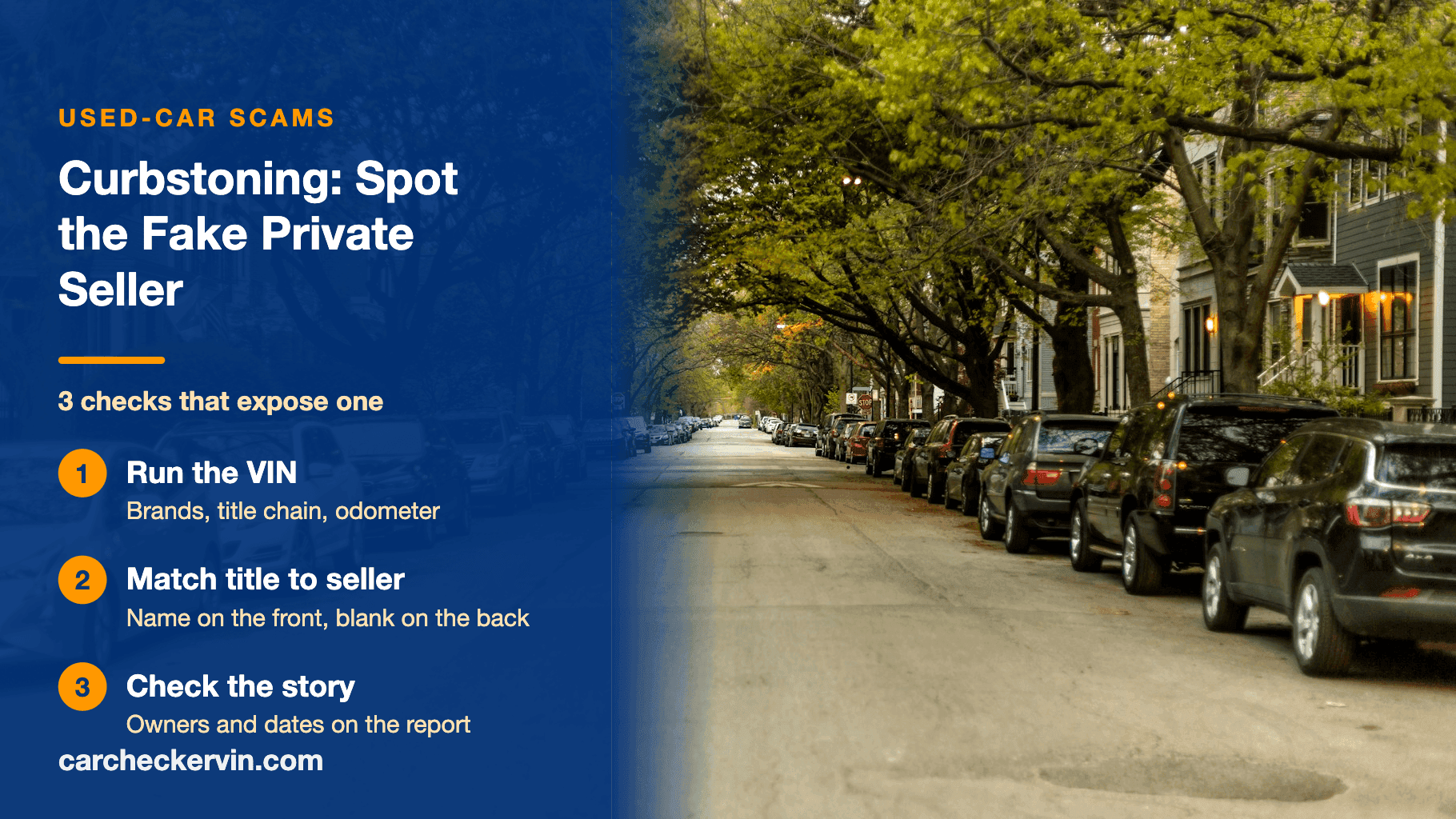
Curbstoning is the sale of used cars by an unlicensed dealer who pretends to be a private owner. The name comes from where the cars sit: at the curb, in a vacant lot, in a grocery store parking lot with a phone number taped to the window. The seller says the car was his mother's, or his own daily driver, or a project he never got round to. In fact it is inventory, bought cheap at auction or off a salvage yard and flipped for cash to a buyer who thinks she is dealing with a neighbor.
The scheme is old, it is illegal in most states, and it has moved from the curb to the online marketplace without changing its shape. This guide covers what curbstoning is, why the cars are so often the ones you least want, the tells that give a curbstoner away, and the checks that expose the scheme before any money changes hands.
The short answer
A curbstoner sells cars repeatedly for profit without a dealer license, dodging the consumer protections, disclosures and bonding that apply to licensed dealers. The Georgia Independent Auto Dealer Association defines it as "the sale of used vehicles by unlicensed dealers who pretend to be private parties in order to evade regulation." The fastest test is the title: if the name on it is not the name of the person selling, you are looking at a curbstoner or a title jumper, and often both.
What curbstoning actually is
Every state licenses car dealers, and a license comes with obligations: a physical place of business, a surety bond, sales tax collection, inspection and disclosure rules, and the federal Buyers Guide on every car. Ordinary people are allowed to sell their own vehicles without any of that, because selling the family car once every few years is not a business.
A curbstoner lives in the gap between those two categories. He sells cars as a business but presents each sale as a private one. GIADA puts the legal principle simply: "State laws prohibit private citizens from selling multiple cars or vehicles other than those titled to them." A curbstoner breaks both halves of that rule. He sells many cars a year, and the cars are rarely titled in his name.
The federal government draws the same line from the other direction. The FTC's Used Car Rule treats anyone who sells or offers more than five used vehicles in a 12-month period as a dealer who must comply with the Rule, including posting a Buyers Guide. A curbstoner is, by that definition, a dealer who has simply decided not to follow dealer law. The Stop Curbstoning initiative, backed by the National Independent Automobile Dealers Association and the National Auto Auction Association, describes the typical operator as "the hustler churning and flipping 20, 50 or even more cars every year," and cites research suggesting that up to one in five vehicles sold outside licensed dealerships is a curbstoned car rather than a genuine private sale.
Why the cars are so often bad
If curbstoning were only a licensing violation it would be the dealer's problem, not yours. It becomes your problem because of what a curbstoner sells. Licensed dealers cannot easily move cars with branded titles, unrepaired damage or rolled-back odometers, because the disclosures required at a licensed sale would kill the deal. Those cars still exist, and they have to go somewhere. GIADA's description is blunt: curbstoners "frequently sell vehicles reputable dealers won't touch, those with hidden problems in their past," and their customers "often get saddled with damaged, dangerous, or uninsurable vehicles."
The usual suspects show up again and again.
- Salvage and rebuilt cars sold as clean. A car written off by an insurer, patched at a body shop and sold to someone who never sees the title brand until the DMV shows them.
- Flood cars. Bought at auction after a hurricane, dried out, and moved to a state where nobody is looking for water damage.
- Odometer rollbacks. NHTSA estimates that more than 450,000 vehicles are sold each year with false odometer readings. A curbstoner who bought a high-mileage car at auction has both the motive and, with a digital cluster, the means.
- Cars with an open lien. The previous owner's lender still has a claim, and the curbstoner is not going to mention it.
- Title-jumped cars. The title was signed by the previous owner and left blank, so the curbstoner can pass it straight through. We cover this in detail in our guide to title jumping.
None of these problems is visible from the curb. All of them are visible in the vehicle's title and odometer history, which is why the check that beats a curbstoner is not a test drive. It is a VIN.
How to spot a curbstoner: the tells
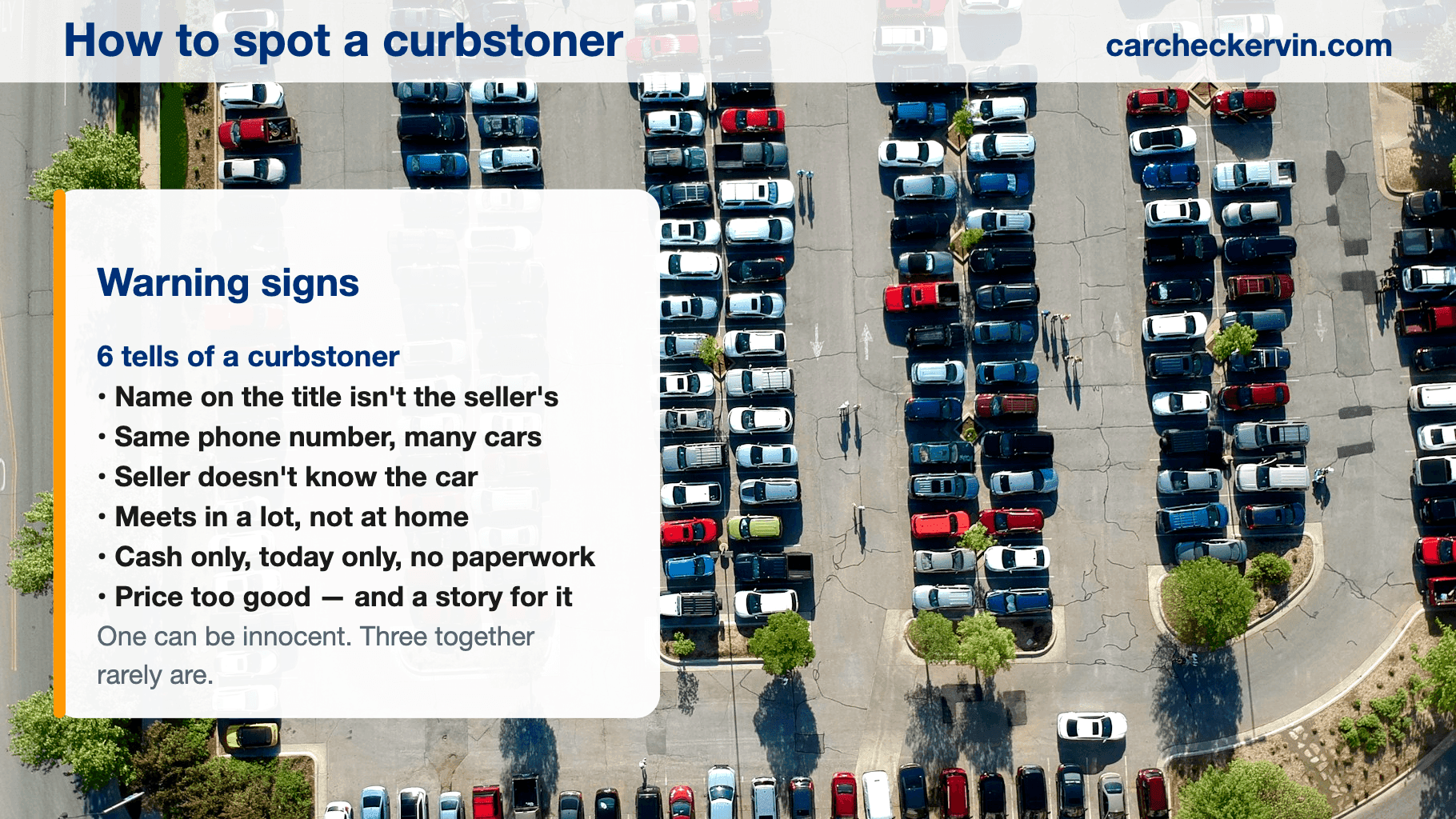
No single sign proves a seller is a curbstoner. Three or four together are close to conclusive. Run through them before you drive out.
The name on the title is not the seller's
This is the tell that matters most, and it is the one a curbstoner cannot fix. Ask to see the title before you talk price. If the registered owner is someone the seller has never mentioned, or the assignment on the back is already signed by a stranger, the person in front of you did not own this car. He may say it belongs to a relative, or that he is selling it for a friend. Sometimes that is true. It is also exactly what a curbstoner says.
The same phone number sells a lot of cars
Search the seller's phone number in the marketplace or classifieds site you found the car on. A genuine private seller has one listing, perhaps two. A curbstoner has a rotating stock, and the number links them. GIADA's advice to dealers who report curbstoning is to capture the phone number in a photograph, for the same reason.
The seller does not know the car
Someone who drove a car for five years knows where the spare is, which window sticks, when the timing belt was done. A curbstoner who bought it at auction ten days ago knows the price. Ask ordinary owner questions and listen for vagueness.
The meeting place is not a home
A parking lot, a gas station, a vacant lot with several cars lined up, or a "come see it at my buddy's shop" invitation. GIADA notes that vacant lots and business parking lots are "loaded up with cars for sale, especially on the weekends," which is where enforcement officers go looking. A genuine seller is usually happy to meet at the address on the registration.
Cash only, today only, no paperwork
A curbstoner wants cash, wants it now, and wants as little paper as possible because paper leaves a trail. Pressure to close immediately, refusal to write a bill of sale, or a suggestion that you "just fill in the buyer's name later" are all warning signs.
The price is too good, and the story explains why
A car priced well below the market always comes with a reason: a divorce, a move, a death in the family. The story is designed to explain the price and discourage questions. Take the price as a signal to check harder, not as a reason to hurry.
Curbstoning versus title jumping: the difference
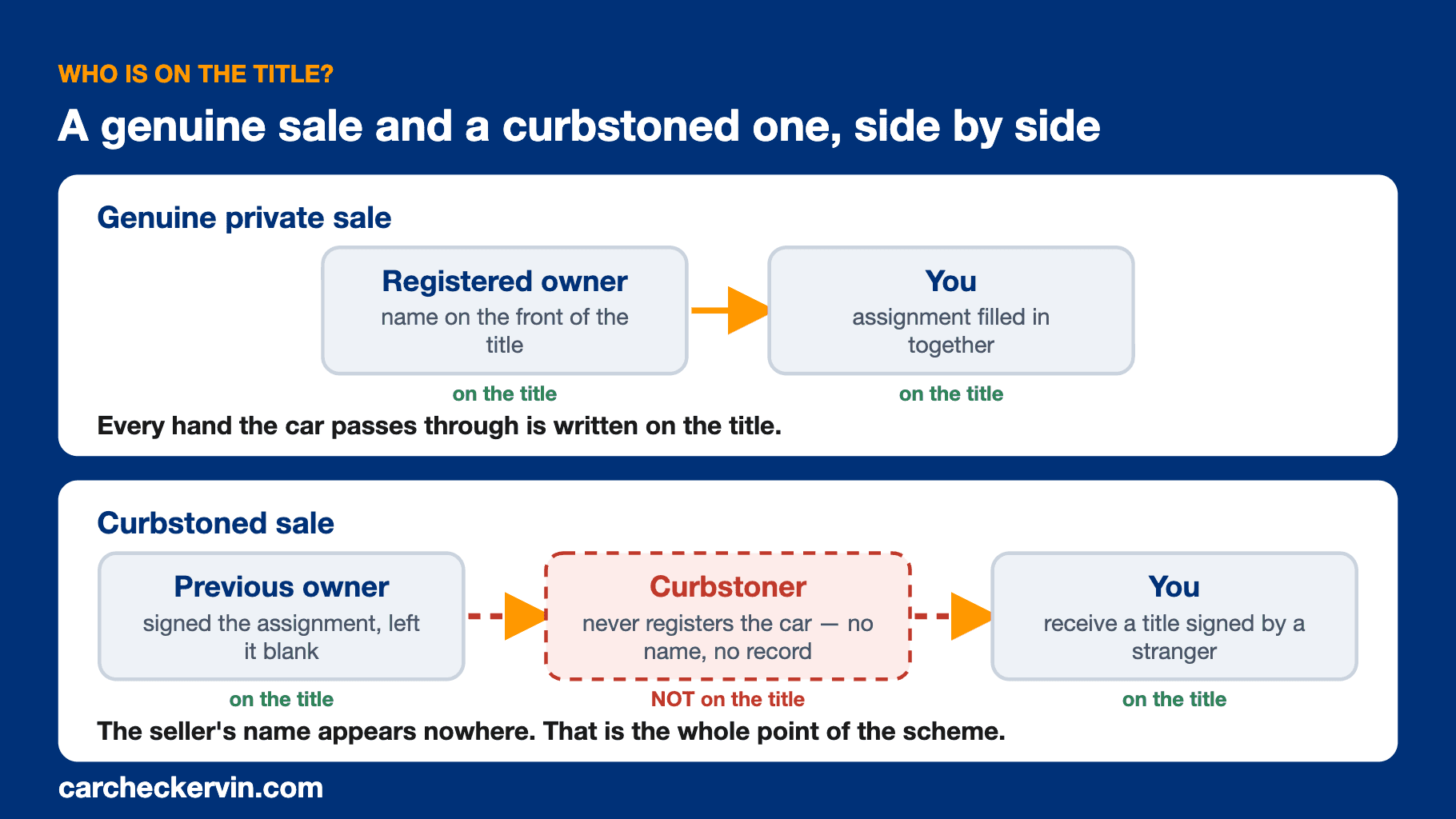
The two schemes are usually found together, but they are not the same thing. Curbstoning describes who the seller is: an unlicensed dealer posing as a private party. Title jumping describes how the paperwork is handled: the seller never puts the car in his own name, and passes on a title that the previous owner signed and left open. A curbstoner title-jumps because registering each car would cost him time, tax and a paper trail that proves he is a dealer. A private individual can also title-jump once, out of laziness or to dodge the transfer fee, without being a curbstoner.
For the buyer the consequence is the same. A title with a gap in it, or a signature that does not match the seller, can leave you unable to register the car, liable for someone else's lien, or holding a vehicle that was never legally sold. Read our guide to what a car title looks like so you can check the assignment section yourself before you pay.
Is curbstoning illegal?
In most states, yes, though the statute usually targets unlicensed dealing rather than using the word curbstoning. Georgia is a clear example. GIADA reports that the state's anti-curbstoning law, House Bill 144, took effect on July 1, 2007 as Georgia Code section 40-2-39.1, and that it falls under motor vehicle and traffic law, so "any city, county or state law enforcement officer is authorized to enforce" it. Officers can ticket the person selling the car, the owner of the property it is parked on, and the tenant leasing that property, and they can have the vehicles towed.
Other states set a numerical threshold: sell more than a set number of vehicles in a year without a license and you are presumed to be dealing. The number varies by state, so check your own state's motor vehicle agency or attorney general. The federal floor is the FTC's: more than five used vehicles in 12 months makes you a dealer for the purposes of the Used Car Rule, wherever you live.
Being the victim is not a crime, but it can still cost you the car
If a curbstoned car turns out to be stolen, or subject to a lien the lender enforces, or impossible to register because of a broken title chain, the buyer is the one left holding it. The curbstoner has the cash and a phone number that no longer answers. That is why the check has to happen before the money moves, not after.
The three checks that expose a curbstoner
You do not need to prove the seller is unlicensed. You only need to know whether the car and the paperwork are what they claim to be. Three checks, in this order, settle it.
- Run the VIN. Read the 17-character VIN off the dashboard at the base of the windshield and confirm it matches the door-jamb sticker and the title. Then run a VIN check. The report draws on the National Motor Vehicle Title Information System, the federal title database run by the U.S. Department of Justice, and shows title brands across every reporting state, the chain of title, every recorded odometer reading, lien records and theft records. A curbstoner's entire business model depends on you not doing this.
- Match the title to the seller. The registered owner's name and address on the front of the title should be the person you are dealing with, and the assignment on the back should be blank until the two of you fill it in together. A pre-signed assignment, a name you do not recognize, or a photocopy instead of the original is a stop sign.
- Check the plate and the story against the report. The report's title history shows how many owners the car has had and when it last changed hands. If the seller says he has owned it for years and the report shows a transfer last month, the story is false. A license plate lookup will give you the VIN if the seller is slow to provide it.
If all three come back clean, you are almost certainly dealing with a real owner and a real car, and the rest of the purchase can follow our checklist for buying from a private seller. If any of them fails, stop. There are other cars.
What a clean report looks like
One or two owners, a title chain with no gaps, odometer readings that rise steadily with the dates, no brands in any state, no open lien and no theft record. That is a car you can buy from a private seller with confidence. A curbstoner's inventory rarely looks like this, which is why the report is the check that works.
What to do if you already bought from a curbstoner
Sometimes the realization comes at the DMV counter, when the clerk explains that the title cannot be transferred, or a year later, when a lienholder's letter arrives. Your options depend on the state and on what went wrong, but the sequence is broadly the same.
- Pull the vehicle history now if you have not already. You need to know whether the problem is a title gap, a brand, a lien or a theft record, because the remedy is different for each.
- Keep every record of the sale. The listing, the messages, the phone number, the bill of sale if there is one, and any photographs. These identify the seller and prove what you were told.
- Report the seller. Your state's motor vehicle agency licenses dealers and investigates unlicensed dealing, and the state attorney general's consumer protection office takes complaints. Industry groups also run reporting channels; the Stop Curbstoning initiative collects reports nationally.
- Talk to the DMV about the title. Some states have a bonded title or court-order process for a vehicle whose chain of ownership is broken. It costs money and time, but it can put the car legally in your name.
- If there is a lien, contact the lienholder before you spend anything else. A lender may accept a payoff or release; it will not simply forget.
Questions people ask about curbstoning
What does it mean to curbstone a car?
To sell it as though you were the private owner when you are in fact an unlicensed dealer flipping it for profit. The term covers the whole practice: buying cars to resell, avoiding a dealer license, and presenting each sale as a one-off private transaction.
How is curbstoning different from a normal private sale?
A private seller owns the car, is named on the title, and is selling one vehicle. A curbstoner is running a business, is usually not on the title, and is selling many vehicles a year without the license that would obligate him to follow dealer law.
Is it curbstoning if I sell my own car with a sign in the window?
No. Selling a vehicle that is titled to you is a private sale in every state. Curbstoning is repeated, for-profit dealing in cars you do not own, without a license.
Can a curbstoner sell me a stolen car?
It happens. Because a curbstoner never registers the cars he sells, a stolen vehicle with a swapped or cloned VIN can pass through his hands without a records check ever being made. A vehicle history report flags theft records and VIN inconsistencies, which is one more reason to run it first.
How do I check whether a seller is a licensed dealer?
Most state motor vehicle agencies publish a dealer license lookup. If the seller claims to be a dealer, check the license. If the seller claims to be a private party, check the title instead: it will show whether that is true.
What is the fastest way to expose a curbstoner?
Ask to see the title before you talk about price, then run the VIN. A seller whose name is not on the title, selling a car whose history report shows a recent transfer, a brand, or a lien, has answered the question for you.
The bottom line
Curbstoning works because the buyer trusts the person, not the paperwork. The person is friendly, the price is good, the story is plausible, and the whole thing takes twenty minutes in a parking lot. The defense is to trust the paperwork instead. A title in the seller's name and a vehicle history report with no gaps, brands or liens are the two things a curbstoner cannot produce, and asking for both, before the money moves, is enough to make most of them find another buyer.
CarCheckerVIN Editorial Team
In-house automotive research team
The CarCheckerVIN editorial team combines decades of automotive industry, dealer, and journalism experience to produce trustworthy buying, selling, and ownership guidance backed by NMVTIS, NICB, and manufacturer data.
Ready to check a VIN?
Run a free VIN check
Decode any vehicle in under 60 seconds.